


International Trade Forum - Volume 2020, Issue 2, 2020
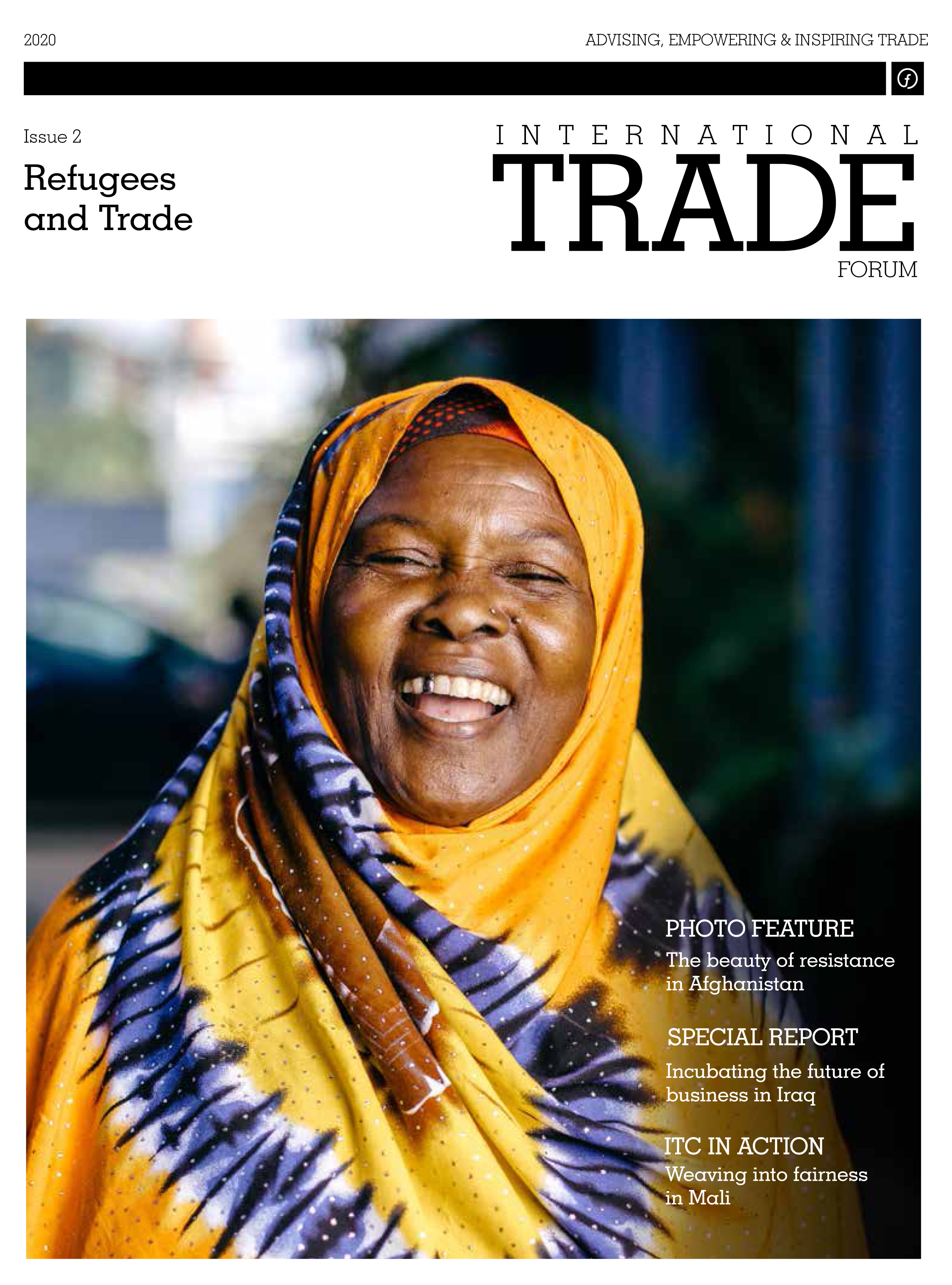
Volume 2020, Issue 2, 2020
-
-
No one leaves home unless…
More LessAuthor: DOROTHY TEMBOFragile and conflict-ridden settings are on the rise globally. Indeed, the World Bank states that as many as two-thirds of the world’s poorest people could live in such environments by 2030. There are many reasons why such circumstances arise – economic or political instability, armed conflict and terrorism, as well as climate change or natural disasters.
-
-
-
The beauty of resistance
More LessAuthor: SABRINA HERZOG DE SOUZA LIMAResilience, independence and heritage are hallmarks of the Afghan people. Decades of conflict have weakened the economy and displaced millions inside the country and abroad. Despite challenges – most recently COVID-19 – returning Afghans resist. It is a beautiful resistance, with roots in the country’s mountainous geography, generous soil and rich tradition in crafting and trading fine silk along the Silk Road.
-
-
-
Real capital and digital footing for the forcibly displaced
More LessAuthor: SASHA KAPADIAIn our global economy, when a crisis hits, we all face the consequences. Although the COVID-19 pandemic brought this phenomenon into sharp relief, it has been true for quite some time now.
-
-
-
Responding to urgent humanitarian and development needs
More LessAuthors: LILI MOHIDDIN and ELIUD MARANGUUntil recently, the contribution of refugees to local economies was overlooked and underestimated.1 Small formal and informal businesses contribute to creating jobs and business opportunities, enabling households to access basic needs and services, which in turn, stimulates additional economic opportunities and reduces poverty. Although both poor displaced and host populations face multiple barriers when entering and engaging in markets, the challenges faced by the displaced tend to be more systemic, significantly hindering their ability to contribute to the local economy and achieve self-reliance.
-
-
-
How trade concessions can improvere fugee self-reliance
More LessAuthor: KEMAL KIRISCIThe COVID-19 pandemic has further revealed the deep vulnerability of refugee populations around the world. The pandemic has exacerbated the precarity of refugees’ lives in terms of access to hygiene and health facilities, decent housing and livelihoods, creating a ‘double emergency’ situation. This compels UN agencies and their partners to double down on mobilizing efforts to support emergency responses. However, as the UN High Commissioner for Refugees Filippo Grandi noted, securing the self-reliance of refugees and the resilience of their host communities remains important. Granting trade concessions to countries hosting large number of refugees would be a novel way to do this.
-
-
-
Anticipating the humanitarian crisis with innovative financial means
More LessAuthors: SUMA SWAMINATHAN, ALEEM REMTULA and JUSTIN SYKESThe world is witnessing the highest number of people fleeing conflict since the end of World War II, with approximately 71 million people forcibly displaced. To add to this, as COVID-19 spreads globally, we have seen a disproportionate impact on the world’s most vulnerable populations. Displaced populations facing widespread stigma, discriminatory regulations and restricted access to safety nets, are likely to be the hardest hit. This dramatic rise in numbers, with no foreseeable end to conflict, puts the humanitarian response and financing system under a great deal of pressure.
-
-
-
Incubating the future of business in Iraq
More LessAuthors: ALICE BOSLEY and PATRICIA LETAYFSince 2011, more than 5.6 million people have fled Syria, arriving in Iraq, Jordan, Lebanon and Turkey. Many Syrian refugees are highly skilled, highly educated, and technologically savvy. In fact, a UN survey conducted in 2015 in Greece showed that 86% of Syrian refugees had secondary or university degrees. Despite these skills, countries across the Middle East have either denied refugees the right to work or curtailed it by only allowing them employment in certain labour-intensive sectors. However, Iraq, unlike many of its neighbours, has allowed Syrian refugees freedom of movement and the right to work since the onset of the conflict.
-
-
-
Entrepreneurs on the move
More LessAuthor: MOHAMED ABDULLAHIMohamed Abdullahi arrived in the Dadaab refugee camp in Garissa County, Kenya in late 2010. Having always wanted to return to his hometown of Mogadishu in Somalia, he was able to do so in late 2019 to start pursuing various business interests. He told the International Trade Forum about his experience as an entrepreneur.
-
-
-
Bringing online jobs to Gaza’s youth
More LessAuthors: NOUR ELHAYYA and EVELYN SELTIERHanan Abu Zaid’s eyes sparkle when she thinks back to her first sale as an online entrepreneur.
-
-
-
Simple measures, better lives
More LessAuthor: EVELYN SELTIERWhen asked about their hopes and dreams, women and youth in Tanzania’s north-western province give very similar and straightforward answers: they want to provide for their families and send their children to school.
-
-
-
Weaving into fairness
More LessAuthors: EVELYN SELTIER and HARAM SIDIBEMali, like its neighbouring countries Burkina Faso and Mauritania in West Africa, is facing waves of migration due to political unrest and the resulting economic instability. With limited job and training opportunities in the North, especially for the young, Malians leave their homes in search of jobs in other parts of their country. These internal migrants face extreme poverty in the light of no income and no chance of improving their situation.
-
-
-
Tahiti limes from Colombia to the world
More LessAuthor: NICOLÁS ESCOBAR PARRAEvery day at 6:00 in the morning, Juan Fajardo begins his work in the Tahiti lime fields at his farm ‘La Cabaña’. Despite being only 15 kilometres away, it takes about one hour to drive from the small producer’s farm to the Pan-American Highway in the rural area of El Rosario (northern Department of Nariño), one of 344 Colombian municipalities designated as ‘Most Affected by the Armed Conflict’.
-
Volumes & issues
Most Read This Month
