


Illicit Drugs

Collection Contents
8 results
-
-
Competent National Authorities Under the International Drug Control Treaties 2022
More LessThis annual directory lists competent national authorities empowered to issue certificates and authorization for the import and export of narcotic drugs and psychotropic substances as well as competent national authorities empowered to regulate or enforce national controls over precursors and essential chemicals. It lists international bodies that might assist national competent authorities in case no authority is listed for a given country or region, or in case contact cannot be established with the listed authorities. The directory also includes contact details of national competent authorities or international bodies. Introductory texts in Arabic, Chinese, English, French, Russian and Spanish.
-
-
-

Narcotic Drugs 2024
Estimated World Requirements for 2025 – Statistics for 2023
More LessThis annual publication provides technical information on the licit movement of the internationally controlled narcotic drugs. The relevant 1961 Convention establishes strict controls on the cultivation of opium poppy, coca bush, cannabis plant and their products, which, in the Convention, are described as “narcotic drugs”; (although cocaine is a stimulant drug rather than one that induces sleep). Control is exercised over 136 narcotic drugs, mainly natural products, such as opium and its derivatives, morphine, codeine and heroin, but also synthetic drugs, such as methadone and pethidine, as well as cannabis and coca leaf. The production and distribution of controlled substances must be licensed and supervised, and governments must provide estimates and statistical returns on the quantities of drugs required, manufactured and utilized and the quantities seized by police and customs officers.
-
-
-
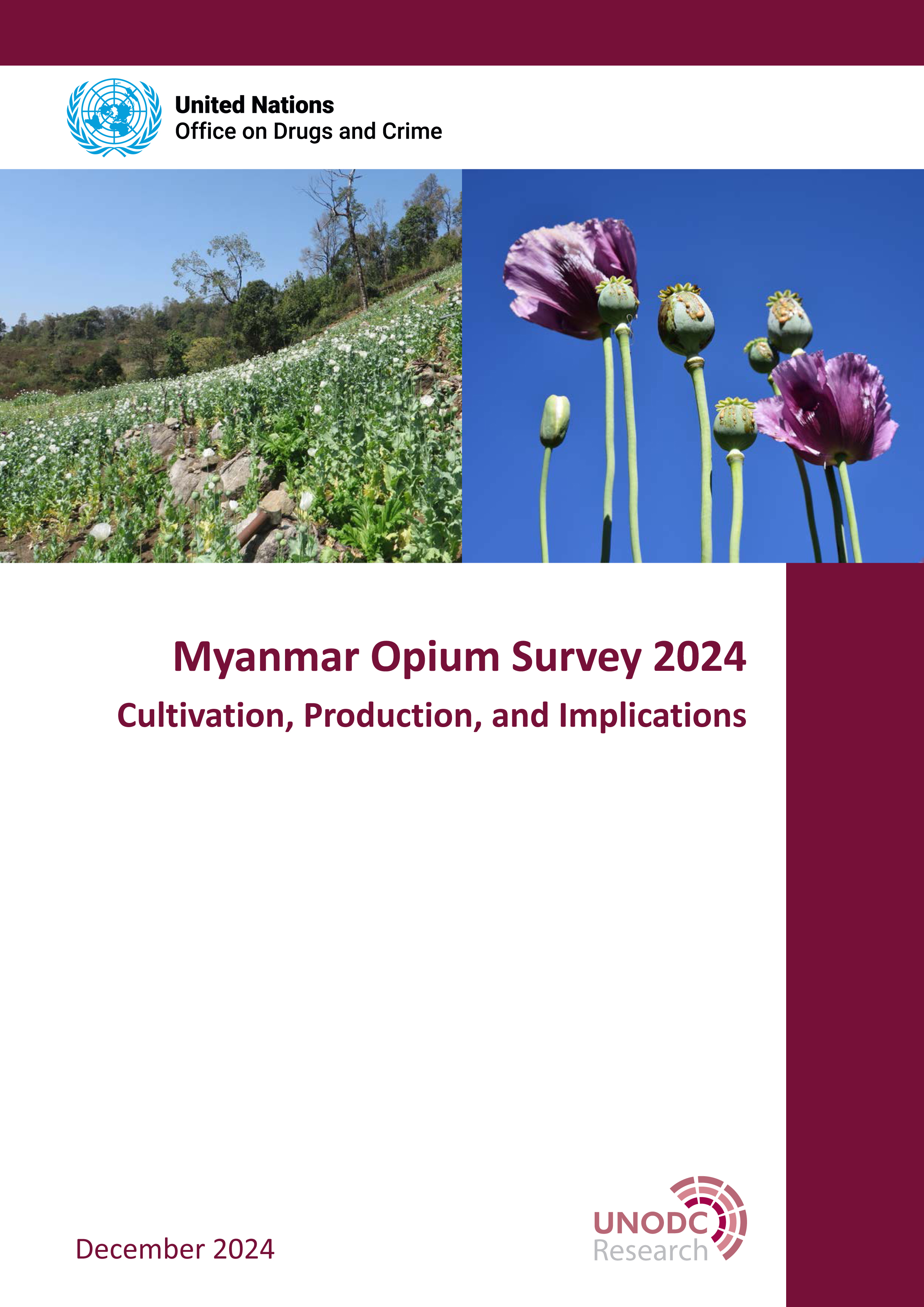
Myanmar Opium Survey 2024
Cultivation, Production, and Implications
More LessThree years after the military takeover in Myanmar, poppy cultivation has stabilized at recent high levels, suggesting that the internal conflict remains a critical factor in illicit cultivation in Myanmar. The 2024 survey points to a slowing down of cultivation, with a slight decrease of 4% to 45,200 ha from 47,100 ha in 2023. Although area under cultivation has not returned to peaks reached in 2013 at nearly 58,000 ha, poppy cultivation remains robust. Historically, illicit poppy cultivation in Myanmar, and Southeast Asia in general, was typically of small, poorly organized, and sparse plots. Field and ethnographic research point to longstanding traditions of small-scale poppy cultivation, sometimes as a cash or insurance crop, but also for household use. However, in recent years, cultivation in Myanmar shifted toward more sophisticated practices that increased yields. National yield estimates from 2022’s survey indicated an average of 19.8kg of opium per hectare of poppy, which was a substantial increase from 14kg per hectare in 2021. In 2023, the national yield estimate rose again to 22.9kg per hectare—the highest ever recorded by UNODC. By 2024, yields declined slightly by 4% to 22kg/hectare.
-
-
-
Psychotropic Substances 2024
Statistics for 2023 - Assessments of Annual Medical and Scientific Requirements for 2025
More LessOn an annual basis the Psychotropics Control Section of the International Narcotics Control Board (INCB) secretariat publishes a technical report that provides an overview of the worldwide licit manufacture, export, import, stocks and consumption of substances controlled under the Convention on Psychotropic Substances of 1971. In addition to providing specific figures for movements of many scheduled substances the report includes commentary on emerging and ongoing trends in the licit market for psychotropic substances under international control.
-
-
-
Precursors, Chemicals and Equipment Frequently Used in the Illicit Manufacture of Narcotic Drugs and Psychotropic Substances 2024
More LessThe Board prepares this report in accordance with the following provisions contained in article 12 of the United Nations Convention against Illicit Traffic in Narcotic Drugs and Psychotropic Substances of 1988. The Board shall prepare an annual report on its work containing an analysis of the information at its disposal and, in appropriate cases, an account of the explanations, if any, given by or required of Parties, together with any observations and recommendations which the Board desires to make. The Board may make such additional reports as it considers necessary. The reports shall be submitted to the [Economic and Social] Council through the Commission which may make such comments as it sees fit. The reports of the Board shall be communicated to the Parties and subsequently published by the Secretary-General. The Parties shall permit their unrestricted distribution.
-
-
-

Transnational Organized Crime in the Pacific: Expansion, Challenges and Impact
More LessThis report provides a detailed analysis of the rapidly evolving organized crime landscape and related drivers. It highlights how foreign criminal groups are capitalizing on the region’s geographic isolation, infiltrating legitimate businesses and using new technologies to advance their illicit operations while evading law enforcement. The report reveals that foreign crime syndicates, primarily from Asia and the Americas, are exploiting the Pacific’s strategic location to traffic illicit drugs and other contraband. The region’s isolation, once considered a barrier, now provides these groups with opportunities to operate in less-patrolled waters, facilitating large-scale shipments through ship-to-ship transfers. UNODC’s research also brings to the forefront the alarming rise in methamphetamine use across several Pacific countries, particularly Fiji, Papua New Guinea and Tonga, posing significant public health risks. The report calls for enhanced regional collaboration and coordination among Pacific Island Countries and Territories, noting that limited resources and capacities make it difficult for these nations to tackle transnational crime alone.
-
-
-
World Drug Report 2024
More LessA global reference on drug markets, trends and policy developments, the World Drug Report offers a wealth of data and analysis. The Key findings and conclusions booklet provides an overview of selected findings, while the Special points of interest offers a framework for the main takeaways and policy implications that can be drawn from those findings. As well as providing an in-depth analysis of key developments and emerging trends in selected drug markets, the Contemporary issues on drugs booklet looks at several other developments of policy relevance. The World Drug Report 2024 is aimed not only at fostering greater international cooperation to counter the impact of the world drug problem on health, governance and security, but also at assisting Member States in anticipating and addressing threats posed by drug markets and mitigating their consequences.
-
-
-

World Drug Report 2025
More LessA global reference on drug markets, trends and policy developments, the World Drug Report offers a wealth of data and analysis and in 2025 comprises several elements tailored to different audiences. Key findings provide an overview of selected findings from the analysis presented in Drug market patterns and trends and the thematic chapters of Contemporary issues on drugs, while Special points of interest offer a framework for the main takeaways and policy implications that can be drawn from those findings. The World Drug Report 2025 is aimed not only at fostering greater international cooperation to counter the impact of the world drug problem on health, governance and security, but also at assisting Member States in anticipating and addressing threats posed by drug markets and mitigating their consequences.
-