


UN Chronicle - Volume 52, Issue 2, 2015
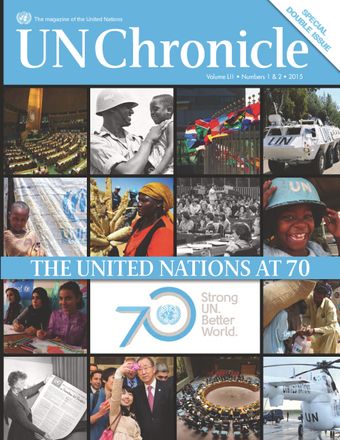
Volume 52, Issue 2, 2015
A must-read for every concerned world citizen, the United Nations Chronicle is a quarterly, easy-to-read report on the work of the United Nations and its agencies. Produced by the United Nations Department of Public Information, every issue covers a wide range of United Nations related activities: from fighting the drug war to fighting racial discrimination, from relief and development to nuclear disarmament, terrorism, and the worldwide environmental crisis.
-
-
Young at 70: The promise of the United Nations work with and for youth
More LessAuthor: Ahmad AlhendawiSeventy years ago, a revolutionary idea to change the landscape of a fragile multilateral scene was introduced. Establishing the United Nations was the necessary response for a world recovering from the devastation of two world wars. The idea was simple, yet very bold; a global body to promote the principles of “faith in fundamental human rights, in the dignity and worth of the human person and to promote social progress and better standards of life”. Looking at the world today, we see that the United Nations has done justice to most of its responsibilities in upholding these principles. However, much work remains, particularly in regard to the inclusion of the world’s youth in development and decision-making processes.
-
-
-
The United Nations and its discontents an academic view
More LessAuthor: David M. MaloneFor most people, reaching 70 allows them to look back on accomplishments and hopefully provides some reprieve from worrying about the future. For the United Nations, there is no such luxury.
-
-
-
Three simple fixes for the next 70 years
More LessAuthor: Ian RichardsIn 2014 I celebrated the 69th birthday of the United Nations in a temple in Bhutan. Speaking to an audience of monks, ministers and staff, the United Nations Country Representative to this mountain kingdom in the Himalayas described how the global Organization had helped set up the country’s first airline and had at one time fed a large part of its population.
-
-
-
The first 70 years of the United Nations achievements and challenges
More LessAuthor: Edward MortimerPerhaps inevitably, the United Nations started on a steep downward trajectory from the high expectations that surrounded it at its birth. The global security organization envisaged in the Charter of the United Nations, based on a perpetuation of the victorious alliance against Nazi Germany, was stillborn because of the rapidly developing rift between the Soviet Union and its Western allies. The Security Council of the United Nations, entrusted with the maintenance of international peace and security, was soon paralysed by the inability of its permanent members to take decisions on any issue where they perceived their interests to be in conflict. The fact that this “cold war” did not develop into a hot one is generally attributed not to the United Nations, but to the “balance of terror” between nuclear-armed super-Powers, both of which were likely to be destroyed by any direct conflict. The role of Secretary-General U Thant in helping to prevent such a conflict during the 1962 Cuban missile crisis has been too widely overlooked, even though at the time both super-Powers acknowledged it in writing.
-
-
-
From world health to world heritage
More LessAuthor: Heidi J. TworekIn a pedestrianized area in the midst of San Francisco, a United Nations flag flutters alongside an American one. Granite columns flank the plaza bearing the names of United Nations Member States and the year in which they joined the Organization. There is a sunken fountain designed by Lawrence Halprin to symbolize the seven continents of the world tied together by oceans. Designed in the mid-1970s to commemorate 30 years since the creation of the United Nations, the plaza raised controversy among architects and San Francisco residents, including for the plaza’s addition into the non-profit group Project for Public Spaces’ Hall of Shame. Though the group criticized the placement of the fountain, it simultaneously praised the plaza’s potential to foster thriving and dynamic community interaction on market days and to provide an entrance to the Civic Center. The Project for Public Spaces called for the United Nations Plaza to “stay true to its name and do all it can to showcase the assets of the multiple cultures that are part of the market”.
-
-
-
Living together
More LessAuthor: Yann Arthus-BertrandThe Charter of the United Nations, signed in 1945, did not address concerns for the natural environment. Neither the word itself, nor a doctrine of environmentalism appears in the founding document. Yet the protection of the environment affects the preservation of the entire planet. It is also a subject closely related to provisions of the Charter, since a sustainable environment decidedly contributes to the assurance of the wellbeing of its inhabitants. United Nations initiatives are thus critical to finding solutions to most environmental challenges. Over the years, this question has become increasingly important in General Assembly deliberations and has been featured in its resolutions—a development I very much welcome.
-
Most Read This Month
Article
content/journals/15643913
Journal
10
5
false
en
