


Africa Renewal - Volume 30, Issue 3, 2017
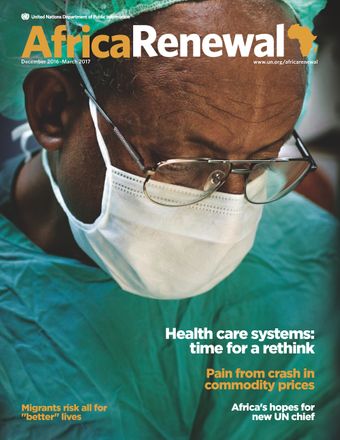
Volume 30, Issue 3, 2017
-
-
Africa Watch: Africa’s high hopes for new UN chief
More Lessمؤلف: Ihuoma AtangaAs the world waits in anticipation for the beginning of a new era in global diplomacy, António Manuel de Oliveira Guterres commences his term as the new Secretary-General of the United Nations.
-
-
-
Health care: From commitments to action
More Lessمؤلف: United NationsIf there is one area that vividly sums up Africa’s development challenges, it is the field of health. Every year, lack of access to basic health care, mostly caused by poor funding, contributes to millions of deaths, untold suffering and harrowing health tragedies on the continent.
-
-
-
Gains made in fight against malaria
More Lessمؤلف: Rodney HatfieldThe World Health Organization (WHO) announced in December 2015 that the global incidence of malaria had finally been slowed, thanks in large part to a massive rollout of mosquito nets, anti-malaria medicines and indoor residual spraying of insecticides. The news was particularly welcome in Africa, where the disease has been the deadliest.
-
-
-
It’s time to rethink medical insurance
More Lessمؤلف: Masimba Tafirenyika“If we can get cold Coca-Cola and beer to every remote corner of Africa, it should not be impossible to do the same with drugs,” the late Dr. Joep Lange, a pioneering researcher in HIV/AIDS treatment in Africa in the late 1990s, once declared.
-
-
-
Diagnosing Africa’s medical brain drain
More Lessمؤلف: Kingsley IghoborDressed in full medical gear and clutching a folder, Folu Songonuga, a physiotherapist, walked briskly across the lobby in the offices of Activa Rehabilitation Services in Orange, New Jersey, United States. An elderly man, evidently in pain, had just been wheeled into an inner room, and Dr. Songonuga was on his way to tend to the patient.
-
-
-
Lifestyle diseases pose new burden for Africa
More Lessمؤلف: Zipporah MusauAnxiety grips Jennifer Nakazi as her phone beeps for the third time since she arrived at a busy bank lobby in downtown New York. She’s going to wire money to her family in Uganda. Her brother is calling with the latest update on their critically ill mother.
-
-
-
Public health schemes: Getting it right
More Lessمؤلف: Franck KuwonuWhen Bernard Natey could not find a qualified cardiac surgeon in his native Togo to implant a pacemaker in his heart to manage an irregular heartbeat, he promptly packed his bags for a hospital stay in neighbouring Ghana.
-
-
-
We can improve health systems in Africa Interview: Dr. Matshidiso Moeti, head of the World Health Organization’s Regional Office for Africa
More Lessمؤلف: Matshidiso MoetiDr. Matshidiso Moeti from Botswana is the first woman to head the World Health Organization (WHO)’s Regional Office for Africa. The new regional director has over 36 years of experience in public health. Her goal is to make the organization more responsive, effective and results-oriented. She plans to accelerate progress towards global development goals while tackling emerging threats. The following are edited excerpts of her interview with Tefo Pheage for Africa Renewal.
-
-
-
Africa’s new strategies to defeat HIV/AIDS
More Lessمؤلف: Juliette MartinAfter more than three decades of wrestling the menacing monster, Africa is finally slowing the rate of HIV/AIDS infections to a crawl.
-
-
-
Wanted: Affordable medicines for all
More Lessمؤلف: Franck KuwonuPneumonia, an acute infection of the lungs, is the biggest killer of children worldwide even though it is treatable and easily preventable with vaccines.
-
-
-
Mental illness: Invisible but devastating
More Lessمؤلف: Lansana GberieWhen American film actor Robin Williams, who suffered from depression, committed suicide two years ago, Kenyan humour writer Ted Malanda feigned incredulity. “I can’t wrap my mind around the fact that depression is an illness…In fact, it is such a non-issue that African languages never bothered to create a word for it,” he wrote in his newspaper, The Standard, under the headline “How Depression Has Never Been an African Disease.”
-
-
-
India’s medical tourism gets Africans’ attention
More Lessمؤلف: Pavithra RaoNagged by a sharp back pain three years ago, Abidemi Ogbonna from Lagos, Nigeria, decided to visit a nearby hospital called Apollo. Thinking it was just a minor problem, she was shocked when her physician informed her that she urgently needed a kidney transplant.
-
-
-
Taking health services to remote areas
More Lessمؤلف: Kwamboka OyaroThe camel is known for its resilience. Carrying heavy loads in sweltering desert heat over 160 km with little water to drink is no easy job.
-
-
-
Dying from lack of medicines
More Lessمؤلف: Tefo PheageApproximately 1.6 million Africans died of malaria, tuberculosis and HIV-related illnesses in 2015. These diseases can be prevented or treated with timely access to appropriate and affordable medicines, vaccines and other health services. But less than 2% of drugs consumed in Africa are produced on the continent, meaning that many sick patients do not have access to locally produced drugs and may not afford to buy the imported ones.
-
-
-
Young Ghanaians risk all for "better" life
More Lessمؤلف: Efam Awo DoviEvery week, in the Brong Ahafo Region — one of Ghana’s major food baskets — vehicles load up with men between 18 and 40 years old. Many, mostly the younger men, hope to reach Europe, while others head for more prosperous countries in Africa. Irrespective of their final destination, they have common aspirations: hopes of good jobs and better lives for themselves and the families they leave behind.
-
-
-
Africa most affected by refugee crisis
More Lessمؤلف: Sulaiman MomoduAs Germany, France and other European countries contend with an unprecedented influx of refugees from Syria, Iraq, Afghanistan and elsewhere, shocking tales of women and children drowning in the Mediterranean Sea are repeated over and over by media networks worldwide.
-
-
-
Commodity prices crash hits Africa
More Lessمؤلف: Kingsley IghoborJust three years ago, most of the world’s fastest-growing economies were in Africa, among them Angola, Chad, Ethiopia, Mozambique, Nigeria, Rwanda and Sierra Leone. A middle class was emerging, led by young, tech-savvy entrepreneurs who bought flashy cars, new houses and the latest smartphones.
-
-
-
Africa welcomes new trade initiatives from Japanese investors
More Lessمؤلف: Kingsley IghoborAfrican leaders who took part in the Sixth Tokyo International Conference on Africa’s Development (TICAD VI), held last August in Nairobi, Kenya, are eager to test the latest Japanese commitment to investment and development on the continent and how it will improve the quality of life of African citizens.
-
-
-
Morocco flexes economic muscles as it seeks AU reinstatement
More Lessمؤلف: Franck KuwonuSlowly and steadily, Morocco has been establishing itself as a major economic force in sub-Saharan Africa, even as it eyes gaining readmission into the African Union (AU), which it left decades ago.
-
-
-
New business opportunities through government tenders
More Lessمؤلف: Doyeun KimPublic procurement is fast becoming big business in Africa. It accounts for almost a third of the gross domestic product (GDP) in poor countries and up to 15% in developed countries.
-
-
-
Africa wired: Portable ultrasound device to tackle child mortality
More Lessمؤلف: Pavithra RaoThe puzzle of the high maternal and child mortality rate in Africa, especially for children under the age of five, remains a major concern even as all efforts are made to reverse the trend.
-
Most Read This Month
