


UN Women Gender Alerts
Since the start of the war in Gaza, UN Women has documented the experiences of women and girls and their resulting humanitarian needs through a series of gender alerts. These alerts highlight how the conflict affects women and girls across various aspects of daily life, including access to food, water, sanitation, hygiene (WASH), shelter, and education. These reports emphasize the responsibilities and priorities of different groups, as well as the influence of gender roles and power dynamics in shaping the experiences, coping strategies, and needs of the impacted population. Each report highlights sector-specific gendered needs and priorities to ensure that the humanitarian response to the Gaza Strip is gender-sensitive.
Filter :
Sustainable Development Goals
Subject
Publication date
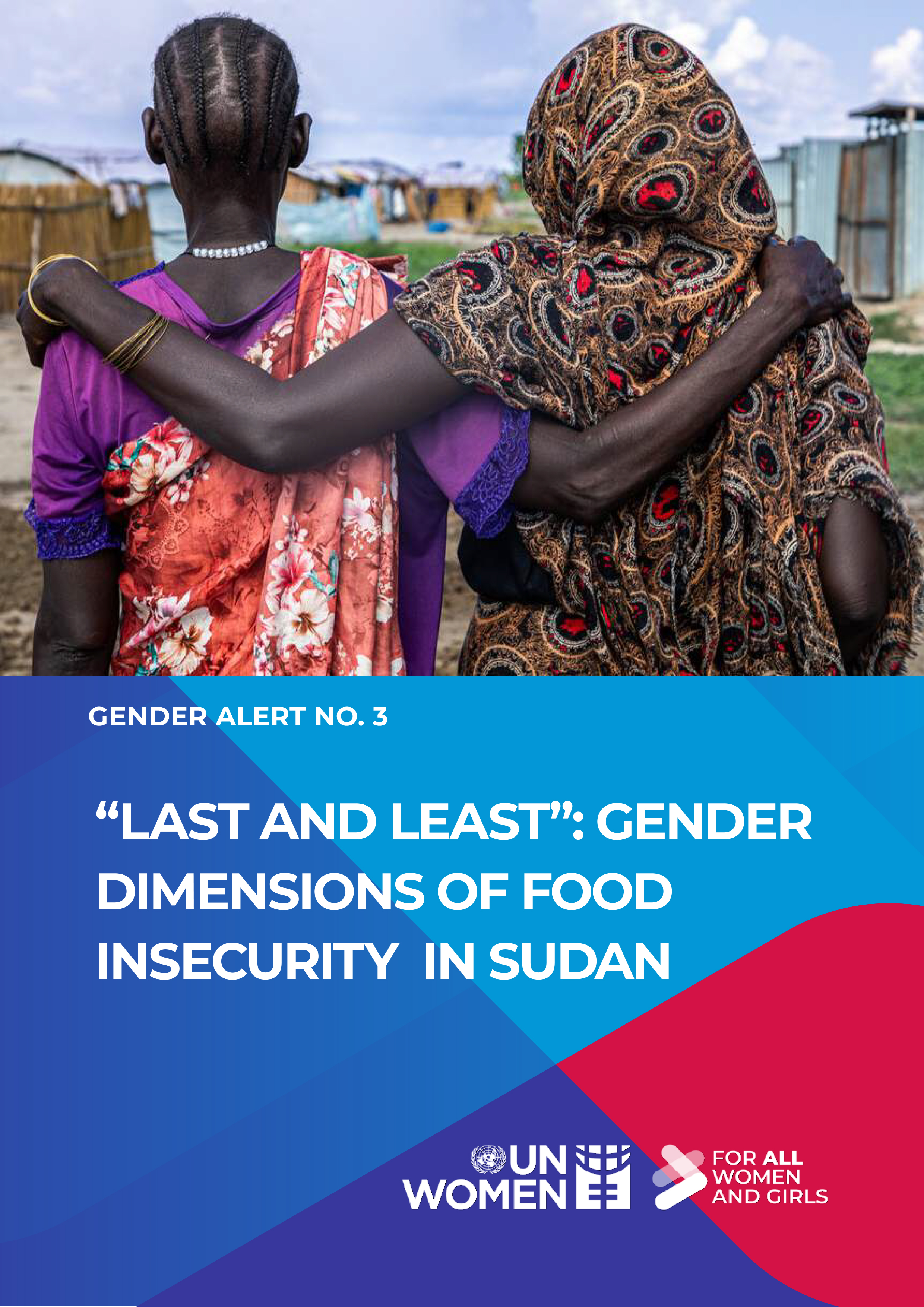
Gender Alert: ‘Last and Least’ - Gender Dimensions of Food Insecurity in Sudan
This gender alert analyses how food insecurity and conflict in Sudan are deepening gender inequalities. The report draws on field testimonies, rapid gender analysis, and data from humanitarian partners to highlight how women and girls are disproportionately affected by one of the world’s worst food crises. Female-headed households are three times more likely than male-headed ones to face extreme hunger, and 74 per cent of girls are out of school. The collapse of livelihoods, markets, and health systems has exposed women and girls to intersecting risks of malnutrition, displacement, and gender-based violence (GBV). Despite these conditions, women-led organizations are delivering frontline relief operating community kitchens, safe spaces, and health services, yet they receive less than three per cent of humanitarian funding. This publication calls for urgent, gender-responsive action, prioritizing women and girls in aid delivery, resourcing women-led organizations, scaling up protection and GBV prevention, and integrating gender equality across humanitarian and recovery efforts to save lives and restore dignity.
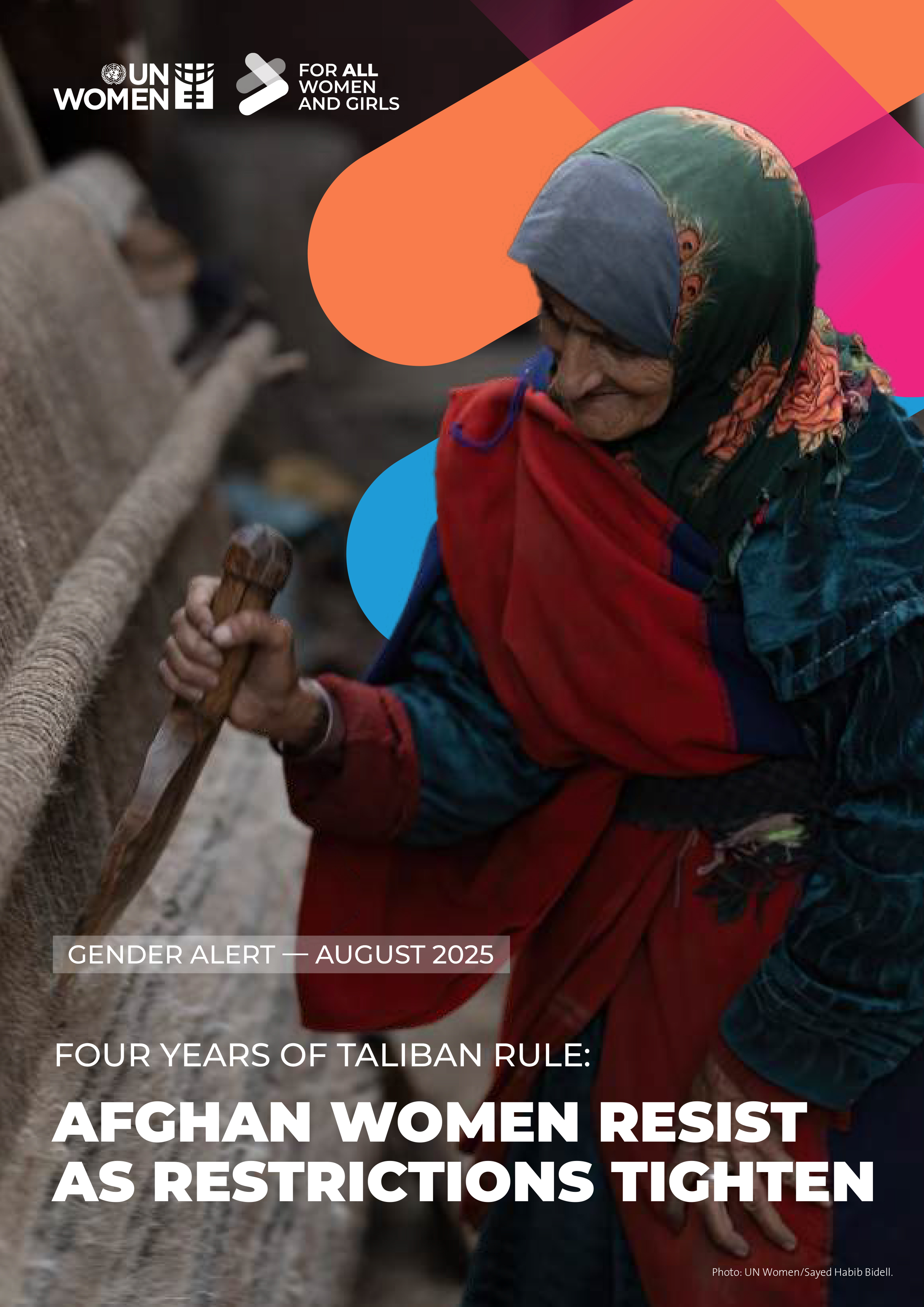
Gender Alert: Four Years of Taliban Rule - Afghan Women Resist as Restrictions Tighten
Four years since the Taliban takeover in August 2021, the women’s rights crisis is being normalized. Not a single decree restricting women and girls has been repealed; measures once framed as temporary are now entrenched as the norm. This gender alert counters such normalization by presenting 10 insights gathered through UN Women’s research and analysis undertaken since August 2021. Despite systemic repression, Afghan women remain resilient, sustaining hope and continuing to contribute as frontline workers, entrepreneurs, and advocates. Yet, enforcement of restrictive decrees has consolidated nationwide, reinforced by the 2024 Law on the Propagation of Virtue and Prevention of Vice. Education and employment bans have sidelined a generation, with nearly 80 per cent of young women excluded from education, employment or training. Women’s mobility and safety have further eroded, with mahram requirements and surveillance undermining access to services, livelihoods, and public life. Women’s representation in decision-making has disappeared entirely, though inheritance rights remain a narrow entry point. Funding cuts are further constraining women-led organizations, jeopardizing the few remaining civic spaces. At the same time, large-scale refugee returns, many forcibly, are compounding vulnerabilities. The alert calls for sustained, flexible funding for women’s organizations, a minimum of 30 per cent of aid directed to gender equality, and the centrality of women’s rights in all humanitarian, development, and political interventions.

Gender Alert: Crisis Upon Crisis - Impact of the Recent Escalation on Women and Girls in Yemen
Since late 2024, escalating conflict has deepened Yemen’s already critical humanitarian crisis. Between February and April 2025, heavy bombardments have caused mass civilian casualties, widespread displacement, and the destruction of critical infrastructure. Attacks on key lifelines—Al Hudayda port and Sana’a airport in May—severed supply routes, halting the delivery of food, fuel, medicine, and humanitarian aid. This disruption has crippled humanitarian operations, shutting down health facilities, restricting food distribution, and impeding emergency services—especially in frontline areas. An estimated 9.6 million women and girls are in need of aid, facing mounting barriers to essential services, including maternal health, clean water, and psychosocial support. The destruction of health facilities and a water reservoir has cut off care for over 400 pregnant and lactating women and 9,600 children. Between January and May 2025, over 6,000 people were newly displaced —26% of whom are in female headed households, adding to the 2.3 million women already living in displacement across Yemen. Displaced women face risks from income loss to protection threats. Despite the complexity of the conflict, the fragile cessation of hostilities between the U.S. and the Houthis in Sanaa offers a narrow but critical window for de-escalation and humanitarian response. This moment must be used to scale up gender-responsive aid and restore essential services to displaced and conflict-affected populations.

Gender Alert: Gender and Displacement in Lebanon at the Juncture of the Ceasefire
Between October 2023 and late November 2024, Lebanon experienced the largest escalation of hostilities with Israel since the 2006 War. Intense Israeli airstrikes coupled with evacuation orders across Lebanon, including in eastern and southern Lebanon and the southern suburbs of Beirut, resulted in mass displacement and heightened socioeconomic vulnerabilities among affected populations. As of 24 November 2024, close to 900,000 individuals were displaced due to the conflict, with women and girls making up 51 per cent of the internally displaced population. Of an estimated 260,000 households, close to 21 per cent were women-led households. Additionally, more than 80,000 Syrians and 3,466 Palestinian refugees in Lebanon were among the displaced. The conflict took a profound toll on people’s lives. Lebanese health officials estimate that, since the escalation of hostilities on 8 October 2023, 4,047 people have been killed and 16,638 wounded, including at least 790 women and 316 children. As commonly witnessed in other contexts, this latest Gender Alert confirms that while the conflict impacts civilians indiscriminately, women and girls have been disproportionately affected due to multiple and intersecting forms of discrimination that heighten their exclusion and risks.

Gender Alert: No Excuse - Calling for an End to Gender-based Violence in Sudan
More than 11 million people have been displaced amid the conflict in Sudan as of October 2024, with more than half (54 per cent) being women and girls. An estimated 12 million people are currently at risk of gender-based violence, as described in this new Gender Alert by UN Women. Documented cases of mass and systemic rape highlight the use of sexual violence as a weapon of war, leaving survivors in dire need of medical, psychological, and social support. Since December 2023, the number of survivors of gender-based violence, including conflict-related sexual violence, seeking services increased by 288 per cent, illustrating the scope of the crisis. Evidence shows that women and girls from ethnic minority groups are being deliberately targeted.

Gender Alert: Women and Girls of Sudan - Fortitude Amid the Flame of War
This publication provides a detailed analysis of the ongoing humanitarian crisis in Sudan, focusing on its disproportionate impact on women and girls. As the country faces the largest internal displacement since the Syrian civil war, millions of Sudanese, particularly women and children, are grappling with severe challenges. This report highlights key data on displacement, malnutrition, lack of access to healthcare, gender-based violence, and food insecurity. It also explores how deeply entrenched gender inequality exacerbates the vulnerabilities of female-headed households and the critical barriers women face in accessing essential resources. It also offers a comprehensive overview of the socio-economic and health impacts on women and girls, drawing from recent assessments and data. The report emphasizes the need for targeted humanitarian interventions. We consider it as an essential resource for understanding the gender dimensions of Sudan’s humanitarian crisis and calls for focused action to mitigate its effects.

Gender Alert: Gaza - A War on Women’s Health
Since 7 October 2023, large-scale Israeli military operations in the Gaza Strip, including aerial bombing and ground offensives, have killed more than 41,000 people. Women and children account for over half of all fatalities. Some 95,000 people have been injured, and approximately 75 per cent of the population has been displaced. Most people reside in overcrowded shelters with limited access to food, water and sanitation. The war has caused a catastrophic public health crisis, leading to a spike in preventable deaths, the rapid spread of diseases, and high rates of physical and mental illnesses. After more than 11 months of war, an estimated 177,000 women face life-threatening health risks, including from non-communicable diseases and hunger and poor nutrition during pregnancy. Close to 84 per cent of health facilities has been damaged or destroyed. Those that remain lack medicine, ambulances, electricity, water and the ability to provide even basic life-saving treatments. At least 491 health-care workers have been killed: 345 men and 146 women. To better understand the gender dynamics of the health crisis, between March and April 2024, UN Women surveyed 600 people, 305 women and 295 men, across Gaza’s five governorates, asking about their health and well-being. Twelve key informant interviews provided additional perspectives. This gender alert on the war in Gaza is the fifth in a series by UN Women. It explores how the conflict has affected women’s physical and mental health and is intended to support evidence-based advocacy and services.

Gender Alert: Voices of Strength: Contributions of Palestinian Women-led Organizations to the Humanitarian Response in the Occupied Palestinian Territory
The war on Gaza has become one of the world’s most brutal man-made humanitarian crises. The war has directly impacted more than 2.2 million people, resulting in an unprecedented number of civilians killed, alongside overwhelming displacement. Since 7 October 2023, more than 36,000 Palestinians have been killed by Israeli forces in Gaza, including at least 10,000 women, and an estimated 82,000 people have been injured. The Israeli incursion into Rafah has led to the displacement of nearly 800,000 people since May 2024, many of whom had already been displaced multiple times since October 2023. In tandem, the situation in the West Bank, including East Jerusalem, has also deteriorated, with more than 500 people killed and 5,000 injured since 7 October. As the death toll increases, severe humanitarian needs continue to grow at an unprecedented rate, in a context where needs were already dire before the current escalation. The war on Gaza remains, among other things, a war on women. Over the past eight months of the war, UN Women has been documenting how the lives of women and girls have deteriorated across sectors, including food security, water, shelter, health, and safety. This Gender Alert is on the work of Women-Led Organizations (WLOs).

Gender Alert: The Gendered Impact of the Crisis in Gaza
Since 7 October 2023, more than 24,620 Palestinians have been killed in the Gaza Strip, 70 per cent of whom were women or children. More than 1.9 million people — 85 per cent of the total population of Gaza — have been displaced, including what UN Women estimates to be nearly 1 million women and girls. The entire population of Gaza — roughly 2.2 million people — are in crisis levels of acute food insecurity or worse. This document provides an overview of the situation in Gaza and articulates UN Women’s work as part of its six-month multisectoral response to the crisis.

Scarcity and Fear: A Gender Analysis of the Impact of the War in Gaza on Vital Services Essential to Women’s and Girls’ Health, Safety, and Dignity – Water, Sanitation, and Hygiene (WASH)
As the war on Gaza reached its six-month mark, it continues to be a war on women. According to UN Women estimates, more than 10,000 women have been killed to date, among them an estimated 6,000 mothers who left 19,000 orphan children behind. Women who have survived have been displaced, widowed, and are facing starvation. More than one million women and girls in Gaza have almost no food, no access to safe water, latrines, washrooms, or sanitary pads, with disease growing amidst inhumane living conditions. Since the start of the war, UN Women has been documenting the experiences of women in Gaza in a series of gender alerts that look at various aspects of how the war is impacting the daily lives of women and girls, including food, water, shelter, health, and protection. This new alert is the latest in this series, and it focuses on water, sanitation, and hygiene (WASH) services, which are integral to women’s health, dignity, safety, and privacy.