


UN Chronicle - Volume 44, Issue 3, 2008
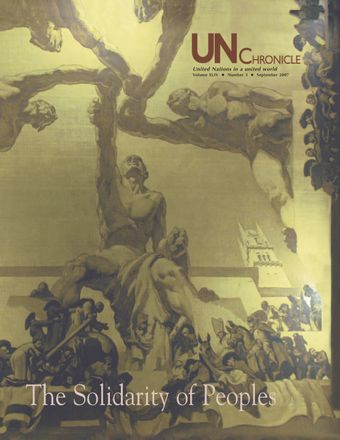
Volume 44, Issue 3, 2008
A must-read for every concerned world citizen, the United Nations Chronicle is a quarterly, easy-to-read report on the work of the United Nations and its agencies. Produced by the United Nations Department of Public Information, every issue covers a wide range United Nations related activities: from fighting the drug war to fighting racial discrimination, from relief and development to nuclear disarmament, terrorism, and the world-wide environmental crisis. Written in English and French, this issue is focused on racism and racial discrimination.
-
-
The new untouchables
More LessAuthor: Glenn C. LouryThe current American prison system is a leviathan unmatched in human history. Never before has a supposedly free country denied basic liberty to so many of its citizens. In December 2006, some 2.25 million people were being held in the nearly 5,000 prisons and jails scattered across Americas urban and rural landscapes. According to a 2005 report of the International Centre for Prison Studies in London, the United Stateswith one-twentieth of the worlds populationhouses one-quarter of the worlds inmates. The US incarceration rate (now at 714 prisoners per 100,000 residents) is almost 40 per cent greater than the nearest competitors (the Bahamas, Belarus, and Russia). Other industrial democracies, some with significant crime problems of their own, are much less punitive: The US incarceration rate is 6.2 times that of Canada, 7.8 times that of France, and 12.3 times that of Japan. The US spends some $200 billion annually on law enforcement and corrections at all levels of Government, a fourfold increase (in constant dollars) over the past quarter century.
-
-
-
Racial discrimination and the legal system
More LessAuthor: Bill QuigleyRacial discrimination is widespread in the legal system of the United States. A recent example from Louisiana will help underscore the statistics that follow.
-
-
-
Double standards of justice
More LessAuthor: Pureterrah WitcherFour years ago, in Douglasville, Georgia, a 17-year-old high school senior made a fateful mistake, one that would cost a surprising price. During a New Years Eve celebration, Gernarlow Wilson participated in consensual sexual act with a 15-year-old girl. He was charged and convicted of aggravated child molestation and received a mandatory minimum sentence of ten years in State prison, without the possibility of parole.
-
-
-
Confronting the legacy of slavery and the slave trade
More LessAuthor: James T. CampbellIn April I had the privilege of participating in a scholarly panel at the United Nations, one in a series of events sponsored by the CARICOM Secretariat to commemorate the 200th anniversary of the abolition of the transatlantic slave trade by the legislatures of the United States and Great Britain. As several of us on the panel noted, the victory of 1807 proved less decisive than abolitionists at the time imagined or hoped. Though the new restrictions reduced the trans-atlantic trade, they did not stop it; over the next sixty years, another 23 million Africans were borne into New World slavery. And it would take a further sixty years, until the 1926 League of Nations Slavery Convention, before slavery itself was formally prohibited in international law. Yet even conceding these limitations, 1807 represents a watershed in human history, a germinal moment in the continuing struggle to create and enforce international norms of humanitarian conduct. It is a moment well worth commemorating, and no setting could be more appropriate than the United Nations, an institution whose foundational commitment to the inherent dignity and equal and inalienable rights of all members of the human family is a direct legacy of the abolitionist struggle.
-
-
-
A new way of dealing with the past
More LessAuthor: Rosa-Maria NdoloStudents in present-day Germany learn early on: there is no denying their past. History teachers tell them that what their grandparents might have been a part of during the Second World War does not apply to them directly. However, they are still faced with prejudice in some parts of the world, with lingering suspicions that Germany never quite left its anti-Semitic and racist past behind.
-
-
-
Bridging the racial divide
More LessAuthor: Sudeshan ReddyOne of the most enduring legacies of apartheid is that an entire generation of black South Africans was deprived of a decent education by a system designed to entrench racial oppression and subjugation. Fourteen years after South Africa became a democracy, the legacy of the countrys racist past has not been completely extinguished. While whites-only schools are a thing of the past, the reality is that the majority of black students in South Africa today are poor and the majority of white students are not. As part of several efforts to bridge the racial chasm that lingers in parts of the country, a unique programme called the South African Model United Nations Debate Competition stands out.
-
Most Read This Month
