


UN Chronicle - Volume 44, Issue 3, 2008
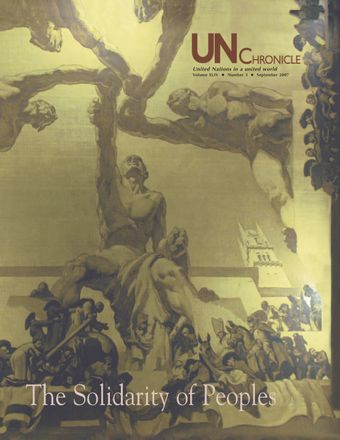
Volume 44, Issue 3, 2008
A must-read for every concerned world citizen, the United Nations Chronicle is a quarterly, easy-to-read report on the work of the United Nations and its agencies. Produced by the United Nations Department of Public Information, every issue covers a wide range United Nations related activities: from fighting the drug war to fighting racial discrimination, from relief and development to nuclear disarmament, terrorism, and the world-wide environmental crisis. Written in English and French, this issue is focused on racism and racial discrimination.
-
-
Looking Beyond Durban
More LessAuthor: Louise ArbourResistance to discrimination goes back to the origin of the human rights concept. It was the rejection of differentiation of people on the basis of national, ethnic or social origin, religion and gender, as well as resistance against slavery, that marked the history of human rights. Since the creation of the United Nations, the international community adopted a comprehensive framework for eradicating racial discrimination, from the 1965 International Convention on the Elimination of All Forms of Racial Discrimination to the 2001 Durban Declaration and Programme of Action. This framework expresses clearly the common agenda for the implementation of the twin principles of equality and non-discrimination.
-
-
-
The long road to durban
More LessAuthors: Peter Jackson and Mathieu FaupinFrom its inception in 1945, the United Nations has led an unrelenting fight against racism and racial discrimination. The framework for the Organizations work in that area was the declaration in the preamble to its Charter on the question of human rights: We the peoples of the United Nations determined to reaffirm faith in fundamental human rights, in the dignity and worth of the human person, in the equal rights of men and women and of nations large and small, and to practice tolerance and live together in peace with one another as good neighbours.
-
-
-
The trans-atlantic slave trade and slavery
More LessAuthor: Rex NettlefordThe Caribbean is arguably the living laboratory of the dynamism of the encounters between Africa and Europe on foreign soil, and both with the Native American who had inhabited the real estate of the Americas during periods of conquest and dehumanization and the corresponding process of struggle and resistance. For these purposes, northeast Brazil with its iconic centre in Bahia, New Orleans and all of the eastern littoral of North America, referred to as Plantation America, constitute along with the island-Caribbean the geo-cultural area that houses a civilization with its own inner logic and inner consistency.
-
-
-
The struggle against apartheid
More LessAuthor: Enuga S. ReddyThe United Nations has been concerned with the issue of racial discrimination since its inception. The UN General Assembly adopted on 19 November 1946 during its first session a resolution declaring that it is in the higher interests of humanity to put an immediate end to religious and so-called racial persecution and discrimination, and calling on Governments and responsible authorities to conform both to the letter and to the spirit of the Charter of the United Nations, and to take the most prompt and energetic steps to that end.
-
-
-
Eliminating racial discrimination
More LessAuthor: Alex OtienoStates Parties undertake to prohibit and to eliminate racial discrimination in all its forms and to guarantee the right of everyone, without distinction as to race, colour or national or ethnic origin, to equality before the law, according to the 1965 International Convention on the Elimination of All Forms of Racial Discrimination, notably in the enjoyment of political, civil, economic, social and cultural rights. State Parties shall also assure effective protection and remedies against any acts of racial discrimination.
-
-
-
The ideology of racism
More LessAuthor: William H. TuckerIn his exceptionally insightful book, Racism: A Short History, Stanford University historian George M. Fredrickson notes the paradox that notions of human equality were the necessary precondition to the emergence of racism. If a society is premised on an assumption of inequality, producing an accepted hierarchyone unquestioned even by those relegated to its nadirthen there is no need to locate the cause of the underlings position in some specific characteristic on their part that makes them less worthy than others.
-
-
-
Asylum today
More LessAuthor: Charlotte MaitreIndustrialized countries in recent years have complained about being swamped by asylum-seekers and have adopted increasingly stricter policies designed to stem the tide of refugees and ensure border protection. Since 2002, the Office of the United Nations High Commissioner for Refugees (UNHCR) has been tracking a downward trend in asylum applications lodged in industrialized countries. Its latest report, Asylum Levels and Trends in Industrialized Countries, 2006, shows a steady decline in 50 industrialized countries (44 European and 6 non-European). The 2006 level was the lowest in many years and, in some cases, even for decades. Germany and Denmark, for instance, recorded the lowest level since 1983, New Zealand since 1988 and the United Kingdom since 1989. In France, the number of asylum applications submitted in 2006 was the lowest since 1998. The 25 countries of the European Union received 53 per cent fewer requests in 2006 compared to 2002, while Europe as a whole registered a 54-per cent decline. While some experts agree that stricter asylum policies are behind the declining trend, others prefer to point out the growing feelings of intolerance and xenophobia fueling these policies.
-
-
-
In the wake of xenophobia
More LessAuthor: Glyn FordEurope was torn apart by fascism in the 1930s, and when the Second World War ended in 1945, remnants of extreme right parties re-emerged on the margins of politics. By the 1980s, when the forgetting had started, some began to pick up protest votes as immigrants became an issue, driven by tabloid journalists looking for a cheap story.
-
-
-
Combating racism and racial discrimination in europe
More LessAuthor: Isil GachetIn todays world, contemporary forms of racism and racial discrimination are complex and disturbing. In Europe, these issues increasingly lie at the heart of political and social concerns. Faced with persistent expressions of racism and xenophobia, the Council of Europe Member States1 have, for several years now, been taking firm and sustained action to combat these trends.
-
-
-
State-led efforts in eliminating racial discrimination
More LessAuthor: Fernando Fernández-AriasThere is no denying the existence of racism in Europe. We pride ourselves on having advanced democratic systems, a legal framework that protects and guarantees the rights of the individual and a welfare State that supplies basic services to all citizens, equally. All the same, no European society is free from the phenomenon of racism. Besides structural and persistent racism, which is often rooted in stereotypes, there are also new tendencies brought about by immigration.
-
-
-
Between past failure and future promise
More LessAuthor: Richard RaceThe focus of this article is to examine the theme of racial discrimination within the context of education policymaking. It will draw on an ongoing conceptual debate that analyses contemporary education and social policy evidence within an integrationist/ multicultural framework, but also analyse the extreme concepts of assimilation and antiracist education policy. The method draws on policy evidence and documentary analysis of the evolution of integration and multiculturalism concepts within education policymaking.
-
-
-
Racism in football — football against racism
More LessAuthors: Kurt Wachter and Michael FanizadehAnti-racism campaigners have been busy over the last couple of months. Concerns over racism, xenophobia and far-right activity in and around football stadiums have reached fever pitch. Even though the new football season, 2007-2008, has barely started in Europe, we have already witnessed a progression of serious incidences.
-
-
-
Looking forward to the future
More LessAuthor: Beate WinklerAt the end of my nine years as Director of the European Monitoring Centre on Racism and Xenophobianow the European Union Agency for Fundamental RightsI would like to share my experience in addressing racial discrimination. I want to focus on eight areas of needs and opportunities, which remain largely unexplored and which, I believe, need to be tackled more thoroughly in political and public debates. I am deeply convinced that, together, we can find forward-looking solutions that will better enable our changing societies to face the future.
-
-
-
Equal opportunity in education
More LessAuthor: Rumyan RussinovIn 2002, on my way to the United States Congress where a hearing on the education of Roma was being held, I was asked by the taxi driver where I come from and what was the purpose of my trip. I told him I was going to testify before the Congress about the problems faced by Roma in education. His reaction was, Ah, you mean those petty thieves? I was surprised that prejudice against Roma existed even in the United States, where they live among hundreds of other minority groups.
-
-
-
The decade of roma inclusion
More LessAuthor: Iskra KirovaThe Decade of Roma Inclusion is an unprecedented pan-European initiative that channels the efforts of Governments, as well as inter-governmental and non-governmental organizations, to eradicate racial discrimination and bring about tangible improvement to the plight of the worlds most populous marginalized community. The Decade, which runs from 2005 to 2015, is expected to present a long-term holistic approach to the situation of the Roma1. The initiative is a prime example of how the creation of human development opportunities can help end racial discrimination. It aims to maximize resources for improving the general economic and social position of the Roma while addressing the racial stereotypes and discrimination they face. The ultimate goal of the Decade is to integrate the Roma as full members of society, enjoying the same opportunities as the majority populations.
-
-
-
Poverty and human rights
More LessAuthor: Roberto CuéllarCurrently, in both the international system and the inter-American system for the protection of human rights, there are instruments which emphasize the obligation of States to guarantee the observance of the rights of all human beings, without distinction as to race, gender, religion or political stance. However, although a considerable body of treaties, declarations and conventions exists to safeguard such equality in law, as yet there is no effective equality in practice. In our opinion, poverty is inseparably linked to human rights, acting as both cause and effect of human rights violations, and must be tackled if de facto equality is to be achieved. Excluded groups and persons will then be able to claim their rights from States and obtain prompt and appropriate responses at a reasonable cost, thereby ensuring that social well-being spreads to all parts of society.
-
-
-
Race and poverty in latin america
More LessAuthor: Judith MorrisonLatin America has made solid economic strides over the past two decades in terms of sustained economic growth, increasing average income levels and decreasing average infant mortality rates. However, these improvements do not share the full development picture. There has been widespread concern that despite these gains Latin American nations should be progressing more quicklyoften leading to comparisons with Asia and, in more insidious moments, to an oversimplified discussion of Latin America merely having a culture that does not lead itself to development. What is rarely mentioned is that most of the regions nations still confront deeply seated racial inequality and discrimination that impacts all aspects of economic and social life. These problems of inequality must be addressed and resolved in order to deepen and sustain opportunities for large segments of the population. Ending racial discrimination in order to fully incorporate African descendant citizens, who account for 30 per cent of the regions population but make up more than half of the poor, is one of the most pressing tasks facing the Hemisphere.
-
-
-
Racial discrimination and miscegenation
More LessAuthor: Edward TellesIn 1888, Brazil, with a mostly black and mixed race or mulatto population, was the last country in the Western Hemisphere to abolish slavery. During more than 300 years of slavery in the Americas, it was the largest importer of African slaves, bringing in seven times as many African slaves to the country, compared to the United States.
-
-
-
Discrimination against indigenous peoples
More LessAuthor: José Francisco Calí TzayIn discussing the issue of discrimination against indigenous peoples, it is tempting to paraphrase a preambular paragraph of the Convention on the Prevention and Punishment of the Crime of Genocide and say that at all periods of history, discrimination, in its many forms, has inflicted great losses on humanity.
-
-
-
Discrimination of aboriginals on native lands in Canada
More LessAuthor: Melissa GorelickWith inflated proportions of their neighbours in prison, on parole or at risk, the worlds native communities have another urgent problem to contend with. Statistics show that the percentage of indigenous people in conflict with the justice system is extreme and in many places those numbers may be on the rise.
-
Most Read This Month
