


UN Chronicle - Volume 47, Issue 1, 2012
Volume 47, Issue 1, 2012
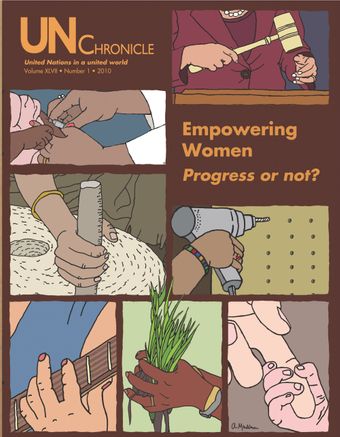
A must-read for every concerned world citizen, the United Nations Chronicle is a quarterly, easy-to-read report on the work of the United Nations and its agencies. Produced by the United Nations Department of Public Information, every issue covers a wide range United Nations related activities: from fighting the drug war to fighting racial discrimination, from relief and development to nuclear disarmament, terrorism, and the world-wide environmental crisis. Written in English and in French, this issue of the Chronicle examines the progress in empowering women.
-
-
Time for solidarity with solidarity women of haiti
More LessAuthor: Asha-Rose MigiroI will never forget the time an earthquake shook Dodoma in 2002 when I was a parliamentarian in my home country of Tanzania. I had no idea how to react to the tremors and instinctively ran outside. Though I was fortunate that the tremors caused minimal damage, they brought home to me in a deeply personal way just how fragile we are. The earthquake that devastated Haiti brought these memories back vividly, and my heart went out to my many colleagues and the people of Haiti who have been deeply affected.
-
-
-
In Haiti … the world from her mother’s side
More LessAuthor: Emily TroutmanAs the earthquake shook the house around her, ten-year-old Dessica ran outside and into a field behind her s ma 11 street. “Did you ran out a lone?” I asked. “Yes”, she says. “You didn’t wait for your mother or your sisters or brothers?” “No” she says. “I just ran.”
-
-
-
At what point does one lose one’s humanity?
More LessAuthor: Charlize TheronI have been incredibly blessed in my life to be able to travel. Seeing the world and its diversity first hand has been the greatest teacher, and never have I learned a more difficult lesson then when I visited the Democratic Republic of the Congo (DRC) in 2009. The DRC, bordered by nine different countries, is home to over 200 ethnic groups, making it literally the heart of Africa. This country is in a state of emergency. Various militias and complicated politics all play a part in the devastation of the land and the population, but no one is suffering more than the women and young girls. Hundreds of thousands of women and girls have been beaten, tortured and raped—atrocities beyond anything that I have ever heard of or could imagine.
-
-
-
United Nations agencies forward together in the response to violence against women
More LessAuthor: Thoraya Ahmed ObaidMomentum is building to eliminate the most pervasive yet least recognized human rights abuse in the world—'violence against women. Studies show that 70 per cent of women experience some form of physical or sexual violence in their lifetime. Everywhere, communities, civil society and governments are mobilizing to end practices that harm the health, dignity, security and autonomy of women and negatively impact society as a whole. The United Nations system is working together to support partners in this effort.
-
-
-
Confronting violence against women
More LessAuthors: Takyiwaa Manuh and Adolf Awuku BekoeHow have women confronted the scourge of gender-based violence? What pathways, strategies and actions have they evolved to defend their bodily integrity and build coalitions and alliances for justice and gender equality? What has worked well and why, and how can their efforts be supported and scaled up?
-
-
-
Armed conflict and women 10 years of security council resolution 1325
More LessAuthor: Rachel MayanjaIN OCTOBER THIS YEAR, the United Nations will commemorate the tenth anniversary of an important. Kit inadequately recognized international development landmark: Security Council resolution 1J25. which recognized the importance of understanding the impact of armed conflict on women and girls and guaranteed their protection and full gurticigotion in peace agreements. Although late in coming, there are now signs of increased commitment and action to ensure that the goals of the resolution are met
-
-
-
Social protection for women
More LessAuthor: Rania AntonopoulosPeriods of economic upheaval are always destabilizing and, as such, outcomes are uncertain. We are right now faced with a great danger and a great opportunity. The danger is that “recovery” efforts will favour those in positions of strength, reinforcing existing inequalities between and within countries. As this occurs, we will see existing disparities deepen, leading to social exclusion with grave social, economic and political repercussions. The opportunity is that leadership and bold policy action could reduce inequalities among countries and across gender lines.
-
-
-
Invisible in the media
More LessAuthor: Liza GrossBack in the eighteenth century, the Anglo Irish philosopher George Berkeley summarized his theory of "immaterialism" in the following dictum: to be is to be perceived.
-
-
-
Women in politics the fight to end violence against women
More LessAuthors: Theo-Ben Gurirab and Pia CayetanoDespite the remarkable progress of women in many professions, politics is not one of them. Indeed, around the world, women have been conspicuous by their absence in decision and policy making in government. When the United Nations First World Conference on Women was held in Mexico City in 1975, the international community was reminded that discrimination against women remained a persistent problem in many countries; and even though governments were called upon to develop strategies to promote the equal participation of women, political participation was not yet identified as a priority. Since then, though there has been an increasing focus on women’s representation and their impact on decision-making structures, the increased attention did not reflect in immediate results. For example, in 1975 women accounted for 10.9 per cent of parliamentarians worldwide; ten years later it increased by one mere percentage point to 11.9 percent.
-
-
-
Educate girls, eradicate poverty a mutually reinforcing goal
More LessAuthor: Hoon Eng KhooThere is no question that educating girls is a prerequisite for eradicating poverty. Education empowers and transforms women. It allows them to break the “traditional” cycle of exclusion that keeps them at home and disengaged from decision making Education, especially higher education, can prepare women to take on roles of responsibility in government, business and civil society. Women make ideal leaders: numerous
-
-
-
Lives of widows — a hidden issue
More LessAuthor: Raj LoombaI grew up the son of a widow and witnessed first-hand the suffering my mother endured. When my father passed away, my grandmother ordered my mother to remove her jewellery, including her bindi, and never to wear brightly-coloured clothes again. I was too young to comprehend these restrictions at that time, however, at my wedding the Hindu priest who was conducting the ceremony asked my mother to move away from the wedding altar because as a widow, she could bring bad luck to the newly-wed couple.
-
-
-
A story of violence
More LessAuthor: Didier FassinLet us call her Magda. The name is invented, but the story is real She was born in Lesotho 35 years ago. Her life exemplifies the burden of physical, sexual and psychological violence against women.
-
-
-
When things fall apart
More LessAuthor: Ruthie AckermanLiberia shows the way to deal with gender-based violence by establishing special courts and laws to try rapists and through empowering women and girls.
-
-
-
A brief survey of women’s rights from 1945 to 2009
More LessAuthor: Francisca De HaanThe story of the global struggle for women’s rights since 1945 is just beginning to be told. For a proper understanding of the continuities and changes in the struggle for women’s rights during this period, we need to go back to the League of Nations, the predecessor to the United Nations. In addition, we need to consider more fully the important role of what are now’ often called “traditional women’s organizations” in advancing women’s rights on the international level, at least until 1975.
-
Most Read This Month
