


UN Chronicle - Volume 48, Issue 1, 2012
Volume 48, Issue 1, 2012
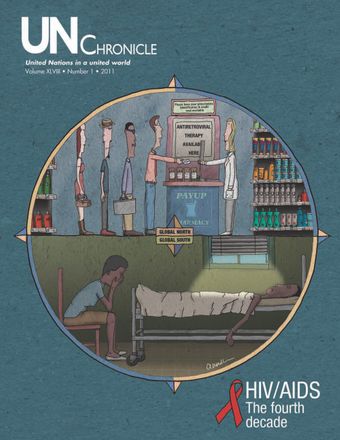
The first issue of 2011 focuses on the ongoing battle against HIV/AIDS, now entering its fourth decade. Coinciding with the UN General Assembly High Level Meeting on AIDS in June 2011, the issue looks back at lessons learned from the earliest advocates that fought bravely against the virus and the stigma that came with it. It celebrates the strides that have been made towards accomplishing Millennium Development Goal 6: halting and reversing the spread of HIV/AIDS by 2015. It also highlights new challenges, including the global inequality in access to treatment, persistent stigma, and the need for HIV prevention that women can use and contral.
-
-
The 4th decade of aids what is needed to reshape the response
More LessAuthor: Michel SidibéThe international community has reached the first part of Millennium Development Goal 6: halting and reversing the spread of HIV. At least fifty-six countries have either stabilized or reduced new HIV infections by more than 25 per cent in the past ten years, and this is especially evident in sub-Saharan Africa, the region most affected by the epidemic. New HIV infections among children have dropped by 25 per cent, a significant step towards achieving the virtual elimination of mother-to-child transmission by 2015. In addition, today more than five million people are on antiretroviral treatment, which has reduced AIDS-related deaths by more than 20 per cent in the past five years. However, with more than 33 million people living with HIV today, 2.6 million new HIV infections, and nearly 2 million deaths in 2009, the gains made in the AIDS response are fragile.
-
-
-
In the beginning
More LessAuthor: Marc ConantIn the beginning, the AIDS epidemic struck like a thief in the night—suddenly, terrifyingly, and deadly. At first, there were a few cases of a rare malignancy Kaposi’s sarcoma; then came the appearance of Pneumocystis pneumonia-, and finally a plethora of opportunistic infections including systemic candidiasis, cryptococcal meningitis, and Mycobacterium avium-intracellulare—all rare diseases associated with this new mysterious, unknown, and unnamed spectre.
-
-
-
Microbicides: New hope for hiv prevention
More LessAuthor: Salim S. Abdool KarimHIV/AIDS is particularly severe in Africa, where women bear a disproportionate burden of the epidemic. One of the most crucial challenges in HIV prevention in Africa is to reduce the high infection rates among young women. Worldwide, just over half of all people living with HIV are women, and 70-90 per cent of all HIV infections among women are through heterosexual intercourse.' In sub-Saharan Africa, women aged fifteen- to twenty-four years with HIV represent 76 per cent of the total cases in that age group, outnumbering their male peers by as much as eight to one.1 Although the majority of new HIV cases in the United States are through male-to-male sexual contact, heterosexual contact accounts for 84 per cent of new infections among women.
-
-
-
HIV/AIDS + education: Lessons from the 1980s + the gay male community in the United States
More LessAuthor: Neal KingKnowledge is power: If we learned anything in the gay male community during the early days of the HIV/AIDS epidemic in the United States, it was that. No one knew what had hit us, and people were dying in huge numbers all around us. The community lost friends, colleagues, and intimate partners. Initially mislabeled “gay-related immune [deficiency” (GRID), valuable time was lost in responding to the crisis because most felt safe in the belief that they were not at risk. Since early victims were predominantly gay men, the stigma attached to homosexuality in the medical, governing, law enforcement and ecclesiastical institutions became a barrier to understanding, prevention, and treatment.
-
-
-
Impact of hiv/aids on education and poverty
More LessAuthor: Nelson Ijumbamarks the thirtieth anniversary of the first report of HIV, which came from the United States, where cases of an unusual disease were seen among young gay men. Thirty years later, the location and pace of the epidemic has changed dramatically. Globally, an estimated 33.3 million people are infected or living with HIV, of which 22.5 million are in sub-Saharan Africa. In addition, of the 2.5 million children in the world estimated to be living with HIV, 2.3 million are in sub-Saharan Africa. Southern Africa, the most affected region, includes a number of middle- and lower-middle-income nations known as the hyperendemic countries. In South Africa alone, there are about 5.7 million
-
-
-
Asleep at the wheel
More LessAuthor: Mechai ViravaidyaThe world has been living with the HIV/AIDS epidemic for some thirty years, and prevention methods have been scientifically proven and disseminated to the public for nearly as long. Yet, there are, according to the Joint United Nations Programme on HIV/AIDS (UNAIDS) High Level Commission on HIV Prevention, at least 7,000 new HIV infections every day—an alarming number that indicates HIV/AIDS awareness is at an unacceptable level of neglect by governments, civil society, and the private sector. There was a strong worldwide effort towards HIV prevention when the disease began spreading rapidly throughout the developing world in the early 1990s but, more recently, a disproportionate amount of funding has been directed towards treatment, rather than prevention. Obviously, prevention is the most effective method in slowing down the spread of this terrible disease, but decisionmakers still view HIV prevention as a health problem, not a societal one.
-
-
-
Interfaith response to hiv/aids
More LessAuthor: Alistair Macdonald-RadcliffThe story of interfaith response to HI V/AIDS is one that moved from initial doubt, denial and moral hesitation—even direct denunciation—to one of global reach and scale. Hi is is a story that demonstrates both the power and challenges that come from specific beliefs, morals, and theology. It also points to greater possibilities for bridging divides in faith and culture through the power of common action on so great an issue of shared concern.
-
-
-
Differential treatment resricted access to newer antiretrovirals
More LessAuthor: Sarah ZaidiThe discovery of antiretroviral (ARV) treatment for people living with HIV (PLHIV) is one of the best success stories of medical research in recent years. It has changed the way in which HIV is viewed—from that of a death sentence to a chronic illness. However, lifelong treatment requires constant access to newer drug regimens, as an HIV-infected person either develops serious side effects, or the virus becomes resistant to the drugs. While patients in developed countries have treatment options, the same cannot be claimed for those in developing countries. With more than twenty approved antiretroviral drugs, the global HIV drug market is estimated to approach $16 billion by 2016. Yet, not all ARVs, especially newer and more potent treatments, are licensed or available in every country, particularly in the global South. Why is there such a gap in access to treatment between industrialized and developing countries? Why are newer, more potent, less toxic ARVs not available to PLHIV in the global South? How can this growing disconnect between treatment options be altered?
-
-
-
A decade of fighting for our lives
More LessAuthors: Vuyiseka Dubula and Mark HeywoodA group of South African activists founded the Treatment Action Campaign (TAC) on 10 December 1998, International Human Rights Day. It was no accident that TAC was formed exactly fifty years after the adoption of the Universal Declaration of Human Rights. The backbone of TAC is its use of advocacy to fight for the realisation of the right to health, which is enshrined both in international treaties and in the South African Constitution.
-
-
-
A national response to the hiv epidemic in Papua New Guinea
More LessAuthor: Carol KiduIn the context of the HIV epidemic in Papua New Guinea, sex workers and males who have sex with males (MSM) engage in potentially risky sexual practices which remain under archaic criminal laws.1 Those at risk continue to face prejudice, moral condemnation, and violent abuse from some sectors of society, as well as harassment by police and blackmail, which are aimed especially at MSM. Their vulnerability and lack of security impacts on the national response, as it drives them underground and alfects their access to treatment and services. However, ongoing educational projects by MSM groups and sex workers appear to be improving police attitudes.
-
-
-
Women and hiv
More LessAuthor: Morolake OdetoyinboWhat is it with women ami girls? Why are we always left behind? Why can’t we choose the things we want to be a part of? Why must we always race to the front, rather than be left peacefully alone when we would rather not partake? Is it because, as women, we are strong, powerful, and the foundation of our society?
-
-
-
The imperative for faith communities: Overcoming the hiv/aids epidemicthrough stigma reduction
More LessAuthor: Gideon ByamugishaThat AIDS is a scourge which continues to fatally wound the physical, cultural, social, economic, political and spiritual health achievements, hopes and aspirations of individuals, families, communities and nations, is probably an established phenomenon that does not need much debate.
-
-
-
Individual global responsibility
More LessAuthor: Pedro Alejandro BasualdoMy primary impulse to write an article on HIV/AIDS came from my fundamental desire to contribute and to collaborate. I realize that my behaviour is founded upon a deeply-rooted sense of duty, a strong commitment, and a profound necessity. Psychologists refer to attitude as the disposition of a person confronting the world (the psychological view), which, once transported to a social setting, becomes values (the sociological view).
-
Most Read This Month
