


Asia-Pacific Population Journal - Volume 18, Issue 4, 2004
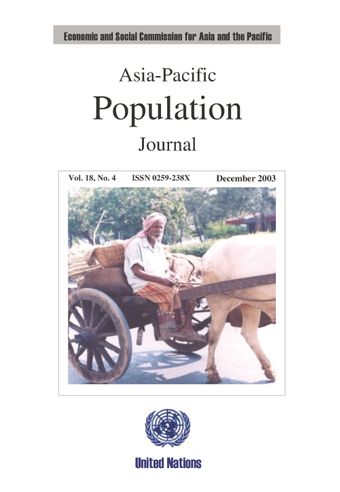
Volume 18, Issue 4, 2004
This journal is an invaluable resource containing opinions and analyses by experts on critical issues related to population. It provides a medium for the international exchange of knowledge, experience, ideas, technical information, and data on all aspects of population. The journal is issued quarterly.
-
-
How well do desired fertility measures for wives and husbands predict subsequent fertility? evidence from Malaysia
More LessAuthors: Julie DaVanzo, Christine E. Peterson and Nathan R. JonesData on fertility preferences are often used to help predict future fertility and the demand for contraception. The quality of fertility preference data is of prime importance when examining how well stated fertility preferences predict subsequent births and completed family size, and how well they predict fertility-related behaviour such as contraceptive use. Data on fertility preferences have also been used to construct measures of the unmet need for contraception and of unwanted fertility. The usefulness of these measures, which have been the basis for many studies and some programmatic efforts, depend on the underlying component (stated fertility preferences) being valid and reliable.
-
-
-
Who has correct information and knowledge about HIV/AIDS in China?
More LessAuthors: Jiajian Chen, Chen Shengli and Minja Kim ChoeAcquired immunodeficiency syndrome (AIDS) is the late clinical stage of infection with the human immunodeficiency virus (HIV). The first AIDS case in China was reported in 1985. By 1998, new HIV infections had spread to all provinces, autonomous regions and municipalities. It has been estimated that HIV/AIDS prevalence among adults rose from less than 0.002 per cent (10,000 cases) in the period 1990-1995 to about 0.2 per cent (1 million cases) in the period 2000-2001 (UNAIDS China, 2002; WHO, 2001). While the rate is still low in comparison with some other affected countries, there is no indication that the spread of HIV/AIDS in China will be controlled or will slow down in the near future (Zeng, 2001; UNAIDS and WHO, 2002).
-
-
-
Knowledge and beliefs about HIV/AIDS among young people in Urban Nepal
More LessAuthors: Shailes Neupane, Douglas Nichols and Shyam ThapaUntil recently, little information has been available on sexually transmitted infections (STIs) in the Nepalese population. Prior to the recognition of HIV/AIDS as a national health problem in the mid-1990s, health authorities in Nepal paid little attention to STIs. Few hospitals or clinics collected statistical information on cases or treatment.
-
-
-
Gender, health, marriage and mobility difficulty among older adults in India
More LessAuthors: Manisha Sengupta and Emily M. AgreeRecent evidence from India suggests a growing prevalence of morbidity and poor health status along with significant increases in longevity in the elderly population (Alam, 2000). Yet, barring a few exceptions, most studies about the health and functional ability of older persons in India are based on impressionistic findings and rarely provide empirical evidence addressing the factors that are associated with morbidity and functional limitations.
-
-
-
Book review
More LessAuthors: Donald T. Rowland and L. RuzickaThis new textbook of demography combines a discussion of methods of analysis of demographic data with explanation of demographic concepts and research issues.
-
Volumes & issues
-
Volume 32
-
Volume 31
-
Volume 30
-
Volume 28
-
Volume 26
-
Volume 29
-
Volume 27
-
Volume 25
-
Volume 24
-
Volume 23
-
Volume 22
-
Volume 21
-
Volume 20
-
Volume 19
-
Volume 18
-
Volume 17
-
Volume 16
-
Volume 15
-
Volume 14
-
Volume 13
-
Volume 12
-
Volume 11
-
Volume 10
-
Volume 9
-
Volume 8
-
Volume 7
-
Volume 6
-
Volume 5
-
Volume 4
-
Volume 3
-
Volume 2
-
Volume 1
Most Read This Month
