


Asia-Pacific Population Journal - Volume 23, Issue 2, 2009
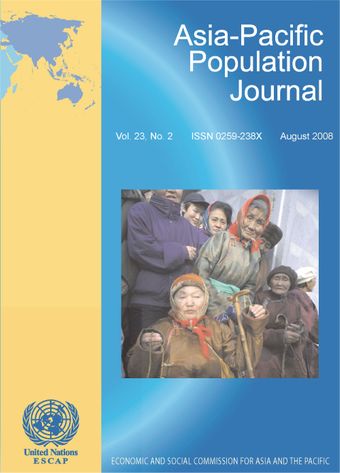
Volume 23, Issue 2, 2009
Issued three times a year, the Asia-Pacific Population Journal is an invaluable resource containing opinions and analysis by experts on important issues related to population. It provides a medium for the international exchange of knowledge, experience, ideas, technical information and data on all aspects of population.
-
-
Are the goals set by the millennium declaration and the programme of action of the international conference on population and development within reach by 2015?
More LessAuthor: Mercedes B. ConcepcionIt is now mid-2008, just seven years away from 2015, the target year for the realization of the International Conference on Population and Development (ICPD) Programme of Ac tion and the eight Millennium De velopment Goals.
-
-
-
Gender and remittance flows in Viet Nam during economic transformation
More LessAuthors: Wade Don ald Pfau and Giang Thanh LongRemittances are growing in importance in our globalizing world and, consequently, they are receiving greater attention from researchers. At the microeconomic level, researchers tend to use household surveys to examine why people send remittances, how the characteristics of remittance recipients compare to those of non-recipients, how remittances impact poverty and the income distribution, if remittances are spent for consumption or investment purposes, and in order to access the role of remittances as an insurance mechanism. However, an issue that has received less attention is the role of gender in remittance decisions, from the perspective of both senders and receivers. In Viet Nam, the doi moi economic reforms that began in 1986 have led to large-scale economic transformation in the country, and gender has emerged as an important distinction for understanding how economic growth benefits society and the various subgroups of the population (Long and others, 2000). Viet Nam represents a case of transition from the traditional patriarchal social structure of Confucianism, to a structure of formal equality under socialism, and currently, with further changes taking place, to a market economy. Using the Viet Nam Living Standards Surveys (VLSSs) for 1992-1993 and 1997-1998, which include information about remittance flows at the individual level, attempts are made to shed some light on the role of gender in remittance decisions in Viet Nam during the period of rapid economic transformation.
-
-
-
Spousal abuse and infant and child mortality in India
More LessAuthors: Abhishek Singh, Bidhubhusan Mahapatra and Subhra DuttaViolence against women continues to be a global epidemic that kills, tortures and maims physically, psychologically, sexually and economically. It is one of the most pervasive forms of human rights violations, denying women and girls’ equality, security, dignity, self-worth and right to enjoy fundamental freedoms. Violence against women is present in every country, cutting across boundaries of culture, class, education, income, ethnicity and age. The evidence of the magnitude of the problem of domestic violence in developing countries is growing fast. In recent years, there has been a greater understanding of the problem of domestic violence, which is one of the forms of violence against women, its causes and consequences, and an international consensus has developed on the need to handle this sensitive issue in an appropriate fashion.
-
-
-
Fertility transition and population ageing in the Asian and Pacific region
More LessAuthor: Bhakta GubhajuDuring the past half century, the world has witnessed a remarkable decline in total fertility rates (TFRs) from a high level of 5 children per woman in the period 1950-1955 to 2.8 children per woman in the period 2000-2005. While the fertility transition was already well under way in Europe, North America, and Australia and New Zealand during the period 1950-1955, TFR was very high in the Asian region, at about 6 children per woman. Fertility continued to decline in Europe, from a TFR of 2.7 in the period 1950-1955 to replacement level (2.1 children per woman) during the 1970s. TFR is now far below replacement level in Europe.
-
-
-
Dramatic fertility transition in Mongolia and its determinants: The demise of the pronatalist state
More LessAuthor: Altankhuyag GereltuyaThe move from a centrally controlled economy to a market-driven economy has had strong political implications for family planning and fertility in Mongolia. Under socialist rule, Mongolia had a strong pronatalist population policy under which those families having children were provided with generous benefits. The changes made to these policies have had a considerable impact on fertility and family formation in Mongolia. In the mid-1970s, the country started to experience a dramatic decrease in the level of fertility, which intensified when the country moved towards a market economy. The country experienced a drop in its total fertility rate (TFR) from 7.2 children per woman (of reproductive age) in 1975 to about 3 children in 1995, and it has remained constant at about 2.3 children since that time. Relatively few studies have been carried out on fertility changes in Mongolia with explanations about their causes, primarily owing to a lack of data sources.
-
Volumes & issues
-
Volume 32
-
Volume 31
-
Volume 30
-
Volume 28
-
Volume 26
-
Volume 29
-
Volume 27
-
Volume 25
-
Volume 24
-
Volume 23
-
Volume 22
-
Volume 21
-
Volume 20
-
Volume 19
-
Volume 18
-
Volume 17
-
Volume 16
-
Volume 15
-
Volume 14
-
Volume 13
-
Volume 12
-
Volume 11
-
Volume 10
-
Volume 9
-
Volume 8
-
Volume 7
-
Volume 6
-
Volume 5
-
Volume 4
-
Volume 3
-
Volume 2
-
Volume 1
Most Read This Month
