


International Trade Forum - Volume 2015, Issue 3, 2015
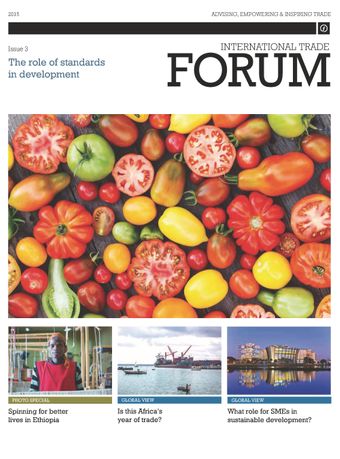
Volume 2015, Issue 3, 2015
Published quarterly since 1964 in English, French and Spanish, the International Trade Forum focuses on trade promotion, export development and import methods, as part of its technical cooperation programme with developing countries and economies in transition.
Language:
English
-
-
Sustainable trade for all
More LessAuthor: Arancha GonzálezEarlier this year, the World Trade Organization hosted its 15th annual Public Forum under the theme ‘Trade Matters to Everyone’. We could say the same about sustainable development. In fact, the two are intertwined: sustainable trade matters to everyone.
-
-
-
Photo special: Spinning for better lives
More LessAuthor: Jarle HetlandCotton production has long history in Ethiopia and the country still has much potential to expand its potential further. The country also has a long history of producing garments from cotton, and the last decade has since a rise in Ethiopian clothing designers making their mark in fashion: in Ethiopia, in Africa and beyond.
-
-
-
Is this Africa's year of trade?
More LessAuthor: Jacqueline Musiitwa‘Export or die’ was a popular mantra used by Kenneth Kaunda, Zambia’s first president from 1964 to 1991, to encourage domestic manufacturing of goods for export. This mantra is still relevant in many African countries, especially this year, which is shaping up to be Africa’s year of trade. The specialized trade in raw materials is decreasing Africa’s competitiveness, making diversification necessary.
-
-
-
Bringing SMEs into the sustainability process
More LessAuthor: Lise KingoOne of the pivotal factors as the world takes up the challenge of the new Global Goals for Sustainable Development, will be the engagement of small and medium-sized enterprises (SMEs).
-
-
-
Voluntary standards and development
More LessAuthor: Jarle HetlandWhat are private voluntary standards? In a nutshell they are guidelines that can be applied to processes and production methods, and submitted for independent certification. These voluntary standards are developed by non-governmental entities such as businesses, not-for-profit organizations or multi-stakeholder initiatives. Voluntary standards today cover everything from cocoa and tea to cotton and textiles, but they also cover issues such as labour and greenhouse gas emissions.
-
-
-
Blue Number Initiative links development to sustainability
More LessAuthor: Joseph WozniakHow can farmers become empowered to produce more goods more sustainably? How can consumers’ confidence be maintained to ensure that the foods they eat are safe and of sufficient quality? How can can environmental and food safety and quality standards in agriculture be implemented to also provide jobs and growth needed to sustain and improve farmer livelihoods? One approach is to ensure that sustainability standards are implemented throughout the supply chain with corresponding infrastructure to make sure the standards have an impact rather than being compliance exercises.
-
-
-
Trade and aid: How certification helps improve sustainability
More LessAuthor: Tensie WhelanThe traditional way of framing international trade solely in terms of profitability and economic development has led to environmental and social disconnects. Civil organizations such as the Rainforest Alliance have worked for decades to inject sustainability principles and standards into the global economy. Hundreds of major businesses are making ambitious commitments to fight climate change, halt deforestation, seek sustainably produced commodities and do right by workers and communities across their supply chains.
-
-
-
How Germany aims to raise standards in supply chains
More LessAuthor: Dominik ZillerWith the advance of globalization and trade liberalization, developing countries are an ever more integral part of global supply chains. Yet the value created does not always translate into greater general prosperity in these countries, particularly the poorer ones. The cause is to be found in inadequate social standards. In many cases workers are not paid a living wage and no trade unions exist. Workers’ health and lives are at risk because of inadequate or non-existent rules governing the structural design of buildings, fire precautions or the handling of toxic chemicals. That was made dramatically clear by the Rana Plaza tragedy in Bangladesh, which claimed the lives of well over a thousand people.
-
-
-
Seizing the power of international standards
More LessAuthor: Kevin McKinleyIt is not enough to say that knowledge is power. To seize its full potential, we should know how to best apply it. International standards, practical knowledge and information, offer tremendous opportunities for development and growth.
-
-
-
Cotton-sector supply chain moves towards sustainable future
More LessAuthor: Ruchira JoshiWhat is a sustainability standard? In a nutshell it is a set of principles and criteria that define good social and environmental practices in a specific sector, crop or industry. Often these standards are voluntary and have been developed by a wide group of stakeholders. In most cases a verification programme has also been set up to assure compliance with the standard.
-
-
-
Trade, investment, development: The EU perspective on voluntary assurance schemes
More LessAuthor: Marc VanheukelenSustainable development is at the core of European Union (EU) action both at home and around the word. This is a principle enshrined in the provisions of the EU Treaty and an objective guiding all of our different policies – whether we are working on the internal market, on our relations with partner countries or on global matters.
-
-
-
How improving garment workers' jobs leads to better development
More LessAuthor: Dan ReesThe global garment industry is a key source of employment, income and growth for developing countries, especially in Asia. However, events like the 2013 Rana Plaza building collapse in Bangladesh exposed the sector’s challenges in a dramatic way. Improving safety and working conditions for garment workers has become a top priority.
-
-
-
Promoting trade, protecting health
More LessAuthor: Melvin SpreijWith tariffs on international trade generally being relatively low, market access increasingly depends on a nation’s ability to comply with a wide range of non-tariff measures (NTMs). These are often used by governments to attain of a range of public-policy objectives such as health, safety, environmental quality and other social imperatives.
-
-
-
Tackling supply chain challenges with credible standards
More LessAuthor: Karin KreiderWhat is the real role of sustainability standards in supply chains? This was a question we had been grappling with for a long time at the ISEAL Alliance, the global membership association for sustainability standards that I head. Hence, we began in late 2014 to interview companies to learn from all kinds of businesses as to what they saw as the value of working with credible standards systems. We wanted to know if certification made good sense from a business perspective.
-
-
-
How sustainability standards can contribute to competitive advantage
More LessAuthor: Claudia KerstenIn recent years, more and more companies have realized that proficient management of ecological and social aspects of business models can increase incomes. In fact, with a view towards economic sustainability, companies can significantly enhance their economic value and standing of their brands, and as such gain competitive advantage.
-
-
-
Women in IT in Bangladesh are empowered and connected
More LessAuthor: Shameem AhsanThe Government of Bangladesh thanks International Trade Forum magazine for its interest in Bangladesh’s IT sector. The ‘Digital Bangladesh’ program, one of the key priorities of Prime Minister Sheikh Hasina, works to increase democracy, human rights, transparency and entrepreneurship through an ambitious effort to upgrade the country’s IT infrastructure and include citizens in the knowledge economy.
-
Volumes & issues
Most Read This Month
Article
content/journals/15645304
Journal
10
5
false
en
