


Our Planet - Volume 2017, Issue 1, 2018
Volume 2017, Issue 1, 2018
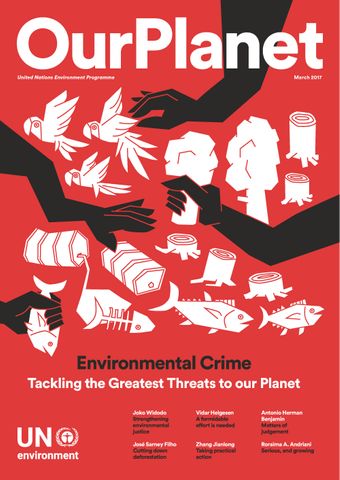
In this issue of Our Planet, government leaders, policymakers and experts explore the growing and complex threats from environmental crime and the political and legal frameworks needed to counteract it.
-
-
Reflections
More LessAuthor: Erik SolheimJust after World Wildlife Day this year, armed poachers broke into a French zoo undetected by staff and security, shot a white rhinoceros and stole the murdered animal’s precious horn.
-
-
-
Strengthening environmental justice
More LessAuthor: Joko WidodoBeing rich in natural resources is a tremendous blessing for Indonesia that brings prosperity and hope to the people. In addition to being the world's largest archipelagic country, Indonesia hosts a tropical forest area of more than 120 million hectares, the most extensive in Asia and the world's third largest. Indonesia is also abundantly rich in maritime resources potential: ocean comprises no less than twothirds of the country’s territory. Together, these ecosystems comprise immense mega biodiversity across the country’s extensive rain forests and rich coastal and marine areas.
-
-
-
UN environment at work. Strengthening law on endangered species
More LessLaw is one of the most effective means of addressing environmental crime. UN Environment is working with countries around the world to strengthen laws and institutions so that criminal acts in violation of environmental laws can be addressed at national and international levels. For environmental law to be effective, environmental crime needs to be clearly defined and institutions empowered to apply the law and to deal with violations through compliance and enforcement.
-
-
-
A formidable effort is needed
More LessAuthor: Vidar HelgesenEnvironmental crime does not only hurt animals or forests. It's dangerous for humans too. Many forms of environmental crime are serious, organized and transnational, weakening the very fibre of our societies. Not only is it the world's fourth largest illegal economy, it is also growing many times faster than the legal one. Many forms of environmental crime are profit driven, no-risk, and contribute to financing terror networks, war and armed conflicts. Let's be straight: we are talking about a global security challenge.
-
-
-
Cutting down deforestation
More LessAuthor: José Sarney FilhoAmazonia is the largest of the six Brazilian biomes, spanning 420 million hectares – or about 49 per cent of the national territory – of which 320 million hectares are covered by natural forests.
-
-
-
Taking practical action
More LessAuthor: Zhang JianlongWildlife is a crucial part of natural ecosystems, and is directly related to global ecological security, cultural inheritance and sustainable development. Indeed, wildlife conservation is an important symbol of the development of human civilization. Yet, the global illegal wildlife trade is still rampant, and the international community must work together to cope with it. For years, the Chinese government has given high attention to wildlife conservation and made consistent efforts to address the illegal trade. In the first place, it has been constantly improving the laws and regulations and setting severe punishments for illegal hunting, trading, smuggling and using wildlife and its products. A new amendment of the Law of the People’s Republic of China on Wildlife Protection has increased punishment for illegal consumption and online wildlife trade. Secondly, we have well established enforcement and coordination mechanisms. Our Inter-agency Joint Mechanism for Addressing Illegal Wildlife Trade, consisting of over 20 departments, has been set up to carry out comprehensive regulation.
-
-
-
UN environment at work. Fighting chemical and waste crime
More LessRapid economic growth is greatly increasing the generation of hazardous and other waste: it is projected to reach 27 billion tons worldwide by 2050. Its movement across boundaries is also on the rise across much of Asia and Africa despite the fact that the Basel Convention requires the country of origin, when exporting hazardous and other wastes, to obtain the written consent of the country receiving them. This is largely due to higher recycling costs in countries of origin than in receiving ones where environmental regulations are less stringent and labour is cheaper.
-
-
-
Matters of judgement
More LessAuthor: Antonio Herman BenjaminAn independent judiciary, in a political and legal system that values integrity and transparency, is vital in addressing environmental degradation and in upholding the environmental rule of law worldwide. In an urban planning case at the National High Court of Brazil, the court stated a view that I believe to be true in all areas of environmental law.
-
-
-
Good connections
More LessAuthor: Ma HuatengIn 2012, I was invited to join a safari at the Lewa Wildlife Conservancy in Kenya. Lion prides, cheetah coalitions and herds of buffalo and giraffes walk freely there. Majestic African elephants also roam the conservancy’s terrain, but in far smaller numbers than they once did.
-
-
-
Serious, and growing
More LessAuthor: Roraima A. AndrianiEnvironmental crime is the fourth largest criminal enterprise after drug smuggling, counterfeiting and human trafficking. But this statistic – perhaps the most commonly cited regarding environmental crime – fails to recognize the nature or scope of the problem, and implies it is less serious than other forms of crime.
-
-
-
Prosecute climate crimes
More LessAuthor: Reinhold GallmetzerCriminal justice can help achieve the objectives of the Paris Agreement on climate change as part of an integrated approach from governments, private businesses, finance, science, civil society and others.
-
-
-
Blood gold
More LessAuthor: Nelly Luna AmancioDay or night? It makes no difference in the Amazon gold rush. The clatter of the hundreds of engines that pump water in search of the precious metal never stops. By day, enormous trucks move the earth where forests once stood; by night, the soil is washed with hundreds of cubic metres of water to extract the gold. Informal mining camps extend into Peru, Colombia, Bolivia and Brazil, destroying the most biodiverse ecosystems in the world and poisoning the land inhabited by hundreds of indigenous peoples with mercury. Huge tracts of tropical rainforest have become graveyards for trees, drenched in the toxic metal.
-
-
-
Making gold greener?
More LessAuthors: Gustavo A. B. da Fonseca and Evelyn SwainPoorly regulated gold mining is spreading around the world. Every day, millions of artisanal and small-scale gold miners work extremely hard in often poor conditions and without the protective framework of formal labour market standards. By evening the vast majority have harvested only miniscule amounts of gold, if anything at all. But the economic incentives are still attractive. Since ancient times, gold has continuously been used as a source of long-term investment, and it has now found its way into modern technologies and industry, including computers, cell phones and medical equipment. Global financial turmoil has helped more than double the price of an ounce of gold from $500 to well over $1,000 over the past decade. Many poor people in rural areas have shifted their attention from agriculture to mining as a source of livelihood.
-
-
-
Creating hope
More LessAuthor: Emmanuel de MerodeIn a seemingly dark and tumultuous world, I find the greatest beacon of hope here in the Virunga National Park, eastern Congo. Hope that, through the efforts of those working to protect the park, we can maintain an example of a working green economy providing both stability and conservation.
-
-
-
Clearing the air
More LessAuthor: Swatanter KumarNinety-eight per cent of cities with more than 100,000 inhabitants in low and middle income countries do not meet World Health Organization (WHO) air quality guidelines, concludes the WHO Global Urban Ambient Air Pollution Database 2016 update. In high-income countries, however, that percentage decreases to 56 per cent. In South Asia, air pollution is especially acute in such countries as China, Indonesia and India, requiring State authorities to take immediate action to safeguard the health of their citizens. Long-term health effects include respiratory diseases like lung cancer and even damage to the brain and an increased risk of heart disease. A WHO study estimated that about 12.6 million deaths in the year 2012 could be linked to an unhealthy environment. India's Air (Prevention and Control of Pollution) Act, 1981 defines air pollution as “the presence in the atmosphere of any air pollutant” and an air pollutant as “any solid, liquid or gaseous substance including noise present in the atmosphere in such concentration as may be or tend to be injurious to human beings or other living creatures or plants or property or environment.”
-
-
-
UN environment at work. Making environmental law work for planet and people
More LessViolations of environmental law, including environmental crimes, can undermine sustainable development and the achievement of agreed goals and objectives at all levels. Though hundreds of treaties, national laws and regulations exist to address environmental problems, there are major challenges when it comes to implementing and complying with them. The fifth Global Environment Outlook reported, for example, that significant progress has only been made on four of the 90 most important global environmental goals and objectives. The consequences of this shortfall can be seen in the increasing environmental pressures from climate change, biodiversity loss, water scarcity, air and water pollution, and soil degradation, among others. These environmental impacts all have far reaching economic and socialconsequences and contribute to poverty and growing social inequalities.
-
-
-
Delivering on the mission
More LessAuthor: Wang Beijing“No matter how minuscule or how vast, only protection will make them last. We need to help the ones that can't help themselves, because they become extinct so fast.”
-
-
-
Ethical business works best
More LessAuthor: Zakaria ArshadForty-four years ago my parents joined the Government of Malaysia's settler programme administered by the Federal Land Development Authority (FELDA), a decision that has had a big influence on my life, right up to today.
-
-
-
Smuggling destruction
More LessAuthor: Clare PerryIt was a warm July day in 1997 when a fax arrived at the London headquarters of refrigerant company Trans-Cool Trading from a Chinese chemicals supplier. It was sent in response to an enquiry about the possibility of importing banned chlorofluorocarbons (CFCs) into Europe.
-
-
-
Take the lead on lead
More LessAuthor: Faridah Hussein WereEnvironmental injustices are mostly experienced by low income groups who are at the receiving end of poor technologies and banned chemicals, and whose main preoccupation is survival. They handle unknown chemicals using their bare hands, and lack sufficient knowledge of their toxicity. In most cases, the chemicals pose significant health risks to them, their families and nearby communities. The resulting chemical wastes are disposed of directly into the immediate environment. There is little regulation, and access to state social protection, training and social services is limited.
-
Volumes & issues
Most Read This Month
