


Our Planet - Volume 2017, Issue 3, 2018
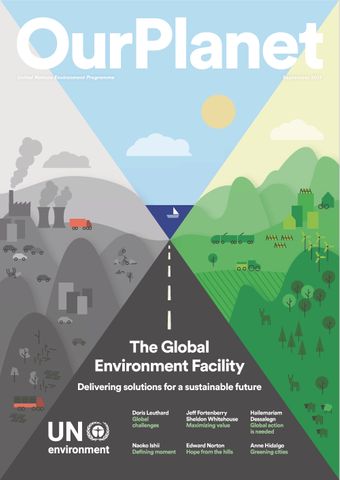
Volume 2017, Issue 3, 2018
In this issue of Our Planet, government leaders, policymakers and experts explore the work of the Global Environment Facility and how the partnership is working to drive progress on the world’s most pressing environmental challenges.
-
-
Reflections
More LessAuthors: Erik Solheim, Achim Steiner and Kristalina GeorgievaMore than just a financial mechanism or a partnership agreement, the Global Environment Facility sits at the very heart of global action to protect and restore our environment. This edition of Our Planet looks at the work of the Facility, which for more than a quarter century has driven catalytic change, enabling progress on the world’s most pressing environmental challenges.
-
-
-
Defining moment
More LessAuthor: Naoko IshiiWe stand at a defining moment for the future of the planet and human well-being. Our global commons – the land, seas and atmosphere we share, and the ecosystems they host – are under severe threat from ever more powerful human activities.
-
-
-
Global challenges
More LessAuthor: Doris LeuthardSince the Global Environment Facility was established more than 25 years ago, the global dimension of environmental challenges has become increasingly evident. Scientists tell us that our 'planetary boundaries', the biophysical processes that determine the stability and resilience of the Earth, are being pushed to their limit or overstepped, with high risks of severely jeopardizing the very base that has allowed our societies to thrive over the past 10,000 years. Especially in developing countries, environmental degradation is imperiling, if not sweeping away, development achievements.
-
-
-
Global action is needed
More LessAuthor: Hailemariam DessalegnThere is no doubt that science is increasingly expanding our knowledge of the problem of environmental degradation (including our role in it) and the extent to which it affects our ability to continually improve our living conditions.
-
-
-
Time to act
More LessAuthor: Tshering TobgayThe Earth Summit in Rio de Janeiro, Brazil, in 1992 was an historic moment for our planet, producing the United Nations Framework Convention on Climate Change and the Convention on Biological Diversity in addition to the Rio Declaration. Bhutan, under the far-sighted leadership of our monarchs, was one of the early countries to welcome and support both agreements to help tackle the world's most pressing environmental problems. In the same year, the Bhutan Trust Fund for Environmental Conservation was established with contributions from the Global Environment Facility, World Wildlife Fund, Norway, Switzerland, Denmark, Finland, the Netherlands and the Royal of Government of Bhutan. It was the world's first environmental trust fund.
-
-
-
The Global Environment Facility at work. Oyster openings
More LessLife can be hard in The Gambia – and even harder for the women who harvest oysters, a local delicacy and key source of protein, in the West African country’s swamps and wetlands.
-
-
-
Greening cities
More LessAuthor: Anne HidalgoClimate change is the greatest threat facing our planet. The leaders of the world’s great cities recognize that fact and are taking urgent action. But mayors need strong allies to deliver the transformations needed to create sustainable, green cities of the future. There is no greater partner for our campaign to save the planet than the Global Environment Facility.
-
-
-
Maximizing value
More LessAuthors: Jeff Fortenberry and Sheldon WhitehouseMany may think us an unlikely pair – a conservative Republican Representative from Nebraska, in the heartland of America, and a progressive Democratic Senator from Rhode Island, the Ocean State. However, we have come together as Co-Chairs in the United States Congressional International Conservation Caucus because we share a conviction that good natural resource management is fundamental to building a strong economy, bolstering national security, and protecting public health.
-
-
-
The Conventions
More LessGEF-7 will cover the last stretch of the global Strategic Plan for Biodiversity 2011-2020 and the first years of a successor framework. It is thus coming at a critical point in time and a strong replenishment is necessary in order to maximize efforts for achieving the global biodiversity targets (Aichi Targets) by 2020. A significant GEF replenishment for biodiversity will also provide a strong political signal and lay solid financial groundwork for a comprehensive and impactful successor agreement post-2020 and its enhanced national implementation.
-
-
-
Stretching for growth
More LessAuthor: Mark Malloch BrownAs stretch targets for the world, the Sustainable Development Goals offer a game plan for harmonizing the demands of a fast-growing human population with a dwindling finite natural resource base. Business, government and civil society need to work together in radically new ways to meet them.
-
-
-
Managing the global commons
More LessAuthor: Johan RockströmHere’s a prediction: planetary intelligence could emerge on Earth by 2050. “Hold on,” you might say, “that has emerged already, right? Homo Sapiens.” No. What we have is a technologically advanced civilization. There is a subtle difference.
-
-
-
Bridging the gaps
More LessAuthor: Peter BakkerIn the last two years something incredibly positive has happened. The often-criticised United Nations has given the world the biggest gift: the Sustainable Development Goals. The Global Goals have moved the conversation about sustainability from “why?” to “how?”. The facts are incontrovertible – we must act, now – and the Goals lay out the agenda. Working out how to find solutions for the sustainability challenges of energy, cities, food systems, waste, water and mobility is now on everyone’s agenda.
-
-
-
The Global Environment Facility at work. Grandma’s secret
More LessThe textile industry has long been an important employer in Mauritius. It is hard work, with many women combining domestic responsibilities with long days in the factories just to feed their families. So when factories began to close in the 1990s, many found themselves struggling to survive.
-
-
-
Only connect
More LessAuthor: Kathy CalvinSustainable development is thirty years old. It was born in 1987 with the release of the “Our Common Future” report, which declared: “Sustainable development is development that meets the needs of the present without compromising the ability of future generations to meet their own needs.”
-
-
-
Elements of change
More LessAuthor: Rosina M. BierbaumThe Global Environment Facility was created to protect the global commons, and funds projects to address climate change, biodiversity loss, land degradation, sustainable forestry, international waters, and chemicals in more than 170 countries. Since 1991, it has provided $17.6 billion in grants and mobilized an additional $88.6 billion in financing for more than 4,453 projects.
-
-
-
Hope from the hills
More LessAuthor: Edward NortonKenya's Chyulu Hills host not just rich wildlife and beautiful landscapes but a groundbreaking partnership to conserve biodiversity and combat climate change between its people and the Maasai Wilderness Conservation Trust.
-
-
-
Rescuing rainforests
More LessAuthor: Rosa Lemos de SáMaps of the Brazilian Amazon in 2000 and 2010 show unmistakable signs of dramatic change. Indigenous lands and several categories of protected areas now occupy millions of hectares, forming a consolidated landscape of conservation. But it might not have been so.
-
-
-
Being accountable
More LessAuthor: Juha I. UittoThe Global Environment Facility is a knowledge-based organization in which evaluation is central to accountability, results and learning. For it to be truly useful, it must respond to changes both in the external landscape in which the Facility operates and in internal modus operandi. During the Facility’s 7th Replenishment process, the Independent Evaluation Office is completing its sixth Comprehensive Evaluation under the theme ‘the Global Environment Facility in the Changing Landscape of Environmental Finance’. All such replenishments have been accompanied by an overall performance study and, as previously, the purpose of the Comprehensive Evaluation is to provide solid evaluative evidence to inform the negotiations, gauging the results and impact of the Facility’s work through a wide mix of methodologies. The Office is pioneering state-of-the-art geospatial methods that allow us to measure environmental change over longer periods of time, both before and after project implementation, and to compare project sites with matched control locations.
-
-
-
Partnering with peoples
More LessAuthor: Lucy MulenkeiIndigenous people are disproportionately represented among the destitute; they constitute approximtely five per cent of the world's population, but make up 15 per cent of the world's poor. The majority of them have historically faced social exclusion and marginalisation. Their levels of access to adequate health and education services are well below national averages. And they are especially vulnerable to the consequences of environmental degradation.
-
Volumes & issues
Most Read This Month
