


CEPAL Review - Volume 2010, Issue 100, 2010
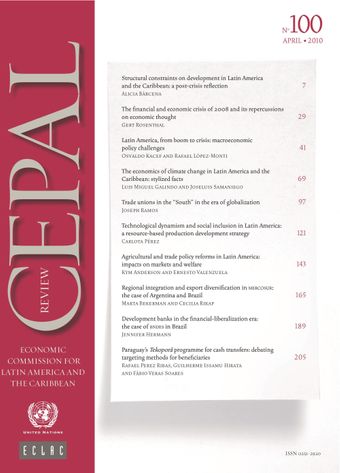
Volume 2010, Issue 100, 2010
The CEPAL Review was founded in 1976, along with the corresponding Spanish version, Revista de la CEPAL, and is published three times a year by the United Nations Economic Commission for Latin America and the Caribbean, which has its headquarters in Santiago, Chile. The purpose of the Review is to contribute to the discussion of socio-economic development issues in the region by offering analytical and policy approaches and articles by economists and other social scientists working both within and outside the United Nations.
-
-
Structural constraints on development in Latin America and the Caribbean: A post-crisis reflection
More LessAuthor: Alicia BárcenaThe development of Latin America and the Caribbean is still a work in progress. Although there have been macroeconomic improvements, allowing the region to confront the recent crisis on a better footing, this crisis has exposed old and new structural constraints faced by the countries of the region, which are reflected in the persistence of large social, economic, fiscal and environmental gaps. These gaps need to be closed for the sake of future generations and as a precondition for viable development that combines economic growth with equality and sustainability. This suggests that there are more than just economic reasons for the State to play, once again, a major role in development strategies, so that public policies take the lead in building the future. The main purpose of the present article is to make this argument.
-
-
-
The financial and economic crisis of 2008 and its repercussions on economic thought
More LessAuthor: Gert RosenthalThe financial and economic crisis of 2008 had multiple consequences in Latin American and Caribbean countries. It disrupted economic performance and called into question the paradigms that had steered economic policy in most countries; and it also exacerbated the growing divergences in points of view that were emerging before the crisis, some of which are ideological, while others reflect different approaches to economic strategies. The differentiating factors include: the role of the State and its relation to the market; and the nature and scope of participation in the global economy. This article addresses some of these divergences, the tensions they generate, and what the future holds for cooperation within Latin America. It also points out that in this new scenario, characterized by some perplexity, issues inherent to the work of ECLAC are clearly emerging.
-
-
-
Latin America, from boom to crisis: Macroeconomic policy challenges
More LessAuthors: Osvaldo Kacef and Rafael López-MontiThis article analyses the most recent phase of growth in Latin America, lasting from 2003 to late 2008, and the way the different policies applied in this period lessened its countries’ vulnerability and gave them greater macroeconomic policy space to confront the international crisis than in other negative shocks of the past. In addition, it briefly surveys the main countercyclical fiscal, monetary, financial and exchange-rate policy measures applied in the region’s economies to mitigate and reverse the effects of the crisis. It concludes by discussing post-crisis macro policy challenges in the region.
-
-
-
Trade unions in the “South” in the era of globalization
More LessAuthor: Joseph RamosThis article examines the effects of globalization on the trade union movement in developing countries (the “South”). It concludes, first, that globalization has been asymmetrical: much further-reaching for trade in goods than for capital flows, weak for technology transfer and very limited in migratory flows. Second, it examines the role and economic repercussions of labour unions. It finds that, contrary to the orthodox view, these have little negative impact on employment but do significantly reduce wage inequalities. In view of the shift in the South since the 1980s away from development strategies based on import substitution aimed at domestic markets and towards export-oriented strategies, the final section proposes new tasks and priorities for unions that are more consistent with this strategic reorientation, both at the national and international levels as well as within firms.
-
-
-
Technological dynamism and social inclusion in Latin America: A resource-based production development strategy
More LessAuthor: Carlota PérezThis paper sets out a strategy for invigorating development in Latin America by taking advantage of specific opportunities in the current context and the advantages offered by the region. It briefly analyses the characteristics of globalization and the techno-economic paradigm of the information and communications technology revolution in order to identify new opportunities in terms of markets, positioning in global networks and technological options. From this perspective, it argues that natural resource-based process industries can complement the specialization of Asia in assembly industries. Given the low rate of employment in the former, it proposes a dual strategy that includes promoting “bottom-up” wealth creation by taking advantage of the new flexibility in technological diversity, transport and trade. The idea is to stimulate policy debate and experimentation and signpost some avenues of research.
-
-
-
Agricultural and trade policy reforms in Latin America: impacts on markets and welfare
More LessAuthors: Kym Anderson and Ernesto ValenzuelaFarm earnings in Latin America have been depressed by pro-urban and anti–trade biases in national policies and by the agricultural support policies of richer countries. These policies have reduced economic welfare and hampered trade and growth, and may well have added to income inequality. This paper synthesizes results from a World Bank project that provides: measures of the extent to which national policies have changed farmers’ price incentives; partial equilibrium indices of the impact of farm policies on trade and economic welfare; general equilibrium estimates of trade, welfare and poverty effects of global reforms retrospectively and prospectively; comparisons with similar estimates for Asia, Africa and high-income countries; and a discussion of prospects for agricultural policy reform.
-
-
-
Regional integration and export diversification in MERCOSUR: The case of Argentina and Brazil
More LessAuthors: Marta Bekerman and Cecilia RikapThis article analyses the effects of Argentina’s trade with its MERCOSUR partners in two key periods: 1997/1998 and 2005/2006 —before and after the crises suffered by the economies of this trade zone. The impact of trade on the regionalization of exports and imports was measured by the Regional Orientation Index, which was used by Yeats in his study of these countries for an earlier time period. Our conclusions show that the results obtained by Yeats are inconsistent with the later reality in Argentina and Brazil, since MERCOSUR enabled them to develop learning processes and grow their trade with countries outside the bloc. This positive impact was mainly felt in Brazil, however, and less in the other partners, particularly Uruguay and Paraguay —owing to the underlying asymmetries between these economies. As a result, the largest MERCOSUR country has been the main beneficiary of integration thus far.
-
-
-
Development banks in the financial-liberalization era: The case of BNDES in Brazil
More LessAuthor: Jennifer HermannThis article considers the potential repercussions of financial liberalization on the role played by development banks, particularly the National Bank for Economic and Social Development (BNDES), as the main source of funding for Brazil’s economic development process. Although liberalization can foster financial development, the latter tends to respond incompletely to the needs of economic development in less developed countries, such as Brazil. Analysis of the Brazilian case seems to confirm this thesis and shows that BNDES not only preserved but actually expanded its position on the domestic market in 1990-2006, despite the financial-liberalization policy that was implemented in that period.
-
-
-
Paraguay’s Tekoporã programme for cash transfers: Debating targeting methods for beneficiaries
More LessAuthors: Rafael Perez Ribas, Guilherme Issamu Hirata and Fábio Veras SoaresThis article analyses alternative targeting methods for Paraguay’s conditional cash transfer programme, Tekoporã. The major practical choice is currently between a multidimensional quality-of-life index, which has been used since the programme started, and a proxy means test. This note evaluates the relative performance of these two alternatives. The simulations conducted herein suggest that changing the targeting mechanism from the quality-of-life index to proxy means does not offer any gains in either the efficiency or the efficacy of the programme. If the intention of policymakers is to improve efficacy in reaching the poor, then maintaining the current targeting mechanism with a higher cut-off point is the best option. If the intention is to alleviate extreme poverty, the most efficient impact is also given by the quality-of-life index, but with a lower cut-off point. However, a higher threshold may provide a considerable gain in coverage without a substantial increase in leakage.
-
Volumes & issues
-
Volume 2025
-
Volume 2024
-
Volume 2023
-
Volume 2022
-
Volume 2021
-
Volume 2020
-
Volume 2019
-
Volume 2018
-
Volume 2017
-
Volume 2016
-
Volume 2015
-
Volume 2014
-
Volume 2013
-
Volume 2012
-
Volume 2011
-
Volume 2010
-
Volume 2009
-
Volume 2008
-
Volume 2007
-
Volume 2006
-
Volume 2005
-
Volume 2004
-
Volume 2003
-
Volume 2002
-
Volume 2001
-
Volume 2000
-
Volume 1999
-
Volume 1998
-
Volume 1997
-
Volume 1996
-
Volume 1995
-
Volume 1994
-
Volume 1993
-
Volume 1992
-
Volume 1991
-
Volume 1990
-
Volume 1989
-
Volume 1988
-
Volume 1987
-
Volume 1986
-
Volume 1985
-
Volume 1984
-
Volume 1983
-
Volume 1982
-
Volume 1981
-
Volume 1980
-
Volume 1979
-
Volume 1978
-
Volume 1977
-
Volume 1976
Most Read This Month
