


CEPAL Review - Volume 2010, Issue 102, 2010
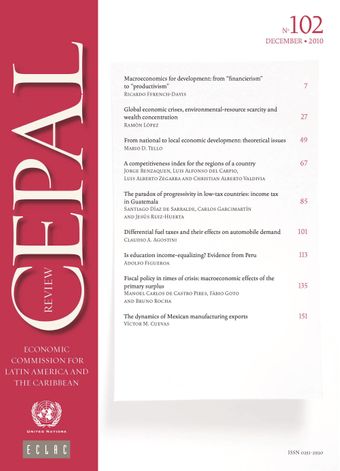
Volume 2010, Issue 102, 2010
Cepal Review is the leading journal for the study of economic and social development issues in Latin America and the Caribbean. Edited by the Economic Commission for Latin America, each issue focuses on economic trends, industrialization, income distribution, technological development and monetary systems, as well as the implementation of reforms and transfer of technology. Written in English and Spanish (Revista De La Cepal), each tri-annual issue brings you approximately 12 studies and essays undertaken by authoritative experts or gathered from conference proceedings.
-
-
Macroeconomics for development: from “financierism” to “productivism”
More LessAuthor: Ricardo Ffrench-DavisContrary to the belief that the region has found its way to an efficient macroeconomic policy, this paper argues that macroeconomic failures have been partly responsible for its disappointing economic and social performance in recent decades. Producers of gdp have had to cope with extremely unstable demand, exchange rates and access to financing, which have discouraged productivity and investment. Financial capital flows have been a determinant of this macroeconomic instability. This paper examines their intrinsically procyclical behaviour and concludes that an environment friendly to production development requires countercyclical regulation of financial flows. It describes how regulation of aggregate demand needs to be reconciled with the evolution of potential gdp, the real exchange rate with the current account, and financial flows with a far-reaching reform of the capital market reforms, away from “financierism” and towards “productivism”.
-
-
-
Global economic crises, environmental-resource scarcity and wealth concentration
More LessAuthor: Ramón LópezThree new structural factors underlie the most recent global crisis: (i) the fact that several high-population countries have joined the growth process; (ii) the increasing scarcity of environmental and certain natural resources; and (iii) the extraordinary concentration of income and wealth that has occurred in the advanced economies over the last two decades. These structural changes have significantly strengthened the links between global growth and commodity demand; they have made world commodity supply increasingly inelastic, and have rendered economic growth more dependent on easy monetary and financial policies. The combination of these factors could make the world economy highly crisis-prone and may hinder recovery from the current one.
-
-
-
From national to local economic development: theoretical issues
More LessAuthor: Mario D. TelloBased upon a brief and selective survey of the literature on local economic development (led), this paper analyses four theoretical aspects that distinguish “local” economic development theories from their “national” counterparts. These are: location factors, local public goods, active participation by a variety of private agents, and the multidisciplinary approach of led theories. This analysis could be used to design an academic discipline of led, which seldom exists in developing countries, and shed light on the objectives and roles of agents involved in ongoing decentralization and led processes in those countries.
-
-
-
A competitiveness index for the regions of a country
More LessThis article, which forms part of a comprehensive research project on measuring the level of competitiveness, sets out a proposal for developing an index to measure the competitiveness of the regions of a country. The aim is to develop a new approach to competitiveness, by measuring how resources and capacities are managed in a given region of a country, to generate a sustained increase in business productivity and the well-being of its population. The following pillars of the competitiveness of regions are identified: (i) government and institutions; (ii) economic development; (iii) productive infrastructure; (iv) human capital; and (v) business efficiency. For each of these pillars, five factors and their variables are identified to measure the various aspects of regional competitiveness. These represent a second and third level of disaggregation that enhance the analysis that can be made using the results obtained.
-
-
-
The paradox of progressivity in low-tax countries: income tax in Guatemala
More LessAuthors: Santiago Díaz de Sarralde, Carlos Garcimartín and Jesús Ruiz-HuertaThe Kakwani and Reynolds-Smolensky indices are used to analyse the consequences of tax reforms in terms of a tax’s progressivity and redistributive capacity. Nonetheless, these indices can only serve as a basis for normative judgments in reforms where revenue remains constant. As this is generally not the case with tax reforms in practice, the Reynolds-Smolensky index is usually broken down into changes in the average tax rate and changes in the Kakwani index. This article argues that this procedure has serious disadvantages, especially in countries with low levels of tax revenue. To help overcome these problems, a number of alternative indicators are proposed based on the traditional indices, to make it possible to analyse the redistributive and progressivity effects of reforms that generate changes in revenue. These indicators are then used to analyse hypothetical reforms to income tax in Guatemala.
-
-
-
Differential fuel taxes and their effects on automobile demand
More LessAuthor: Claudio A. AgostiniFuel taxation policy in Chile has always been to keep taxes on diesel lower than those on gasoline. The proportion of automobiles with diesel engines has grown considerably as a result. Just 20% of diesel engine emissions are equivalent to 80% of gasoline engine emissions, and this affects the level of externalities associated with automobile use, especially in cities such as Santiago where pollution levels are high. This study estimates the effect of the fuel tax differential on automobile demand. The findings indicate diesel automobile demand elasticities of -3.4 and 2.1 with respect to the price of the vehicle and the tax differential. The scale of these effects means there is scope for substantial emissions cuts by way of tax changes to equalize gasoline and diesel tax rates and create a specific tax on diesel automobiles.
-
-
-
Is education income-equalizing? Evidence from Peru
More LessAuthor: Adolfo FigueroaIs the education system income-equalizing? The evidence from developing countries shows that while education has expanded tremendously in recent decades, income distribution has not become more equal. This article seeks to resolve this seeming paradox. A theoretical model is constructed for the relationship between education and income in which ethnicity plays a key role in the distribution process. The model predicts that the education system is not income-equalizing. A broader set of predictions are derived from the theoretical model and then compared to Peruvian data. Statistical tests produce results that are consistent with the model’s predictions.
-
-
-
Fiscal policy in times of crisis: macroeconomic effects of the primary surplus
More LessAuthors: Manoel Carlos de Castro Pires, Fábio Goto and Bruno RochaThe international financial crisis that hit the Brazilian economy in the third quarter of 2008 called forth several economic-policy responses. In the case of fiscal policy, expansionary measures rendered the existing fiscal target unviable, and it was formally reduced in April 2009. The purpose of this article is to analyse the macroeconomic effects of reducing the primary budget-surplus target and to evaluate its repercussions on the level of activity, time-structure of interest rates and the exchange rate.
-
-
-
The dynamics of Mexican manufacturing exports
More LessAuthor: Víctor M. CuevasThis article evaluates several of the determinants of Mexican manufacturing exports, using two complementary econometric methods: a structural arima model, which makes it possible to estimate elasticities; and a generalized var model, which provides a fully dynamic perspective by estimating impulse response functions. As some of the findings are robust to changes in the econometric methodology used, the article reaches the following conclusions. First, manufacturing exports are positively related to labour productivity and external demand; so the adverse effects of an international recession on Mexican exports could, to some extent, be offset by raising worker productivity. Second, real exchange-rate depreciation does not increase manufacturing exports, but actually reduces them, at least in the short run. These findings are consistent with the idea that a real depreciation not only affects demand, but also generates strong supply-side effects.
-
Volumes & issues
-
Volume 2025
-
Volume 2024
-
Volume 2023
-
Volume 2022
-
Volume 2021
-
Volume 2020
-
Volume 2019
-
Volume 2018
-
Volume 2017
-
Volume 2016
-
Volume 2015
-
Volume 2014
-
Volume 2013
-
Volume 2012
-
Volume 2011
-
Volume 2010
-
Volume 2009
-
Volume 2008
-
Volume 2007
-
Volume 2006
-
Volume 2005
-
Volume 2004
-
Volume 2003
-
Volume 2002
-
Volume 2001
-
Volume 2000
-
Volume 1999
-
Volume 1998
-
Volume 1997
-
Volume 1996
-
Volume 1995
-
Volume 1994
-
Volume 1993
-
Volume 1992
-
Volume 1991
-
Volume 1990
-
Volume 1989
-
Volume 1988
-
Volume 1987
-
Volume 1986
-
Volume 1985
-
Volume 1984
-
Volume 1983
-
Volume 1982
-
Volume 1981
-
Volume 1980
-
Volume 1979
-
Volume 1978
-
Volume 1977
-
Volume 1976
Most Read This Month
Article
content/journals/16840348
Journal
10
5
false
en
