


CEPAL Review - Volume 2015, Issue 116, 2015
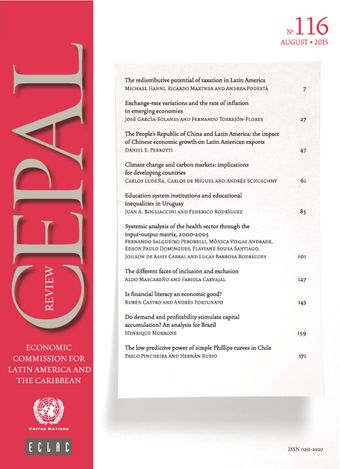
Volume 2015, Issue 116, 2015
Cepal Review is the leading journal for the study of economic and social development issues in Latin America and the Caribbean. Edited by the Economic Commission for Latin America, each issue focuses on economic trends, industrialization, income distribution, technological development and monetary systems, as well as the implementation of reforms and transfer of technology. Written in English and Spanish (Revista De La Cepal), each tri-annual issue brings you approximately 12 studies and essays undertaken by authoritative experts or gathered from conference proceedings.
-
-
The redistributive potential of taxation in Latin America
More LessAuthors: Michael Stephen Hanni, Ricardo Martner and Andrea PodestáThis study uses internationally comparable methodologies to analyse the distributional impact of income tax and public transfers in 17 countries of Latin America. The results indicate that fiscal policy plays a limited role in improving the distribution of disposable income; the Gini coefficient decreased by barely three percentage points after direct fiscal action. On average, 61% of this reduction was due to public cash transfers and the rest to direct taxes, reflecting the pressing need for personal income tax to be strengthened. Analysis of household surveys gives an indication of the potential effects of tax reforms aimed at increasing the average effective tax rate of the top income decile. Allocating this additional revenue to targeted transfers would produce significant results. Consequently, tax reforms must be evaluated bearing in mind how those resources are used.
-
-
-
Exchange-rate variations and the rate of inflation in emerging economies
More LessAuthors: José García-Solanes and Fernando Torrejón-FloresThis paper develops a structural general equilibrium model to analyse the reactions of the nominal exchange rate and the domestic price level to three types of external shock in emerging economies that have limited access to world capital markets. Although the results depend crucially on the type of external shock, each of the two national balance-sheet parameters considered here the risk premium and the ratio of external indebtedness exacerbates the reactions of the two endogenous variables without altering the degree of exchange-rate pass-through (erpt). Moreover, flatter Phillips curves, as observed today in many economies, tend to increase erpt. On the basis of these results, the authorities of emerging economies seeking to stabilize markets and limit erpt are advised to minimize the two risk parameters by applying a flexible inflation-targeting regime.
-
-
-
The People’s Republic of China and Latin America: The impact of Chinese economic growth on Latin American exports
More LessAuthor: Daniel E. PerrottiThe role of the Peoples Republic of China in the world economy has grown substantially in recent decades, turning it into a strategic foreign trading partner for much of Latin America. Bilateral trade between the region and China totalled US$ 120 billion in 2009. This study analyses the income elasticity of the regions exports to the country. The findings show that, assuming real gross domestic product (gdp) growth in China of about 7% a year, the value of Latin American exports to China (at 2005 prices) can be expected to increase by an average of about 10% a year between 2014 and 2019. In a more conservative scenario of 4.5% average annual growth in the Chinese economy over the period, exports would rise by about 7% a year.
-
-
-
Climate change and Carbon markets: Implications for developing countries
More LessAuthors: Carlos Ludeña, Carlos de Miguel and Andrés SchuschnyWhile the Kyoto Protocol provided a framework for reducing the greenhouse gas emissions of industrialized nations, current climate change negotiations envisage future commitments for major CO2 emitters among developing countries. This document uses an updated version of the gtap-e general equilibrium model to analyse the economic implications of reducing carbon emissions under different carbon trading scenarios. The participation of developing countries such as China and India would reduce emissions trading costs. Impacts in Latin America would depend on whether a country is an energy exporter or importer and whether the United States reduces emissions. Welfare impacts might be negative depending on the carbon trading scheme adopted and a countrys trading partners.
-
-
-
Education system institutions and educational inequalities in Uruguay
More LessAuthors: Juan A. Bogliaccini and Federico RodríguezThis article shows how certain aspects at the secondary level of Uruguays public school system produce inequalities in student achievement. The 2006 edition of the Programme for International Student Assessment (pisa) (oecd, 2006a) points to three key aspects of the institutions that regulate secondary education that play a part in reproducing inequalities of origin, hindering the equalizing role that guides the education system. First, the teacher assignment mechanism has the dual effect of sending a revolving door of young and inexperienced teachers to schools in unfavourable sociocultural contexts as well as concentrating teachers with more experience in schools in favourable contexts. Second, the geography-based system for assigning students to schools reproduces the residential segregation process. Lastly, the centralized system for supplying educational and technological materials is inadequate to the needs of the schools.
-
-
-
Systemic analysis of the health sector through the input-output matrix, 2000-2005
More LessThis article provides a systemic analysis of the health sector in Brazil, based on a study of its productive structure and its interactions with the other sectors of the economy. The article draws on unpublished data on the National Health Accounts provided by the Brazilian Geographical and Statistical Institute (ibge); and it proposes a methodology for harmonizing the System of National Accounts (input-output matrix) with the Health Satellite Accounts for 2000 and 2005. This sheds light on the relations that exist between the health sector and the other sectors the economy, through input-output indicators.
-
-
-
The different faces of inclusion and exclusion
More LessAuthors: Aldo Mascareño and Fabiola CarvajalThe notions of inclusion and exclusion have a long tradition in sociology, but have gained significant currency more recently in public policy analysis. However, a certain conceptual inflexibility arises when the distinction is applied to complex social situations. This article examines the main approaches to inclusion/exclusion in the sociological tradition, systems theory and the theory of new inequalities. On this basis, five interrelated situations of inclusion and exclusion are constructed: self-inclusion/self-exclusion, inclusion by risk/ exclusion by danger, compensatory inclusion, inclusion in exclusion and sub-inclusion. They are illustrated with specific examples to refine an analytical approach to problems of inclusion and exclusion, with a view to contributing to sociological analysis and to assessing the consequences of public and private decisions.
-
-
-
Is financial literacy an economic good?
More LessAuthors: Rubén Castro and Andrés FortunatoFinancial literacy (FL) is generally regarded as an economic good which individuals choose whether or not to consume depending on how much of a contribution they expect it to make to the quality of their financial decision-making. This construct has not, however, been tested empirically. In this study we analyse variations in FL on the part of individuals who experience major life-cycle events that show up in the data and that can be assumed to have repercussions on their personal finances. The analysis of a panel made up of approximately 12,000 people indicates that there is a correlation between 13 of the 17 selected life events and financial decisions, but only one of those events (job training) is associated with a change in FL. This evidence casts doubt upon the conceptualization of FL as an economic good and is in line with a series of other studies that, for one reason or another, have questioned the soundness of the current conceptual approach to FL.
-
-
-
Do demand and profitability stimulate capital accumulation? An analysis for Brazil
More LessAuthor: Henrique MorroneThis article tests whether the profit share of GDP and capacity utilization affect capital accumulation in Brazil in the period 1950-2008 (in the sense of Granger causality). The methodology developed by Toda and Yamamoto (1995) is used to verify the Granger non-causality hypothesis. The results show that capacity utilization Granger-causes capital accumulation in the Brazilian economy and, also that the profit share of GDP does not Granger-cause the national investment-capital ratio. This corroborates the Kaleckian proposal based on the fundamental role of the accelerator, and suggests that the Brazilian economy can grow with either a concentration or a de-concentration of income, provided a suitable institutional arrangement is in place.
-
-
-
The low predictive power of simple Phillips curves in Chile
More LessAuthors: Pablo Pincheira Brown and Hernán Rubio HurtadoThis study uses some backward-looking versions of Phillips curves, estimated from both revised and real-time data, to explore the existence, robustness and size of the contribution that a variety of activity measures may make to the task of predicting inflation in Chile. The main results confirm the findings of the recent international literature: the predictive power of the activity measures considered here is episodic, unstable and of moderate size. This weak predictive contribution is robust to the use of final and real-time data.
-
Volumes & issues
-
Volume 2025
-
Volume 2024
-
Volume 2023
-
Volume 2022
-
Volume 2021
-
Volume 2020
-
Volume 2019
-
Volume 2018
-
Volume 2017
-
Volume 2016
-
Volume 2015
-
Volume 2014
-
Volume 2013
-
Volume 2012
-
Volume 2011
-
Volume 2010
-
Volume 2009
-
Volume 2008
-
Volume 2007
-
Volume 2006
-
Volume 2005
-
Volume 2004
-
Volume 2003
-
Volume 2002
-
Volume 2001
-
Volume 2000
-
Volume 1999
-
Volume 1998
-
Volume 1997
-
Volume 1996
-
Volume 1995
-
Volume 1994
-
Volume 1993
-
Volume 1992
-
Volume 1991
-
Volume 1990
-
Volume 1989
-
Volume 1988
-
Volume 1987
-
Volume 1986
-
Volume 1985
-
Volume 1984
-
Volume 1983
-
Volume 1982
-
Volume 1981
-
Volume 1980
-
Volume 1979
-
Volume 1978
-
Volume 1977
-
Volume 1976
Most Read This Month
Article
content/journals/16840348
Journal
10
5
false
en
