


CEPAL Review - Volume 2016, Issue 120, 2016
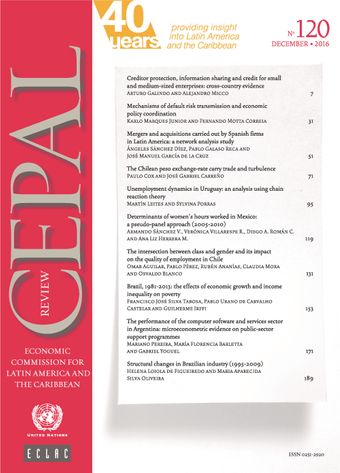
Volume 2016, Issue 120, 2016
-
-
Creditor protection, information sharing and credit for small and medium-sized enterprises: Cross-country evidence
More LessAuthors: Arturo Galindo and Alejandro MiccoUsing World Business Environment Survey results for firms in 61 countries, together with country dummies that allow us to deal with observed and unobserved country-specific components, as well as with partial endogeneity, we explore the roles played by creditor protection (e.g. the enforcement of credit contracts) and by the development of credit information mechanisms, such as credit registries, in determining the availability of bank credit for small and medium-sized enterprises (SMEs). We find that better creditor protection and the development of information-sharing mechanisms narrow the financing gap between small and large firms. Countries with poor creditor protection can offset this shortcoming by implementing credit information mechanisms.
-
-
-
Mechanisms of default risk transmission and economic policy coordination
More LessAuthors: Karlo Marques Junior and Fernando Motta CorreiaThis paper analyses the coordination between monetary and fiscal policy in an emerging economy with an inflation-targeting monetary regime, in a context in which default risk shocks can lead to macroeconomic imbalances. It develops a macrodynamic model in order to capture the mechanisms of default risk transmission and its effects on the definition of reaction functions for the monetary and fiscal authorities. The main findings of the model point to the existence of new mechanisms of default risk transmission associated with price and fiscal stability.
-
-
-
Mergers and acquisitions carried out by Spanish firms in Latin America: A network analysis study
More LessThis article analyses the changing role played by Spanish firms in foreign investment through mergers and acquisitions in Latin America in 1999-2012. Spanish enterprises that acquired local assets in Latin America and became leading players in the late 1990s have seen the situation change drastically, as new competitors have emerged to undermine Spain’s importance as an investor in the region. This study uses the social networks methodology, which enables a more complex analysis than traditional approaches, by studying the position of agents as members of a network being analysed. The use of centrality, density and centralization indicators reveals the structure of the network and how it changes through time, and thus, it shows the relative position of each investor country, Spain in particular.
-
-
-
The Chilean peso exchange-rate carry trade and turbulence
More LessAuthors: Paulo Cox and José Gabriel CarreñoIn this study we provide evidence regarding the relationship between the Chilean peso carry trade and currency crashes of the peso against other currencies. Using a rich dataset containing information from the local Chilean forward market, we show that speculation aimed at taking advantage of the recently large interest rate differentials between the peso and developedcountry currencies has led to several episodes of abnormal turbulence, as measured by the exchange-rate distribution’s skewness coefficient. In line with the interpretative framework linking turbulence to changes in the forward positions of speculators, we find that turbulence is higher in periods during which measures of global uncertainty have been particularly high.
-
-
-
Unemployment dynamics in Uruguay: An analysis using chain reaction theory
More LessAuthors: Martín Leites and Sylvina PorrasThis article analyses unemployment dynamics in Uruguay within the framework of chain reaction theory and offers evidence to account for the remarkable drop in unemployment over recent years. It confirms the impact of exogenous variables on the long-run trajectory of unemployment and rules out the notion that its long-run level gravitates around an equilibrium value. It identifies inertia processes in labour supply and demand and in wages, whose mutual interactions mean that shocks have persistent effects on unemployment. There are also complementary spillover effects that influence the magnitude and duration of the effects of shocks. Lastly, the article emphasizes that growth in the capital stock and capital productivity accounts for some of the substantial decline in unemployment in Uruguay since 2003.
-
-
-
Determinants of women’s hours worked in Mexico: A pseudo-panel approach (2005-2010)
More LessThe hours worked by Mexican women depend not only on wages and individual characteristics, but also on factors related to household structure, which generate incentives for women to restrict their hours of paid work. This study uses a pseudo-panel containing five million observations from the National Survey on Occupation and Employment, for 2005-2010. Different age cohorts of the female working population are analysed along with a pseudopanel model that measures the sensitivity of women’s hours worked to wage variations and factors related to household structure, such as the availability of help in the home and the presence of children. It is found that women’s hours worked increase when the household contains another adult woman, but decrease in the presence of children or a male adult.
-
-
-
The intersection between class and gender and its impact on the quality of employment in Chile
More LessAuthors: Omar Aguilar, Pablo Pérez, Rubén Ananías, Claudia Mora and Osvaldo BlancoThis study explores the impact of the intersection between class and gender on the quality of employment in Chile. The method used to measure social class position is based on the work of Erik O. Wright, while, for the quality of employment, a multidimensional measurement was used, including one index for objective working conditions and two indices for subjective ones (motivation on the job and the perception of control over work processes). The results demonstrate that class and gender give rise to significant differences in objective and subjective job quality. However, the data also indicate that gender (more specifically, the fact of being female) does not necessarily amplify the class-based inequalities observed in the labour market. Drawing on these findings, a number of thoughts about how the class/gender intersection operates in the Chilean labour market are shared in the final section of this study.
-
-
-
Brazil, 1981-2013: The effects of economic growth and income inequality on poverty
More LessThis study analyses the impact of economic growth and income inequality on poverty in Brazil in the years from 1981 to 2013. A dynamic panel model was used, estimated by the twostep generalized method-of-moments system developed by Blundell-Bond (1998), in order to analyse three scenarios: the first corresponds to the entire period covered by this study (i.e. 1981-2013); the second encompasses the years from 1981 to 1994 (the period leading up to the Real Plan); and the third is the period from 1995 to 2013 (the years following the implementation of the Real Plan). The results indicate that economic growth policies that promote an increase in income in conjunction with a reduction in income disparities are more effective in combating poverty in Brazil than those that focus only on raising mean income levels. The findings also point to the existence of a pro-poor form of growth in the period following the Real Plan.
-
-
-
The performance of the computer software and services sector in Argentina: Microeconometric evidence on public-sector support programmes
More LessAuthors: Mariano Pereira, María Florencia Barletta and Gabriel YoguelThis article analyses the impact of public-sector support programmes on the recent performance of the computer software and services sector in Argentina. First, the effect of these programmes on firms’ innovation performance is studied, with a propensity score matching technique used to calculate the average treatment effect on treated firms. The results confirm that receiving public funds had a positive impact on the ratio between research and development (R&D) spending and sales, employment in R&D and the propensity to introduce new products or processes. The effect of policy intervention on firms’ economic performance is then analysed, with an instrumental variables design being used in this case. The results show a positive impact on the propensity to export, export intensity and employment growth.
-
-
-
Structural changes in Brazilian industry (1995-2009)
More LessThis article analyses the structural changes that took place in Brazilian industry between 1995 and 2009, by considering their intersectoral relations, through input-output analysis using the structural decomposition method and the calculation of linkage indices. The results show that the expansion of final demand plays a key role in industry growth in terms of employment, value added and gross production value. Natural-resource-intensive industry has grown particularly strongly. Another finding is that intersectoral demand has weakened, particularly in scale-intensive sectors that use differentiated technology.
-
Volumes & issues
-
Volume 2025
-
Volume 2024
-
Volume 2023
-
Volume 2022
-
Volume 2021
-
Volume 2020
-
Volume 2019
-
Volume 2018
-
Volume 2017
-
Volume 2016
-
Volume 2015
-
Volume 2014
-
Volume 2013
-
Volume 2012
-
Volume 2011
-
Volume 2010
-
Volume 2009
-
Volume 2008
-
Volume 2007
-
Volume 2006
-
Volume 2005
-
Volume 2004
-
Volume 2003
-
Volume 2002
-
Volume 2001
-
Volume 2000
-
Volume 1999
-
Volume 1998
-
Volume 1997
-
Volume 1996
-
Volume 1995
-
Volume 1994
-
Volume 1993
-
Volume 1992
-
Volume 1991
-
Volume 1990
-
Volume 1989
-
Volume 1988
-
Volume 1987
-
Volume 1986
-
Volume 1985
-
Volume 1984
-
Volume 1983
-
Volume 1982
-
Volume 1981
-
Volume 1980
-
Volume 1979
-
Volume 1978
-
Volume 1977
-
Volume 1976
Most Read This Month
