


CEPAL Review - Volume 2018, Issue 126, 2018
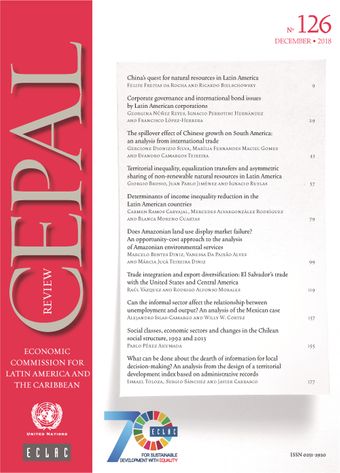
Volume 2018, Issue 126, 2018
-
-
In memoriam
More LessAuthor: Oscar AltimirAs we prepare this edition of CEPAL Review, our editorial team wishes to express its deep sorrow upon the death of Oscar Altimir on 27 September in Santiago. His departure is deeply felt by the ECLAC community, especially by those of us involved in the production of CEPAL Review. We acknowledge the intellectual legacy of Altimir, who directed this publication between 1996 and 2008, succeeding its first two directors: Aníbal Pinto Santa Cruz (1986–1996) and founder Raúl Prebisch (1976–1986). This editorial is intended to convey our heartfelt homage to Altimir’s academic figure and distinguished career as a leading development economist in the region and as one of the most prominent thinkers of the Economic Commission for Latin America and the Caribbean (ECLAC) over the past 40 years.
-
-
-
China’s quest for natural resources in Latin America
More LessAuthors: Felipe Freitas da Rocha and Ricardo BielschowskyThis article describes and analyses China’s pursuit of natural resources in Latin America, particularly oil, iron, copper and soybeans, which account for over 70% of its imports from the region. This is motivated by the rapid growth and relative scarcity of natural resources in China itself, and the country’s long-term planning that sees the region as a major supplier. In the case of oil, access occurs mainly through loans for oil and direct investments, while in iron and copper it is obtained through direct investments and imports. The method chosen by China to guarantee supply security seems to involve physical control of the resource in question. In the case of soybeans, the path chosen has involved imports increasingly intermediated by trading companies already present in the region, which have recently been taken over by China.
-
-
-
Corporate governance and international bond issues by Latin American corporations
More LessThis paper analyses the relationship between corporate bond issues and the existence of corporate governance frameworks that influence the development of financial markets by reducing information asymmetries and conflicts of interest. To this end, the international corporate bond market is reviewed and corporate governance standards in Brazil and in the four countries belonging to the Latin American Integrated Market (MILA) —Chile, Colombia, Mexico and Peru— are evaluated using a bond issues indicator developed by the Economic Commission for Latin America and the Caribbean (ECLAC), the Andean Development Corporation (CAF) and the Inter-American Development Bank (IDB). The evidence gathered using a probit panel model and a pooled probit model indicates that adherence to corporate governance standards can increase the likelihood that a firm will be able to carry out a successful international bond issue.
-
-
-
The spillover effect of Chinese growth on South America: an analysis from international trade
More LessChina’s rising share of South American trade since 2001 has made that country’s growth a matter of huge importance for the continent’s economies. This study sets out to analyse the spillover effect of China’s growth on that of the leading South American economies (Argentina, Brazil, Chile and Colombia) between 1981 and 2014. It analyses whether the increase in China’s share of these countries’ trade since 2001 has altered that effect. The findings suggest that, while positive, it has remained substantially unchanged. The main conclusion from these results is that expanding exports from traditional sectors of the South American economies (commodities) is not enough for earnings to increase with China’s growth. The article emphasizes the importance of public policies designed to diversify South America’s portfolio of exports to China, such as incentives for exporting by non-traditional sectors.
-
-
-
Territorial inequality, equalization transfers and asymmetric sharing of non-renewable natural resources in Latin America
More LessAuthors: Giorgio Brosio, Juan Pablo Jiménez and Ignacio RuelasNon-renewable natural resources (NRNR) contribute a large share of tax revenue in Latin American countries; and the fact that these resources are concentrated in just a few regions generates a high level of territorial inequality. This paper aims to analyse how NRNR revenues could be included in equalization grants, and how countries are implementing adequate equalization grant systems, or could do so. Based on fiscal equalization theory, vertical and horizontal systems are evaluated with reference to mid-level governments in Argentina and Peru. The study identifies a variety of political and economic costs for different NRNR revenue systems, where: (i) the provinces own the resources in question (Argentina); and (ii) NRNR revenues are collected and distributed by central government to a large number of subnational governments under a fully asymmetrical scheme (Peru).
-
-
-
Determinants of income inequality reduction in the Latin American countries
More LessThis article analyses patterns of income inequality and its determinants in the countries of Latin America in the period 2004–2013. First, income distribution in several countries is determined using the Theil index and is found to have decreased over the study period. An econometric panel data model is then employed to study the determinants of the level of inequality. Per capita GDP, per capita health spending, tax pressure, the poverty rate, the literacy rate and years of schooling are found to be statistically significant variables in explaining inequality. Multivariate techniques are then used to group the countries by level of inequality, thereby establishing a classification in terms of ability to reduce inequality.
-
-
-
Does amazonian land use display market failure? An opportunity-cost approach to the analysis of amazonian environmental services
More LessThe article discusses whether deforestation in the Amazonian region should be considered a typical case of market failure and computes the opportunity cost of economic activities that promote deforestation relative to uses that keep the forest intact. For environmental resources threatened by Amazon deforestation, forms of productive land use (“opportunity” uses) are considered in terms of the net benefit values of primary land-based activities. The accounting exercise conducted in this study calculates the net benefit per hectare obtained from the direct use value (DUV) for different land use alternatives (timber, non-timber, livestock and agriculture); the indirect use value (IUV) related to carbon storage; and the non-use value (NUV) (existence value). The results show that the opportunity cost of deforestation in 2009 was positive for the most common land use, livestock activity. Such findings indicate a market failure. Nonetheless, this is not the only possible outcome when considering alternative land uses.
-
-
-
Trade integration and export diversification: El Salvador’s trade integration and export diversification: El Salvador’s trade with the United States and Central America
More LessAuthors: Raúl Vázquez and Rodrigo Alfonso MoralesThis article conducts a comparative analysis of the diversification of El Salvador’s baskets of exports to the United States and Central America. It uses the most detailed level of disaggregation available and organizes products by technology intensity. The results show greater export diversification and sophistication in trade with Central America. Evidence is also found that, where El Salvador is concerned, it is more advisable to strengthen South-South integration, especially within Central America, than North-South integration.
-
-
-
Can the informal sector affect the relationship between unemployment and output? An analysis of the Mexican case
More LessAuthors: Alejandro Islas-Camargo and Willy W. CortezA key aspect of developing countries is the existence of a large informal sector. In the present paper, we analyse the effect of this feature on the relationship between unemployment changes and output growth for Mexico, a country characterized by the existence of a large informal sector. Following recent studies on Okun’s coefficient, we first test whether the relationship between the cyclical components of unemployment and output is asymmetric. We then explore the possibility that this non-linear relationship may be affected by changes in the informal sector. Our results indicate that there is evidence of an asymmetric relationship between the cyclical components.
-
-
-
Social classes, economic sector sand changes in the chilean social structure, 1992 and 2013
More LessAuthor: Pablo Pérez AhumadaAccording to recent research studies, a central characteristic of Chilean society is its mesocratization, in other words the sustained growth of the middle class. This article tests that thesis empirically, using Erik O. Wright’s class model and the shift-share analysis technique to study the changes that occurred in Chile’s class structure in two periods 1992–2003 and 2003–2013. The study concludes that the idea of mesocratization is questionable; between 1992 and 2013, there are substantially fewer people located in middle-class positions than in the “popular” classes (working class and informal self-employed). Moreover, the growth of the middle class has been relatively marginal and has been accompanied by trends that contradict the idea of a mesocratic society (such as the expansion of the working class between 2003 and 2013).
-
-
-
What can be done about the dearth of information for localdecision-making? An analysis from the design of a territorial development index based on administrative records
More LessAuthors: Ismael Toloza, Sergio Sánchez and Javier CarrascoThis article addresses the issue of information availability for decision-making at the subregional level. It proposes the construction of a territorial development index (TDI) based on administrative records and comprising 19 variables grouped into 6 dimensions: (i) cultural capital, (ii) social capital, (iii) human capital, (iv) institutional capital, (v) tangible capital and (vi) economic capital. The approach underlying the proposed model centres on territorial development and the structural factors determining it. The variables making up the TDI were selected in consultation with experts and with the use of multivariate statistical analyses. This paper sets out to document many of the phases, procedures and decisions leading to the TDI, as a way of opening up the discussion around this line of research. It concludes by presenting calculations of the TDI for the Chilean municipalities of Angol and Carahue.
-
Volumes & issues
-
Volume 2025
-
Volume 2024
-
Volume 2023
-
Volume 2022
-
Volume 2021
-
Volume 2020
-
Volume 2019
-
Volume 2018
-
Volume 2017
-
Volume 2016
-
Volume 2015
-
Volume 2014
-
Volume 2013
-
Volume 2012
-
Volume 2011
-
Volume 2010
-
Volume 2009
-
Volume 2008
-
Volume 2007
-
Volume 2006
-
Volume 2005
-
Volume 2004
-
Volume 2003
-
Volume 2002
-
Volume 2001
-
Volume 2000
-
Volume 1999
-
Volume 1998
-
Volume 1997
-
Volume 1996
-
Volume 1995
-
Volume 1994
-
Volume 1993
-
Volume 1992
-
Volume 1991
-
Volume 1990
-
Volume 1989
-
Volume 1988
-
Volume 1987
-
Volume 1986
-
Volume 1985
-
Volume 1984
-
Volume 1983
-
Volume 1982
-
Volume 1981
-
Volume 1980
-
Volume 1979
-
Volume 1978
-
Volume 1977
-
Volume 1976
Most Read This Month
