


CEPAL Review - Volume 2019, Issue 127, 2019
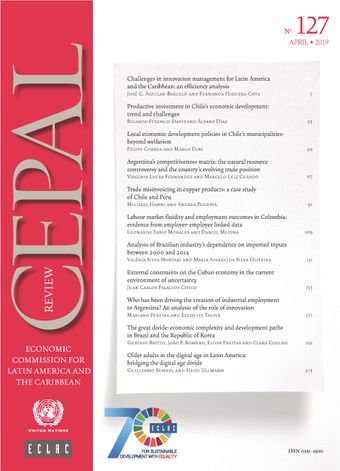
Volume 2019, Issue 127, 2019
Cepal Review is the leading journal for the study of economic and social development issues in Latin America and the Caribbean. Edited by the Economic Commission for Latin America, each issue focuses on economic trends, industrialization, income distribution, technological development and monetary systems, as well as the implementation of reforms and transfer of technology. Written in English and Spanish (Revista De La Cepal), each tri-annual issue brings you approximately 12 studies and essays undertaken by authoritative experts or gathered from conference proceedings.
-
-
Challenges in innovation management for Latin America and the Caribbean: an efficiency analysis
More LessAuthors: José G. Aguilar-Barceló and Fernanda Higuera-CotaApplying data envelopment analysis (DEA) to data from the 2016 Global Innovation Index (GII) (Cornell University/INSEAD/WIPO, 2016), the paper evaluates the efficiency of 19 Latin American and Caribbean economies in creating innovation-friendly environments. Where the region performs best is on infrastructure and adaptation of information and communication technologies (ICTs), but there are problems with human capital formation, the conduct and impact of research, and institutional aspects. The output of countries such as Chile and Colombia proved lower than expected given their factors, meaning that their strong innovation results are not matched by their efficiency management. Enhancing market functioning (competition, credit and investment) and knowledge absorption capacities is among the main challenges for the region.
-
-
-
Productive investment in Chile’s economic development: trend and challenges
More LessAuthors: Ricardo Ffrench-Davis and Álvaro DíazThis article reviews the trend of investment in Chile and its relationship with economic growth since the 1973 coup d’état; and it documents how investment remains the main growth driver. Notwithstanding that fact, innovation helps to mitigate diminishing returns from natural resources, while technology-intensive investment, such as broadband infrastructure, helps to diversify the production matrix. The article shows how a persistent increase in the investment ratio in 1990–1998 supported GDP growth of 7.1% per year; but since 1999 investment has wavered, and average growth dropped to below 4%. The article examines the macroeconomic environment and its real instability since 1999, along with investment in infrastructure, the quality of natural resources and environmental services; and it identifies challenges for boosting both investment and innovation, diversifying the production matrix and its agents, and moving towards inclusive growth.
-
-
-
Local economic development policies in Chile’s municipalities: Beyond welfarism
More LessAuthors: Felipe Correa and Marco DiniTo what extent are local economic development policies limited to a welfare approach in Chile? The hypothesis pursued in this work is that, taken together, these policies far exceed this paradigm. For the study, a register of 40 policy categories was taken by means of a reading and systematization of local economic development policies run by Chile’s municipalities through 69 District Development Plans (PLADECO). On average, municipalities propose actions in 16 of the 40 categories, but these, overall, are capable of encompassing in a satisfactory manner the various local economic development challenges faced by each municipality depending on the district’s production structure and situation.
-
-
-
Argentina’s competitiveness matrix: The natural resource controversy and the country’s evolving trade position
More LessAuthors: Virginia Laura Fernández and Marcelo Luiz CuradoThis paper uses Fajnzylber and Mandeng’s competitiveness matrix to analyse the evolving structure of Argentine exports between 1985 and 2010. In particular, it seeks to identify links between the country’s export pattern, in which natural resources predominate, and the evolving structures of different markets: the Organization for Economic Cooperation and Development (OECD), the Southern Common Market (MERCOSUR), the developing countries of Asia and the world. One of the main conclusions is that, although historically it has been the developed countries that have been responsible for the dominance of commodities in Argentina’s export pattern, in recent decades it has been the developing countries of Asia. In MERCOSUR, on the other hand, there has been an improvement in the pattern of Argentine exports. The article suggests that this has been driven by the bilateral agreements between Argentina and Brazil, especially in the automotive sector.
-
-
-
Trade misinvoicing in copper products: a case study of Chile and Peru
More LessAuthors: Michael Hanni and Andrea PodestáThis study examines the underinvoicing of exports of copper concentrates and refined copper cathodes from Chile and Peru. A novel methodology, which takes the industry’s standard contractual terms and insurance and freight costs into account, is used to reveal the existence of below-market unit prices in copper trading. A sharp decline since 2011 in the extent of underinvoicing reflects improvements in the area of international taxation in the two countries; however, this progress represents no more than the first steps towards the establishment of a strong enough legal framework and institutional structure for the proper oversight of mining activity in its entirety. Given the complexity of evaluating and inspecting transactions of mining products, attention is drawn to the importance of strengthening tax and customs administrations.
-
-
-
Labour market fluidity and employment outcomes in Colombia: Evidence from employer-employee linked data
More LessAuthors: Leonardo Fabio Morales and Daniel MedinaLabour market flexibility has been a traditional subject of study in labour economics; recent literature has focused on the related concept of fluidity, broadly understood as the mobility of workers and jobs in the labour market. Here, we compute standard measures of fluidity for the Colombian urban labour market, finding evidence of increased fluidity, especially after 2010. Recent developments in equilibrium unemployment models predict, in general settings, a negative relationship between some fluidity measures and the equilibrium rate of unemployment. Recent literature on worker and job flows has identified benign aspects of fluidity, in that fluid labour markets are expected to have shorter average unemployment duration. We find evidence for a positive effect of fluidity on different employment and occupation indices using instrumental variable regression models that exploit variations in labour market outcomes and fluidity measures over time.
-
-
-
Analysis of Brazilian industry’s dependency on imported inputs between 2000 and 2014
More LessAuthors: Valéria Silva Mortari and Maria Aparecida Silva OliveiraThe aim of this paper is to analyse the extent to which different sectors of Brazilian industry were dependent on imported inputs between 2000 and 2014. The methodology of input-output analysis was used for this purpose, and the sectors were classified according to their direct and indirect demand for imported inputs. Sectors with relatively little demand for imported inputs are those related to the food, timber, wood and cork product industries and the repair and installation of machinery and equipment. The other industrial sectors relied on imported inputs to carry out their productive activities. The increasing use of imported inputs in Brazilian production processes means that the benefits of sector growth are partly appropriated by other economies.
-
-
-
External constraints on the Cuban economy in the current environment of uncertainty
More LessAuthor: Juan Carlos Palacios C.This study seeks to explore the external factors that are acting as constraints on the Cuban economy and to identify the main opportunities that are open to it and the main threats that it faces in the current context of uncertainty. In order to accomplish this, a balance-of-payments-constrained growth model is used which, unlike any other model of this type that has been used before, incorporates the effect of the different flows of foreign exchange on the short- and long-run growth paths ofthe Caribbean economy.
-
-
-
Who has been driving the creation of industrial employment in Argentina? An analysis of the role of innovation
More LessAuthors: Mariano Pereira and Ezequiel TacsirThis paper analyses the relationship between innovation and job creation in firms. In particular, it seeks out data on the role played by innovation during the latest phase of expansion in Argentine manufacturing employment (2010–2012). It uses the model proposed by Harrison and others (2014), taking an instrumental variables approach and drawing data from the recently concluded National Survey of Employment Dynamics and Innovation (ENDEI). The results show that process innovations do not influence employment growth, but that this is positively affected by product innovations. The latter also enable production efficiency to be increased by more than it can with existing products. Where the composition of employment in terms of skills is concerned, product innovation is found not to present any particular bias.
-
-
-
The great divide: Economic complexity and development paths in Brazil and the Republic of Korea
More LessAuthors: Gustavo Britto, João Prates Romero, Elton Freitas and Clara CoelhoThis paper uses the product space methodology to gain new perspectives on the relationship between economic complexity and economic development, illustrated by case studies of Brazil and the Republic of Korea. It takes import data as an indicator of revealed comparative disadvantage to highlight the relevance of the local market. Product space networks for each decade between 1960 and 2000 are then presented, revealing the significant changes in each country’s position in the international division of labour. Lastly, a structural development index is used to measure economic development in each country. The revealed comparative advantage and disadvantage indices indicate that while both countries had similar levels of per capita gross domestic product (GDP) in the early 1960s, the Republic of Korea saw faster growth than Brazil thanks to its early specialization in more complex, technology-intensive goods.
-
-
-
Older adults in the digital age in Latin America: Bridging the digital age divide
More LessAuthors: Guillermo Sunkel and Heidi UllmannIn recent decades, countries across Latin America have entered a stage of sustained population ageing. In parallel, changes associated with the rise of the digital society have profoundly transformed the way in which people in the region interact with each other and with their governments. This paper examines the use and appropriation of digital technologies among older adults in the region. In particular, it describes the evolution of Internet use by older adults in the region, using data from national household surveys; examines the determinants of Internet use among older adults, considering variables such as sex, ethnicity, education level and rural/urban residence using logistic regression analysis; and, lastly, highlights policies and programmes that are being implemented to promote the inclusion of older adults through the use of digital technologies.
-
Volumes & issues
-
Volume 2025
-
Volume 2024
-
Volume 2023
-
Volume 2022
-
Volume 2021
-
Volume 2020
-
Volume 2019
-
Volume 2018
-
Volume 2017
-
Volume 2016
-
Volume 2015
-
Volume 2014
-
Volume 2013
-
Volume 2012
-
Volume 2011
-
Volume 2010
-
Volume 2009
-
Volume 2008
-
Volume 2007
-
Volume 2006
-
Volume 2005
-
Volume 2004
-
Volume 2003
-
Volume 2002
-
Volume 2001
-
Volume 2000
-
Volume 1999
-
Volume 1998
-
Volume 1997
-
Volume 1996
-
Volume 1995
-
Volume 1994
-
Volume 1993
-
Volume 1992
-
Volume 1991
-
Volume 1990
-
Volume 1989
-
Volume 1988
-
Volume 1987
-
Volume 1986
-
Volume 1985
-
Volume 1984
-
Volume 1983
-
Volume 1982
-
Volume 1981
-
Volume 1980
-
Volume 1979
-
Volume 1978
-
Volume 1977
-
Volume 1976
Most Read This Month
