


CEPAL Review - Volume 2022, Issue 136, 2022
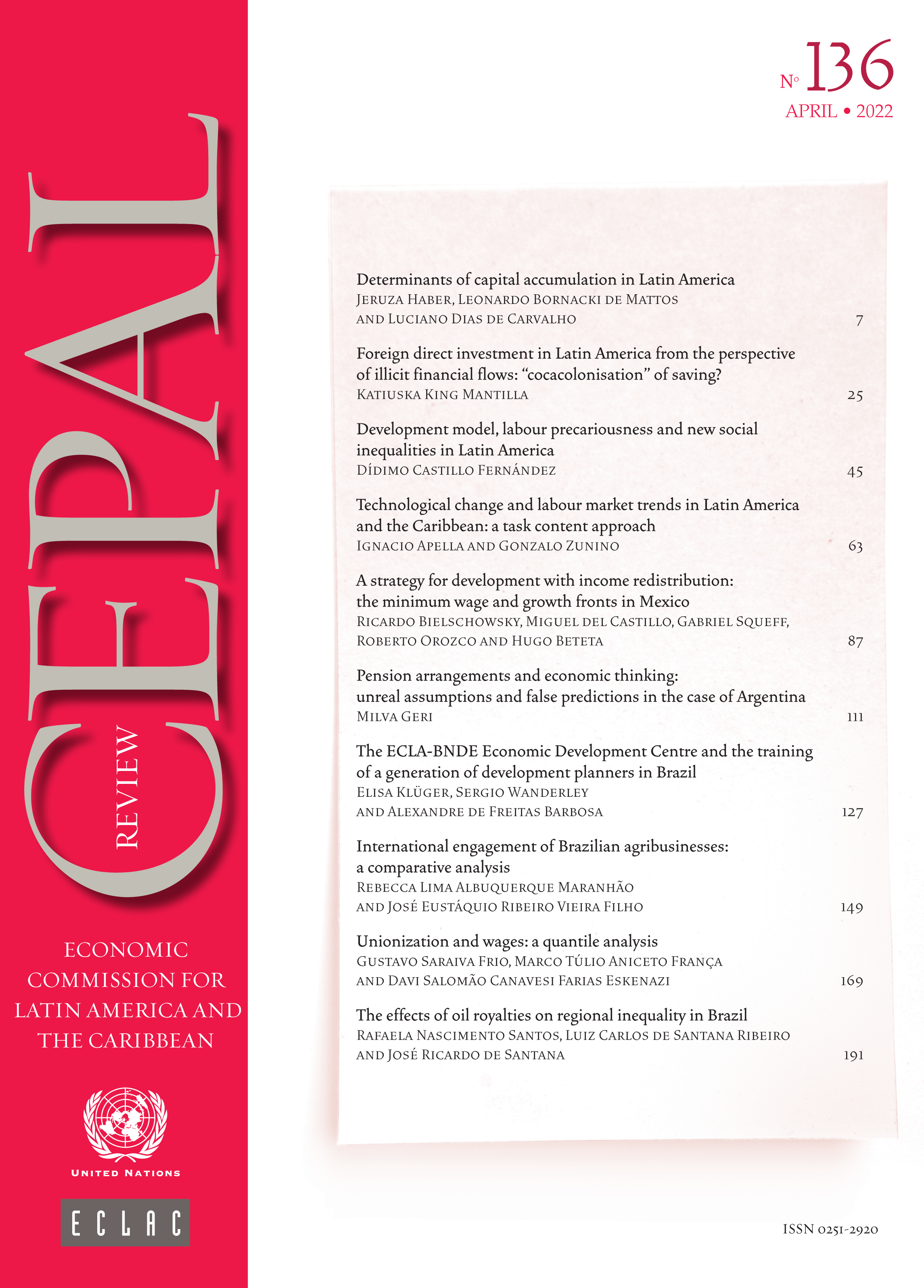
Volume 2022, Issue 136, 2022
-
-
Determinants of capital accumulation in Latin America
More LessAuthors: Jeruza Haber, Leonardo Bornacki de Mattos and Luciano Dias de CarvalhoThe theoretical model of Bhaduri and Marglin (1990) is one of the most discussed works regarding capital accumulation and functional income distribution. However, their analysis does not include the effects of an economy with government. The aim here is to identify the relationships between capital accumulation, the real exchange rate and the debt-to-GDP ratio, using a modified version of that model. The results of the theoretical model showed that an increase in the debt-to-GDP ratio contributes to a regime of conflict between capitalists and workers. The empirical results for a group of countries in Latin America are consistent with this. Undervaluation of the real exchange rate has a positive influence on capital accumulation. A higher debt-to-GDP ratio has a negative effect.
-
-
-
Foreign direct investment in Latin America from the perspective of illicit financial flows: “cocacolonisation” of saving?
More LessAuthor: Katiuska King MantillaThis article analyses the implications of illicit financial flows for foreign direct investment (FDI). During the 2003–2017 period, in the financing of gross fixed capital formation in Latin America, external savings show high variability in relation to domestic saving. This study calculates the net effects of FDI on the balance of payments by country, concluding that its contribution is not always positive. In fact, it is negative in countries with investments mainly in the primary or extractive sector. The volume of inward FDI is lower than recorded for all countries when considering pass-through or phantom investment, with signs of round-tripping in secrecy jurisdictions. This is of concern in countries that have traditionally kept their capital abroad. The concept of “cocacolonisation” of savings is therefore proposed.
-
-
-
Development model, labour precariousness and new social inequalities in Latin America
More LessAuthor: Dídimo Castillo FernándezThis article analyses the key characteristics of the two major economic models of the last century, and of the current one thus far, in Latin America. The first is centred on national development, with a relative welfare structure. The second presents the distinctive features of the current neoliberal model, in terms of the breakdown of the social pact between capital, the State and the working class, together with flexibilization and deregulation as modalities of labour management. As a hypothesis, some of these singularities are analysed in terms of the emergence of a new labour precariousness and new income inequalities and poverty. The study considers the differences between countries that adopted the neoliberal model and those that chose post-neoliberal forms of governance. In all of the dimensions and variables considered, it is found that conditions were worse in the countries that followed the neoliberal model most closely.
-
-
-
Technological change and labour market trends in Latin America and the Caribbean: a task content approach
More LessAuthors: Ignacio Apella and Gonzalo ZuninoThe aim of this paper is to analyse employment profile trends in the Latin American and Caribbean countries according to the task content of workers’ jobs. This analysis seeks to approximate the impact of technological change on the labour market. The paper uses the definitions of an indicator that captures the relative importance of four types of tasks, namely cognitive versus manual and routine versus non-routine tasks, based on information from the Occupational Information Network (O*NET) and household surveys. The analysis finds that there has been growing demand for workers over the last two decades in occupations which are intensive in cognitive abilities, with higher remuneration than for occupations which are intensive in manual tasks. Cognitive skills are therefore a key variable for improving participation in current and future labour markets.
-
-
-
A strategy for development with income redistribution: the minimum wage and growth fronts in Mexico
More LessAuthors: Ricardo Bielschowsky, Miguel del Castillo, Gabriel Squeff, Roberto Orozco and Hugo BetetaThe purpose of this study is to contribute to the discussion on the viability and potential impact of substantially increasing the pay of the lowest-income workers. To this end, a set of simulations are carried out using the input-output matrix to assess the impact on economic variables of increasing the minimum wage. The analysis yields very favourable indications for the viability of growth with income redistribution in Mexico, based essentially on the domestic mass consumption market. Stimulating growth in demand from the lowest-income households has a favourable impact on GDP and employment and only a relatively small effect on both inflation and imports, which grow by much less than they have with the model that has operated over recent decades.
-
-
-
Pension arrangements and economic thinking: unreal assumptions and false predictions in the case of Argentina
More LessAuthor: Milva GeriIn accordance with mainstream economic thinking, the World Bank advised Latin American countries to reform and fully or partially privatize their pension systems. Argentina was one of the countries to follow these recommendations, which it did without first checking whether the arguments were valid or whether the theoretical assumptions were fulfilled. On the basis of publicly available statistical information and a historical review of the Argentine pension system, we conclude that most of the arguments put forward by the World Bank were refutable at the time of the reform, which did not solve the problems it set out to address. For this reason, decision-makers should heed the economic history of each country before following the recommendations of international organizations.
-
-
-
The ECLA-BNDE Economic Development Centre and the training of a generation of development planners in Brazil
More LessAuthors: Elisa Klüger, Sergio Wanderley and Alexandre de Freitas BarbosaThis paper aims to reconstruct the history of the partnership between the Economic Commission for Latin America (ECLA) and Brazil’s National Bank for Economic Development (BNDE). The ECLA/BNDE Economic Development Centre, which operated in Rio de Janeiro between 1960 and 1967, held courses on Problems of Economic Development in several regions of the country, training a generation of development planning specialists who worked to overcome underdevelopment. The Centre also functioned as a gateway to ECLA ideas and writings in Brazil and as a locus of knowledge production in the area of economic development. It thus impacted both the governmental sphere and the academic world, providing an alternative to predominantly neoclassical economics courses. Drawing on a combination of documents, newspaper articles and the testimony of former members of the Centre, this article describes its activities and retraces the events leading to its creation, expansion and closure.
-
-
-
International engagement of Brazilian agribusinesses: a comparative analysis
More LessUrban population growth in developing countries, together with the expansion of the middle class and increase in per capita income worldwide, have increased the demand for food. This article uses the method of constant market share analysis (CMSA) to identify the drivers of agricultural export growth among the main countries operating in the market. Two periods are analysed: (i) 1992–2001 and (ii) 2002–2013. The countries studied were Argentina, Brazil, China, France, Germany, India and the United States. The results reveal the increasing representation of emerging countries with natural resource potential (Argentina, Brazil and India), while developed economies (the United States and European countries) and China (owing to its particular internal dynamics) are losing ground in the international market.
-
-
-
Unionization and wages: a quantile analysis
More LessThe aim of this article is to analyse the wage effects of unionization in a sample of the Brazilian population in 2015. Using data from the National Household Sample Survey (PNAD) and its supplement on labour relations and unionization, econometric techniques (ordinary least squares, propensity score matching and unconditional quantile regressions) are used to test the hypotheses that being unionized affects wages, and whether there is an additional benefit in the case of unions that participate more actively with their members. The results show that there is a positive relationship between unionization and average wages. It was also found that an increase in total unionization seems to reduce the pay of workers at the lower end of the distribution, but raise wages for the majority of the population. In addition, unions that participated in an agreement in the last 365 days generated average gains of 4.3%.
-
-
-
The effects of oil royalties on regional inequality in Brazil
More LessThis article evaluates the impact of oil royalties on Brazil’s production structure and their effects on regional inequality. An interregional input-output model was used, encompassing the 27 Brazilian states and 26 sectors, with base year 2008. The simulation strategy assumed 75% of these funds are channelled into education and 25% into the health sector, as mandated by Law 12.858/2013. To measure the effect of royalties on regional inequality, the Gini coefficient was calculated both ex-ante and ex-post with respect to the impact analysis. The main findings indicate that interregional and intersectoral spillovers are weak; but, in the Southeast and Northeast regions, the investment of royalties in education and health could help reduce intraregional inequality.
-
Volumes & issues
-
Volume 2025
-
Volume 2024
-
Volume 2023
-
Volume 2022
-
Volume 2021
-
Volume 2020
-
Volume 2019
-
Volume 2018
-
Volume 2017
-
Volume 2016
-
Volume 2015
-
Volume 2014
-
Volume 2013
-
Volume 2012
-
Volume 2011
-
Volume 2010
-
Volume 2009
-
Volume 2008
-
Volume 2007
-
Volume 2006
-
Volume 2005
-
Volume 2004
-
Volume 2003
-
Volume 2002
-
Volume 2001
-
Volume 2000
-
Volume 1999
-
Volume 1998
-
Volume 1997
-
Volume 1996
-
Volume 1995
-
Volume 1994
-
Volume 1993
-
Volume 1992
-
Volume 1991
-
Volume 1990
-
Volume 1989
-
Volume 1988
-
Volume 1987
-
Volume 1986
-
Volume 1985
-
Volume 1984
-
Volume 1983
-
Volume 1982
-
Volume 1981
-
Volume 1980
-
Volume 1979
-
Volume 1978
-
Volume 1977
-
Volume 1976
Most Read This Month
