


Asia-Pacific Development Journal - Volume 11, Issue 1, 2005
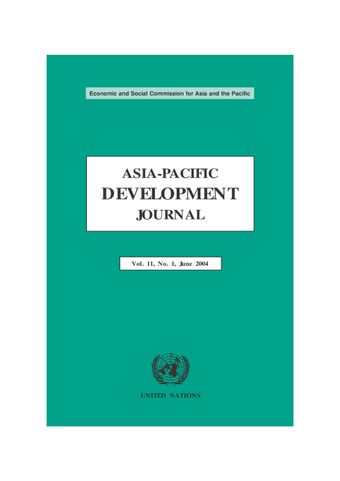
Volume 11, Issue 1, 2005
The primary emphasis of the Journal is the publication of empirically based, policy-oriented articles, which can engage the attention of policy makers, academicians and researchers. The articles analyze development issues and problems relevant to the Asia-Pacific region.
-
-
The political economy of trade liberalization
More LessAuthor: Linda LowThe paper advances the view that while free trade and trade liberalization under the multilateral framework is the first best policy on purely theoretical grounds, the theory of the second best in the form of regional, plurilateral and bilateral free trade arrangements is at work in the real world. The methodology of economics is an important discipline; however, dysfunctional and power-structured multilateralism, heterogeneous economic structures and diverse development paths and levels render a political economy approach based on strategic pragmatism more realistic. In addition, empirical results have demonstrated that regional, plurilateral and bilateral free trade agreements can offer benefits to complement and supplement multilateralism provided these arrangements are consistent with the rules of the World Trade Organisation.
-
-
-
The future of industrialization in Malaysia under WTO
More LessAuthor: Tham Siew YeanThe objectives of this paper are: (1) to review Malaysia’s commitments and compliance with the WTO agreements thus far, (2) to assess the impact of Malaysia’s commitments to WTO on its industrial development, and (3) to evaluate WTO-consistent policy options that will enable the country to advance its industrialization process. The findings of this paper show that Malaysia has pursued a dual industrialization strategy. While the export-oriented sector has been able to fulfil Malaysia’s commitments to WTO, this has not been the case for the import-substituting sector. Thus, Malaysia’s compliance with its WTO commitments is incomplete and the import-substituting sector will face considerable challenges in its future development.
-
-
-
Beyond the phaseout of quotas in the textile and clothing trade: WTO-plus rules and the case of US safeguards against Chinese exports in 2003
More LessAuthors: Huan Liu and Laixiang SunInternational trade in textiles and clothing has been subject to strong protectionism for decades. Although the WTO Agreement on Textiles and Clothing has set procedures to phase out the quota system, this paper questions how far the regime will actually be liberalized. It highlights the significant differences between the China-specific safeguard provisions in China’s WTO accession protocol and the general WTO Agreement on Safeguards. It also examines the recent case of a US safeguard application against China’s textile and clothing products and analyses the potential impact of this case on both countries and the global economy. The analysis suggests that prospects for China’s textile and clothing exports after WTO accession may not be as optimistic as is generally assumed.
-
-
-
Intellectual property rights and enterprise development: Some policy issues and options in ASEAN
More LessAuthor: Thitapha WattanapruttipaisanIntellectual property (IP) is a form of knowledge or intellectual activity embodied in various ways in the production and marketing of goods and services of an industrial, scientific, literary or artistic nature. At the micro level IP has been a significant source of growth and a major driver of competitive strategies virtually across the globe. This paper analyses the divergence between enterprise development and IP creation in the ASEAN region. The paper highlights the fact that most IP assets, particularly patents, are not formally registered in the ASEAN group of countries. This is due to the complexity and high transaction costs of registering IP assets. The paper indicates the strong need for more research into the nature and characteristics of technological progress at the enterprise level and how best to adapt formal IP registration systems so that enterprises can be encouraged to register their technological innovations and derive benefit from them.
-
-
-
A single currency for the Pacific island countries: A stepwise approach
More LessAuthor: T. K. JayaramanTwo agreements, the Pacific Agreement on Closer Economic Relations and the Pacific Island Countries Trade Agreement, which were signed in August 2001, are important milestones towards greater regional integration in the south Pacific. In addition to trade integration, the adoption of a single currency for 12 countries in Europe and similar efforts in the Eastern Caribbean Currency Union have kindled new interest in the subject. This paper seeks to examine, as a first step, the feasibility of a single currency for a compact group of the Melanesian island countries, which share many commonalities.
-
Most Read This Month
