


Asia-Pacific Development Journal - Volume 17, Issue 2, 2011
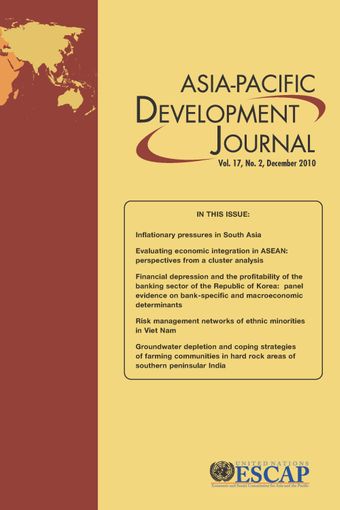
Volume 17, Issue 2, 2011
The Asia-Pacific Development Journal is published twice a year by the Economic and Social Commission for Asia and the Pacific. Its primary objective is to provide a medium for the exchange of knowledge,experience, ideas, information and data on all aspects of economic and social development in the Asian and Pacific region. The emphasis of the Journal is on the publication of empirically based, policy-oriented articles in the areas of poverty alleviation, emerging social issues and managing globalization.
Language:
English
-
-
Inflationary pressures in South Asia
More LessAuthor: Ashima GoyalThe similarities yet differences across South Asian countries, and their differential response to recent food and oil price shocks, provides a useful opportunity to better understand the structure of inflation in these economies. Analysis of the internal goods market and external balance of payments equilibrium and evidence on demand and supply shocks suggests that output is largely demand determined but inefficiencies on the supply side perpetuate inflation. Pro-cyclical policy amplifies the negative impact of supply shocks on output. Inflation surges are reduced at high output cost while propagation mechanisms and well-intentioned administrative interventions turn relative price shocks into chronic cost-push inflation. The analysis brings out the importance of food prices for the inflationary process. It is necessary to protect the poor from inflation and especially food inflation. But this must be done effectively. The paper concludes with an analysis of effective short- and long-run policy options.
-
-
-
Evaluating economic integration in ASEAN: perspectives from a cluster analysis
More LessAuthors: Maria Estela Varua, Arlene Garces-Ozanne and Rachel BenicThis paper uses hierarchical cluster analysis to examine the degree of economic integration among member countries of the Association of Southeast Asian Nations (ASEAN), and Japan, China and the Republic of Korea during three time periods: 1969-1984, 1985-1994 and 1995-2009. The results indicate that the five founding members of ASEAN, Indonesia, Malaysia, the Philippines, Singapore and Thailand, have become less integrated over time. Moreover, the region as a whole does not appear to have attained the degree of integration that was hoped for at the time the Association was established 30 years ago.
-
-
-
Financial depression and the profitability of the banking sector of the Republic of Korea: panel evidence on bank-specific and macroeconomic determinants
More LessAuthor: Fadzlan SufianThe paper provides new empirical evidence on factors that determine the profitability of the banking sector of the Republic of Korea. The empirical findings indicate that the banks of the Republic of Korea with high capitalization levels tend to have higher profitability levels. However, the impact of credit is consistently negative under both controlled and uncontrolled macroeconomic and financial conditions. Meanwhile, the effect of the business cycle towards the profitability of banks are mixed. On the one hand, inflation displays a pro-cyclical impact, while gross domestic product (GDP) has a counter-cyclical influence on the banks’ profitability. The findings also indicate that the industry concentration of the national banking system has a positive as well as a significant effect on the banks. The study is based on data from the period 1994-2008. This period is broken down into 4 sub-periods, the tranquil period before the Asian financial crisis (1994-1996), the Asian financial crisis (1997-1998), the tranquil period between the Asian financial crisis and recent global financial crisis (1999-2008) and recent global crisis (2008). The impacts of both the Asian financial crisis and the recent global financial crisis are negative, while the banks have been relatively more profitable during both the tranquil periods.
-
-
-
Risk managmement networks of ethnic minorities in Viet Nam
More LessAuthors: Isabel Fischer, Tina Beuchelt, Tom Dufhues and Gertrud BuchenriederThe utilization of informal social networks is an important risk management strategy of vulnerable households in South-East Asia. To gain insight on this issue, a social network analysis (SNA) was implemented to assess risk management networks of ethnic minority farm households in the northern uplands of Viet Nam. The results from the analysis suggest that kinship relations and the level of wealth play an essential role in enabling basic network services to function. This paper also points out that effective networks require investments to fulfil the requested mutual obligations and that subsequently, social networks among poor farmers are relatively limited. The findings of the analysis show, not surprisingly, that networks cannot completely buffer severe shocks. Consequently, policy measures to reduce the costs of investing in social capital of poor farmers as well as improved access to appropriate social security systems are essential. These findings are applicable to other upland areas of South-East Asia.
-
-
-
Groundwater depletion and coping strategies of farming communities in hard rock areas of southern peninsular India
More LessAuthors: K. H. Anantha and K. V. RajuThis study examines the impact and potential opportunities of groundwater irrigation on rural farm households. Focusing on the size and pattern of the groundwater economy in selected villages located in the hard rock areas of Karnataka, India, the paper argues that the groundwater economy is shrinking due to the depletion of this precious resource. Although investment in groundwater irrigation provides wealth-creating opportunities in addition to helping to meet consumption needs, more often than not, the ongoing need to drill for new wells to counteract severe depletion problems cuts into the investment returns and ultimately affects the pool of assets. Farmers have adopted several coping strategies to overcome the negative externalities of groundwater depletion in this region. Groundwater irrigation has the potential to be a more productive instrument for sustainable rural development in fragile eco-regions. But, in order to make investment in this area a viable option for rural livelihood enhancement, certain policy, institutional factors and other issues need to be addressed.
-
Most Read This Month
Article
content/journals/24119873
Journal
10
5
false
en
