


Asia-Pacific Development Journal - Volume 21, Issue 1, 2014
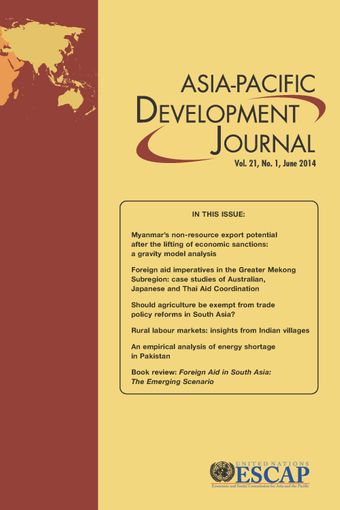
Volume 21, Issue 1, 2014
The Asia-Pacific Development Journal (APDJ) is published twice a year with the primary objective of providing a platform for the exchange of knowledge, experience, ideas, information and data on all aspects of economic and social development issues and concerns facing the region and aims to stimulate policy debate and assist policy formulation. The Asian development experience is an example of what can be achieved when policymakers, experts, scholars and people at large harness their creativity, knowledge and foresight. The APDJ has been a proud partner in this process, providing a scholarly means for bringing together research work by eminent social scientists and development practitioners from the region and beyond for use by a variety of stakeholders. Over the years, the Journal has emerged as a key United Nations publication in telling the Asian development story in a concise, coherent and impartial manner to stimulate policy debate and assist policy formulation in the region.
Language:
English
-
-
Myanmar's non-resource export potential after the lifting of economic sanctions: A gravity model analysis
More LessAuthor: Koji KuboThe easing of economic sanctions against Myanmar by Western countries in 2012 augmented the prospect that Myanmar would expand its exports. However, a sharp rise in natural resource exports during the time sanctions had been applied raises concern about the so-called Dutch disease. This study forecasts Myanmar’s export potential by calculating counterfactual export values using a gravity model that takes into account the effects of natural resource exports on non-resource exports. Without taking into consideration the effects of natural resource exports, the counterfactual predicted values of non-resource exports during the period 2004-2011 are more than five times larger than those of actual exports. If these effects are taken into account, however, the predicted values are lower than those of actual exports. The empirical results imply that Dutch disease is more of a risk in Myanmar than it is in any other South-East Asian country.
-
-
-
Foreign aid imperatives in the greater mekong subregion: Case studies of Australian, Japanese and thai aid coordination
More LessAuthor: Christopher SelvarajahAlthough Australia and Japan are among the largest aid donors in the Greater Mekong Subregion (GMS), there is limited academic research on their activities as donors and on their relationships with recipient countries in the region. In this study, the aid activities of Australia, Japan and Thailand (an aid recipient/donor) within the region are investigated, with a particular focus on aid coordination practices. The empirical results show that bilateral aid coordination and cooperation are highly elusive and have been further complicated by the emergence of new donor countries that are supportive of the South-South cooperative model rather than of the traditional North-South model.
-
-
-
Should agriculture be exempt from trade policy reforms in South Asia?
More LessAuthors: Sumudu Perera, Mahinda Siriwardana and Stuart MounterContracting parties to the Agreement on South Asian Free Trade Area (SAFTA) are committed to trade liberalization within a fixed time frame. Most contracting parties have kept agriculture out of their tariff liberalization commitments. A key question therefore is: should agriculture receive dispensation given the sector’s important contribution to South Asia’s economic structure? An enhanced multi-household framework within a multi-country computable general equilibrium (CGE) approach was used to assess the impacts on trade flows, government fiscal revenues and income distribution among households in countries that are contracting parties to SAFTA, assuming full trade liberalization and trade liberalization with the protection of the agricultural sector. The results indicate that, although both policies would facilitate economic growth and lead to a reduction in income disparity among household groups in all South Asian countries, the overall welfare gains would be greater under full trade liberalization. Hence, the removal of agricultural sector tariffs should be an important consideration in future SAFTA discussions; such a step would be a principal means for strengthening intraregional trade.
-
-
-
Rural labour markets: Insights from Indian villages
More LessAuthor: A. Amarender ReddyIn this paper, labour market behaviour in rural India is examined, with the objectives of assessing the structure of the work status among sample individuals and of testing segmented labour market theory. Simple regression techniques and an estimated modified Mincer equation to determine earnings are used in the paper, followed by the application of multinomial regression analysis. Labour markets are segmented based on social background to some extent, which is in line with segmented labour market theory based on caste, sex and assets. Most of the more highly educated remain unemployed due to a lack of sufficient employment opportunities, even though higher education increases the probability of being engaged in regular employment. However, households invest heavily in children’s education in the hope that they will obtain regular employment. Policies that promote asset ownership, household savings and skills development would increase people’s chances of obtaining regular employment with higher earnings.
-
-
-
An empirical analysis of energy shortage in Pakistan
More LessAuthors: Mubashir Qasim and Koji KotaniIn this paper, the electricity shortage in Pakistan is addressed through an examination of data over the period 1971-2010 with a time-series analysis. The novelty of the study lies in characterizing energy shortages using both an index comprising the demands for electricity, gas and oil, and information on the public electricity supply. This index allows for a simple empirical approach where energy shortages cannot be directly measured as data. The main findings are as follows: first, end consumers adjust their energy demands to prices only in the long run; second, the underutilization of installed power-generation capacity encourages fossil fuel consumption for private electricity; third, an uninterrupted electricity supply could be attained by regulating private electricity generation; and fourth, the relative demand for electricity increases with an increase in real income and then starts to decrease as income increases beyond the threshold of $1,127. Overall, the results of the study suggest that the price adjustment tactics adopted by the Government of Pakistan are not an effective policy to deal with power shortages in the short run. Rather, the Government should focus on improving the utilization rate of installed power plants and on rechannelling the use of oil and gas for public electricity generation. Otherwise, energy shortages will worsen with economic growth in Pakistan.
-
-
-
Foreign aid in South Asia: The emerging scenario
More LessAuthor: Sayed NasratThe publication Foreign Aid in South Asia: The Emerging Scenario is a collection of case studies examining the role that foreign aid (except military aid) has played in the economic and social development of eight countries in South Asia. The main objective of the book is to provide policies to be applied for better aid utilization in the future in that subregion. The book is superbly edited by one of the most renowned economists in South Asia, Saman Kelegama of Sri Lanka. According to Kelegama, South Asia has been receiving development aid (bilateral and multilateral) since the 1950s from various donors, particularly in the West, and through organizations such as the World Bank and the Asian Development Bank in the form of grants and loans, but the impact of the aid has not been assessed in order to determine what has worked and what has not. In the book, it is pointed out that most countries in South Asia view foreign aid as a long-term opportunity to cover their recurrent expenditures. Therefore, this book is a “must read” for policymakers, academic scholars, aid recipients and donors in the South Asian subregion. It is also an excellent asset for students who wish to know specifically about the political economy of foreign aid in the subregion.
-
-
-
Readership survey
More LessAuthor: United NationsThe Macroeconomic Policy and Development Division of ESCAP is undertaking an evaluation of the Asia-Pacific Development Journal, with a view to improving the usefulness of future publications to our readers. We would appreciate it if you could complete this questionnaire and return it, at your earliest convenience, to:
-
-
-
Asia-Pacific Development Journal instructions to contributors
More LessAuthor: United NationsPublished by the Macroeconomic Policy and Development Division of the United Nations Economic and Social Commission for Asia and the Pacific, the Asia-Pacific Development Journal provides a platform for the exchange of ideas and experiences on development issues and concerns facing the region, and aims to stimulate policy debate and assist in the formulation of policy. Policyoriented articles and original pieces of work, focusing on development issues and challenges relevant to the Asian and Pacific region, are welcomed in the Journal, which is published twice a year.
-
Most Read This Month
Article
content/journals/24119873
Journal
10
5
false
en
