


Asia-Pacific Development Journal - Volume 24, Issue 1, 2017
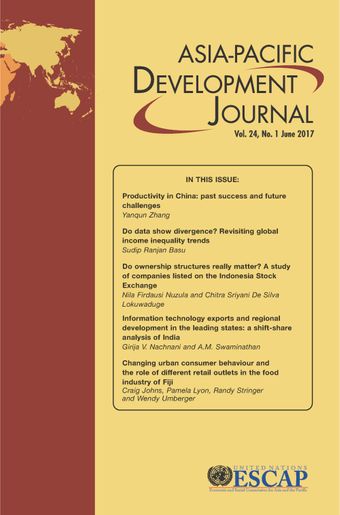
Volume 24, Issue 1, 2017
This journal’s objective is to provide a platform for the exchange of knowledge, experience, ideas, information and data on all aspects of economic and social development issues and concerns facing the region and aims to stimulate policy debate and assist in the formulation of policy. The development experience in the Asian and the Pacific region has stood out as an extraordinary example of what can be achieved when policymakers, experts, scholars and people at large harness their creativity, knowledge and foresight. The Journal provides a scholarly means for bringing together research work by eminent social scientists and development practitioners from the region and beyond for use by a variety of stakeholders. It aims to stimulate policy debate and assist in the formulation of policy in the region.
-
-
Productivity in China: Past success and future challenges
More LessAuthor: Yanqun ZhangThe present paper discusses total factor productivity (TFP) in China, including its past success, the current slowdown, and the potential for future growth. It begins by documenting the development of TFP growth over the past three and a half decades, its driving forces and its contribution to the economic growth of the country. It then analyses the reasons for the current slowdown of TFP and economic growth, addresses the institutional imperfections that hinder growth, and explains the government policies and strategies aimed at fostering TFP. Next, it explores the potential for TFP growth from the perspective of institutional reform, investment in research and development and human capital. The paper concludes that although the resources of the past successful TFP have decreased or diminished, further institutional reform, increasing investment in research and development and human capital, and strategies promoting indigenous innovation will become new engines for future TFP growth in China. As the country’s TFP is still at a low level compared with advanced economies, there is large scope for China to maintain relatively high TFP growth, although uncertainty and risk are associated with this process.
-
-
-
Do data show divergence? Revisiting global income inequality trends
More LessAuthor: Sudip Ranjan BasuThe present paper shows the results of an empirical study to prove that income inequality has increased over the past decades. To conduct the study, an income inequality dataset containing 133 countries over the 1990-2014 period was created. The results indicate that globally, income inequality (population-weighted Gini coefficients), on average, increased from 38.6 to 41.8 during that period. They further show the existence of variations in the level of income inequality across regions and groups of countries. The reduction in income inequality, among others, remains one of the key challenges associated with the 2030 Agenda for Sustainable Development. Therefore, in this paper, various transmission mechanisms and drivers of the increasing level of income inequality are identified and possible forward-looking development policies to reduce income inequality are given.
-
-
-
Do ownership structures really matter? A study of companies listed on the Indonesia stock exchange
More LessAuthors: Nila Firdausi Nuzula and Chitra Sriyani De Silva LokuwadugeExamining the ownership structure of Indonesian corporations and its contribution towards developing appropriate corporate governance is an interesting endeavour, as the country is putting a lot of effort in improving trusts and attracting more foreign investors. A concentrated ownership structure is a common feature in the Asia-Pacific region. For the present paper, an analysis was conducted centred on ownership structures and their impact on governance and firm value in Indonesia. Measurements for ownership structure were based on the percentages of institutional and managerial ownership, while independent commissioners, board of directors and audit committees were used to measure corporate governance and Tobin’s Q was used to measure firm value. The results of the study, which is based on secondary data gathered from all the companies listed on the Indonesia Stock Exchange from 2009 to 2016, reveals that ownership structure affects two measures used for corporate governance and firm value. As expected, ownership structure shows a statistically significant relationship with corporate governance.
-
-
-
Information technology exports and regional development in the leading states: A shift-share analysis of India
More LessAuthors: Girija V. Nachnani and A.M. SwaminathanIndia has adopted a balanced growth strategy driven by its large internal market, which entails making a major commitment to the endogenous development model. Previously, the country’s development plans were built around the supply-side and import substitution approach. In the early 1980s, the economy of India experienced structural changes, as the gross domestic product growth rate steadily increased, and then in the early 1990s, the country leapfrogged into a development policy centred on information technology, which led to the development of a globally competitive information technology (IT) sector. IT has helped states in India to develop through intersectoral linkages with several services and the multiplier effect. This makes it interesting to review the impact of growth of IT on development in states where IT development is prominent. As states have not been equal beneficiaries, a shift-share analysis was carried out to arrive at these imbalances for the period 2004/05-2008/09 and 2009/10-2013/14. The results of a shift in the share show that regional variations in software exports can largely be attributed to a regional component. In addition, the results of ordinary least squares estimation point out that existing infrastructure is overstressed, namely that there is excessive pressure on teledensity, a shortage of power and a large population, which is making it difficult for regions to sustain a high level of specialization.
-
-
-
Changing urban consumer behaviour and the role of different retail outlets in the food industry of Fiji
More LessAuthors: Craig Johns, Pamela Lyon, Randy Stringer and Wendy UmbergerThe food industry is undergoing transformation globally. The set of circumstances specific to Fiji provides important insights into the drivers of this change, which have implications for private, government and donor agency stakeholders. A novel study of 1,000 urban households in Fiji found that among those surveyed, modern supermarkets have overtaken traditional markets as the dominant food retail outlet and now have 100 per cent patronage and take in 54 per cent of total household food expenditures. However, the battle for the fresh fruit and vegetable category appears to be in its infancy, with 97 per cent of households still shopping for products in this category at the traditional main market. Although foreign investment is a key driver of the retail food sector transformation in more rapidly growing developing countries, in Fiji, where foreign investment is relatively low, this transformation appears to be predominantly supported by rising urban income and changing consumer preferences. Consequently, policy attention should be directed towards market channels that can take advantage of changing consumer preferences, while still supporting local farmers.
-
Most Read This Month
