


Africa Renewal - Volume 28, Issue 2, 2014
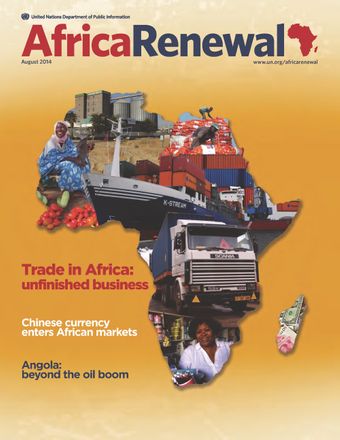
Volume 28, Issue 2, 2014
The Africa Renewal magazine examines the many issues that confront the people of Africa, its leaders and its international partners: sustainable development goals, economic reform, debt, education, health, women's empowerment, conflict and civil strife, democratization, investment, trade, regional integration and many other topics. It tracks policy debates. It provides expert analysis and on-the-spot reporting to show how those policies affect people on the ground. And, it highlights the views of policy-makers, non-governmental leaders and others actively involved in efforts to transform Africa and improve its prospects in the world today. The magazine also reports on and examines the many different aspects of the United Nations’ involvement in Africa, especially within the framework of the New Partnership for Africa’s Development (NEPAD).
-
-
Trade between two unequal partners
More LessAuthor: Kingsley IghoborSixty-one heads of government and other top-level officials from African and European countries converged last March in Brussels, the de facto European Union capital, to discuss mutual relations. After two days of deliberations, they issued a 63-point agreement laced with customary platitudes such as “We take particular pride in the breadth and depth of our partnership” and “We are convinced that the growth of our two continents will be mutually beneficial.”
-
-
-
Intra-Africa trade: Going beyond political commitments
More LessAuthor: Masimba TafirenyikaAmong Africa’s policy wonks, underperforming trade across the continent is a favoured subject. To unravel the puzzle, they reel off facts and figures at conferences and workshops, pinpoint trade hurdles to overcome and point to the vast opportunities that lie ahead if only African countries could integrate their economies. It’s an interesting debate but with little to show for it until now.
-
-
-
Africa needs borth aid and trade - Interview: Arancha González, Executive Director, International Trade Centre
More LessAuthor: Arancha GonzálezThe International Trade Centre (ITC), a subsidiary of the United Nations Conference on Trade and Development (UNCTAD) and the World Trade Organization (WTO), provides technical assistance on global trade to businesses in developing countries. Arancha González, the ITC’s executive director, sat down with Africa Renewal’s Nirit Ben-Ari and Kingsley Ighobor to talk about the centre’s activities and Africa’s growing influence in the global marketplace. These are excerpts from the interview.
-
-
-
Raw deal for African women traders
More LessAuthor: Nirit Ben-AriDaily, millions of women in Africa are engaged in one form of trade or another, either within their countries or across national borders. They buy and sell everything, from agricultural produce to manufactured products. It is mostly women who conduct cross-border trade, delivering goods and services, reports the World Bank. They also run the majority of agricultural small landholdings. Indeed, women traders’ contribution to national economies has become essential in boosting trade in Africa.
-
-
-
Africa’s trade under a changing climate
More LessAuthors: Richard Munang and Jesica AndrewsThe devastating effects of climate change are already being felt across the planet, including in Africa. The 2011 drought-induced famine in the Horn of Africa affected more than 10 million people, claimed 257,000 lives and cost over $1 billion in damages. The recent Africa Adaptation Gap Report by the UN Environment Programme warns that climate change could reduce total crop yields in sub-Saharan Africa by as much as 20% by 2070. Worse still, it could begin to affect Africa’s trade potential. For example, a projected sea-level rise in Tanzania of 70 centimetres by 2070 could devastate the port city of Dar es Salaam, its largest and richest city and a major player in East Africa trade, and cost the country about $10 billion in property damages and related losses. Environmentalists warn that rising sea levels could cause severe flooding, submerge land and destroy coastal ecosystems.
-
-
-
Africa wants equal partners - Interview: Maged Abdelaziz, UN Special Adviser of the UN Secretary-General on Africa
More LessAuthor: Maged AbdelazizIn 2012 the United Nations General Assembly created a mechanism to monitor commitments made by African countries and their partners to improve Africa’s economic development. The Office of the Special Adviser on Africa (OSAA) is the secretariat for the mechanism, and works with other UN agencies to track progress on these commitments. In an interview with Africa Renewal’s Kingsley Ighobor, Maged Abdelaziz, the secretary-general’s special adviser on Africa, explained what the UN hopes to accomplish with the monitoring mechanism. The following are excerpts.
-
-
-
Chinese Yuan penetrates African markets
More LessAuthor: Tonderayi MukeredziIn March this year Zimbabwe joined a growing list of countries in Africa and the world using the Chinese currency, yuan, also known as remnibi (RMB), as one of its official currencies after its central bank added the RMB, the Japanese yen, the Australia dollar and the Indian rupee to the existing basket of currencies.
-
-
-
Peace in South Sudan critical to regional stability
More LessAuthor: Raphael ObonyoDespite two ceasefires, thousands of lives lost and over a million and a half civilians displaced, fighting continues in South Sudan, pitting government troops against opposition forces. The latest ceasefire — the second since violence erupted in December last year — was signed in May between President Salva Kiir and his former deputy, Riek Machar.
-
-
-
Political stability remains a challenge - Interview: Babacar Gaye, Special Representative of the Secretary-General in the Central African Republic and Head of the UN Multinational Integrated Stabilization Mission in the Central African Republic (MINUSCA)
More LessAuthor: Babacar GayeIn April 2014, the United Nations Security Council authorized the establishment of the UN Multidimensional Integrated Stabilization Mission in the Central African Republic (MINUSCA). The mission, led by Babacar Gaye, the special representative of the UN secretary-general in the country, is mandated to protect civilians and support peace efforts. Damian Cardona, a UN staffer, recently sat down with Mr. Gaye, a Senegalese national, in the capital Bangui for an interview for Africa Renewal. Following are the excerpts:
-
-
-
Angola: Inequality clouds growing economy
More LessAuthor: Nirit Ben-AriAngola has one of the world’s fastest growing economies. Its economy grew by 5.1% in 2013. As major public infrastructure investments in energy and transport kick in, its growth is projected to reach 7.9% in 2014 and 8.8% in 2015. Yet, the United Nations Development Programme (UNDP) reports that around 36% of Angolans live below the poverty line and one in every four persons is unemployed.
-
-
-
Biofortification offers hope for Africa’s malnourished
More LessAuthor: Busani BafanaMany people who live in Lira district in northern Uganda consider Perpetua Okao a farmer and a life saver—and it is easy to know why. Her neighbour’s son was malnourished and often sickly. But after feeding him a diet of vitamin A-rich orange-fleshed sweet potatoes, the boy’s health improved dramatically in just a few days. Ms. Okao is among some 126,000 Ugandan farmers growing the orange-fleshed sweet potato, a new variety of potatoes enriched with vitamin A through biofortification.
-
-
-
Africa's economy set for dramatic changes - Interview: Carlos Lopes, Executive Secretary of the UN Economic Commission for Africa
More LessAuthor: Carlos LopesFollowing the launch of the 2014 Economic Report on Africa in Abuja, Nigeria, Carlos Lopes, the executive secretary of the Economic Commission for Africa, attended the New York launch of the same report. The report addresses two essential questions: what are the right policies for industrialization and what role can the private and public sectors play? In an exclusive interview with Africa Renewal’s Kingsley Ighobor, Mr. Lopes explored these issues. These are excerpts from the interview.
-
-
-
Africa to push development agenda at upcoming climate summit
More LessAuthor: Dan ShepardThere is no country in the world that has been unaffected by climate change, and no continent in the world has been more affected than Africa – and that state of affairs appears unlikely to change anytime soon.
-
-
-
Africa wired
More LessAuthor: Ying M. Zhao-HiemannUshahidi, a not-for-profit technology company based in Kenya, has invented a cloud-managed, portable Wi-Fi router that consists of a mobile modem, which can also be used as a backup power generator for the Internet during electricity blackouts or in situations of limited network coverage. Called BRCK (pronounced as “brick”), experts are already recognizing it as an ingenious solution to Africa’s intractable power problems.
-
Most Read This Month
Article
content/journals/25179829
Journal
10
5
false
en
