


CEPAL Review - Volume 2010, Issue 101, 2010
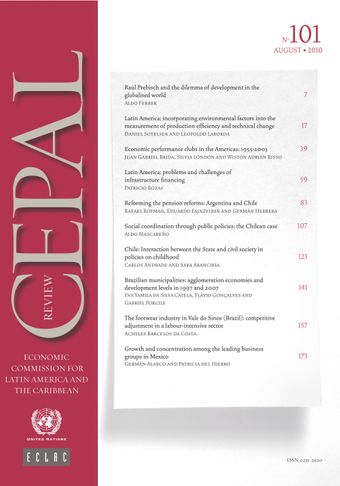
Volume 2010, Issue 101, 2010
Cepal Review is the leading journal for the study of economic and social development issues in Latin America and the Caribbean. Edited by the Economic Commission for Latin America, each issue focuses on economic trends, industrialization, income distribution, technological development and monetary systems, as well as the implementation of reforms and transfer of technology. Written in English and Spanish (Revista De La Cepal), each tri-annual issue brings you approximately 12 studies and essays undertaken by authoritative experts or gathered from conference proceedings.
-
-
Raúl Prebisch and the dilemma of development in the globalised world
Больше МеньшеАвтор: Aldo FerrerGlobalization poses both challenges and opportunities. Prebisch confronted this development dilemma in the global world and left three messages which form the great legacy of his work. Firstly, central countries form visions of the world order that serve their own interests; and peripheral countries need to rebel against this theoretical framework to resolve the dilemma. Secondly, it is possible to transform reality and achieve a symmetrical non-subordinate relationship with the world’s power centres. Thirdly, the transformation requires a fundamental change in productive structures to incorporate knowledge into economic and social activity, since this is the fundamental instrument of development. These messages remain fully current to this day.
-
-
-
Latin America: Incorporating environmental factors into the measurement of production efficiency and technical change
Больше МеньшеАвторы): Daniel Sotelsek and Leopoldo LabordaThis paper examines growth in a set of Latin American countries from 1980 to 2004 by analysing total factor productivity (tfp) from a twofold perspective: maximization of output (gdp) and minimization of the co2 emissions generated in the production process. Malmquist productivity indices are constructed for this purpose. In addition, kernel density functions are employed to analyse convergence (or divergence) in the efficiency estimated. The results obtained indicate that incorporating environmental factors into the measurement of efficiency and productive change significantly improves the estimates for certain countries in the region by comparison with those obtained by more traditional methods.
-
-
-
Economic performance clubs in the Americas: 1955-2003
Больше МеньшеАвторы): Juan Gabriel Brida, Silvia London and Wiston Adrián RissoThe aim of this paper is to study the economic dynamics of a set of countries of the Americas during the 1955-2003 period. It does this by introducing an alternative concept of economic performance based on the idea of dynamic regimes. These regimes are defined by the level and growth rate of per capita gross domestic product (gdp). By introducing a non-parametric clustering method, the study identifies two main performance clubs whose evolution is studied. One of them, identified as the club of high-performing countries, displays a relatively homogeneous structure. The second group, conversely, presents a high level of dispersion in performances, suggesting the existence of subclusters with a degree of divergence between them. The study also finds that there is mobility between the low- and high-performing groups and that the distance between clusters increases over time.
-
-
-
Latin America: Problems and challenges of infrastructure financing
Больше МеньшеАвтор: Patricio RozasThis article seeks to quantify basic infrastructure trends in the region, and assess the extent to which they have fallen behind those in Southeast Asian countries, which were clearly less developed than their Latin American counterparts in the late 1970s. The specific aim is to identify the main general characteristics of basic infrastructure development in Latin America, highlighting the problems faced by the investment process, with a view to identifying the main consequences of those problems and thus specify the challenges facing the region’s countries.
-
-
-
Reforming the pension reforms: Argentina and Chile
Больше МеньшеАвторы): Rafael Rofman, Eduardo Fajnzylber and Germán HerreraThis article describes the most recent pension reforms in Argentina and Chile. The previous reforms, implemented in the 1980s and 1990s, aimed to improve long-term fiscal sustainability and institutional design of the systems, shifting part of the social and economic risks away from the State and on to participants. In recent years, the authorities in both countries identified the main problems facing current pension systems as inadequate coverage for older adults and the low level of benefits. The two countries have responded differently, however, owing to institutional and political divergences. In Chile, a lengthy participatory process resulted in a wide-ranging reform targeting medium-term effects through carefully calibrated adjustments. In contrast, the reforms in Argentina were made through a succession of corrections, with little public discussion of their implications or effects on coverage and fiscal needs.
-
-
-
Social coordination through public policies: The Chilean case
Больше МеньшеАвтор: Aldo MascareñoSocial complexity involves inter-relationships between various actors and systems that enjoy considerable autonomy to define their own interests and operating procedures. This provides a backdrop for the development of models of social coordination that combine autonomous actors and systems pursuing coherent objectives. Drawing on examples from Chile, this article reviews: (i) policy-network models (public works concession system); (ii) deliberation systems (presidential advisory commissions); and (iii) reflexive law systems (international trade arbitration). It is found that the high level of reflexiveness of these models makes it possible, albeit with limitations, to combine principles of autonomy and coherence in the implementation of public policies.
-
-
-
Chile: Interaction between the State and civil society in policies on childhood
Больше МеньшеАвторы): Carlos Andrade and Sara ArancibiaThis article discusses the public-private links that exist in Chile to collaborate on childhood policies. It analyses the role played by the two sectors and the dimensions and components that are needed to ensure that their collaboration puts the best interests of the child at the forefront. It considers expert opinion through an analysis of content, which makes it possible to identify the relevant dimensions and components of the interaction, which are then prioritized quantitatively using the analytical hierarchical process (ahp) methodology to ensure a positive effect on childhood. The article shows that this interaction is top-down, with the State defining policies and civil society implementing them, which mainly reflects the fact that the public domain manages resources that are largely sustained by the private sector. The conclusion is that there is a challenge in generating horizontal dialogues, in which interaction is not constrained by economic resources but by shared purpose with regard to children.
-
-
-
Brazilian municipalities: Agglomeration economies and development levels in 1997 and 2007
Больше МеньшеАвторы): Eva Yamila da Silva Catela, Flávio Gonçalves and Gabriel PorcileThis article sets out to analyse the relation between agglomeration economies —both the Marshall-Arrow-Romer type (economies of specialization) and the Jacobs-Porter type (economies of diversification)— and the unequal development of Brazilian municipalities as estimated by labour productivity (measured by the average wage). To that end, measures of specialization were constructed for 1997 and 2007, and the data were used to test the relation between the industrial specialization and diversification indices and productivity, using finite-mixture regressions to capture the heterogeneity of the data. The results confirm the duality existing between the north-northeast and south-southeast-centre-west regions of Brazil, which has been widely documented in other research. Nonetheless, this duality needs to be analysed further, because some cities do not reflect the general dynamic of their region.
-
-
-
The footwear industry in Vale do Sinos (Brazil): Competitive adjustment in a labour-intensive sector
Больше МеньшеАвтор: Achyles Barcelos da CostaThis article analyses the production relocation strategies deployed by firms in the Vale do Sinos footwear cluster in Rio Grande do Sul, in response to competitive pressures from other parts of the world, mainly Asia. The hypothesis proposed here is that, as the sector competes mainly in terms of product price, the factors that most directly influence that variable —such as wages, the exchange rate and tax and financial incentives— have affected the industry’s spatial distribution. The study’s main conclusions are that, since 1990, footwear production has been migrating to other parts of Brazil and firms have been seeking other sources of competitiveness.
-
-
-
Growth and concentration among the leading business groups in Mexico
Больше МеньшеАвторы): Germán Alarco Tosoni and Patricia del HierroThis article discusses various hypotheses relating to the origin and operation of business groups in Mexico, and it proposes a model to explain the sources of their total asset growth. It highlights their growing contribution to Mexican gdp, but notes that their shares of employment and profits are smaller. Over time, sales and assets have clearly tended to become more concentrated in the largest groups. The paper concludes that the main financing sources for asset growth between 2005 and 2007 were firstly debt and secondly capital contributions from shareholders. It also finds that the leading groups invest discretely over time and tend to “overinvest” to block the entry of other competitors.
-
Volumes & issues
-
Volume 2025
-
Volume 2024
-
Volume 2023
-
Volume 2022
-
Volume 2021
-
Volume 2020
-
Volume 2019
-
Volume 2018
-
Volume 2017
-
Volume 2016
-
Volume 2015
-
Volume 2014
-
Volume 2013
-
Volume 2012
-
Volume 2011
-
Volume 2010
-
Volume 2009
-
Volume 2008
-
Volume 2007
-
Volume 2006
-
Volume 2005
-
Volume 2004
-
Volume 2003
-
Volume 2002
-
Volume 2001
-
Volume 2000
-
Volume 1999
-
Volume 1998
-
Volume 1997
-
Volume 1996
-
Volume 1995
-
Volume 1994
-
Volume 1993
-
Volume 1992
-
Volume 1991
-
Volume 1990
-
Volume 1989
-
Volume 1988
-
Volume 1987
-
Volume 1986
-
Volume 1985
-
Volume 1984
-
Volume 1983
-
Volume 1982
-
Volume 1981
-
Volume 1980
-
Volume 1979
-
Volume 1978
-
Volume 1977
-
Volume 1976
Most Read This Month
