


CEPAL Review - Volume 2012, Issue 107, 2012
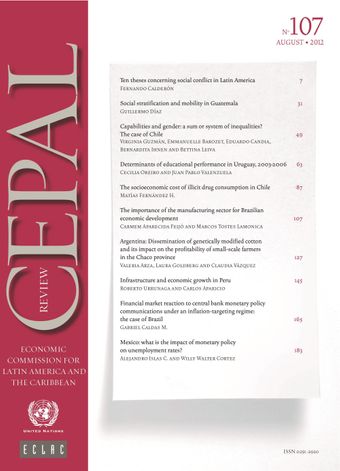
Volume 2012, Issue 107, 2012
Cepal Review is the leading journal for the study of economic and social development issues in Latin America and the Caribbean. Edited by the Economic Commission for Latin America, each issue focuses on economic trends, industrialization, income distribution, technological development and monetary systems, as well as the implementation of reforms and transfer of technology. Written in English and Spanish (Revista De La Cepal), each tri-annual issue brings you approximately 12 studies and essays undertaken by authoritative experts or gathered from conference proceedings.
-
-
Ten theses concerning social conflict in Latin America
更多 更少Conflict in the countries of Latin America presents common features: platforms of exclusion and chronic inequalities that are under challenge from citizens; complex struggles relating these inequalities with their number and intensity; a combination of social protests that are manifested both at the national level and at the general cultural level; practical rationalities in the tensions arising from social reproduction that coexist with demands for greater institutional efficiency and effectiveness and with systemic cultural conflicts. Other common factors are States that are omnipresent in all spheres of conflict but have only a limited ability to process them, and societies with fragmented conflicts; new public spaces where tensions are represented in a contradictory way, and conflicts that have been moving on to information and communication networks, with multiplier effects in the new environments where power is increasingly exercised. There is increased social complexity related to political systems and States with limited management capabilities. The situations and scenarios in prospect are diverse and options remain open.
-
-
-
Social stratification and mobility in Guatemala
更多 更少作者: United NationsThis article deals with two vital components of a country’s social structure: social stratification and social mobility. It examines the social structure of Guatemala, adapting for this purpose two approaches to social class that are often used in studies dealing with the issue. The aim is to delineate the Guatemalan social pyramid, showing not so much classes as rough strata based on employment data. Statistical analysis of data from a living conditions survey is used to provide information about social mobility with a view to illustrating educational and occupational mobility in the country. The results indicate a pyramid-shaped social structure and low educational and occupational mobility when children are compared with their parents. They also show that mobility opportunities differ between the sexes and between ethnic groups.
-
-
-
Capabilities and gender: A sum or system of inequalities? The case of Chile
更多 更少Setting out from the broad capability approach put forward by Amartya Sen and working with data from the 2009 National Social Stratification Survey (enes), this article explores the influence of sex on differences in the personal capabilities deemed important for attaining outcomes that determine people’s levels of well-being or deprivation. In terms of capabilities, it investigates individuals’ ability to exercise material, cultural, social and political control over their lives and surroundings, distinguishing between the situation of men and women. Following the construction of individual capability measures, the hypothesis of female disadvantage was tested by the adjustment of multivariate models incorporating relevant controls. The findings suggest that there are non-negligible differences in capabilities between women and men in Chile.
-
-
-
Determinants of educational performance in Uruguay, 2003-2006
更多 更少作者: Cecilia Oreiro and Juan Pablo ValenzuelaStudents’ performance at the lower secondary level in Uruguay is examined on the basis of the mathematics scores compiled by the Programme for International Student Assessment (pisa) for 2003 and 2006. An effort is made to analyse the differences in score distributions, to identify the variables influencing students’ performance and to trace the trends over that period and weigh their significance. In order to do so, a production function for educational achievement is defined and a number of different decomposition methodologies are applied. The findings indicate that the small increase in scores between 2003 and 2006 is the net result of differing changes, most of which are primarily the result of an across-the-board increase in the school system’s efficiency, especially in the case of public schools. However, this improvement is partially offset by reduced resource endowments and, in particular, unfavourable socioeconomic and cultural conditions in many of the students’ households. Most of the changes that are analysed in this study are found to be of a redistributive nature.
-
-
-
The socioeconomic cost of illicit drug consumption in Chile
更多 更少This article estimates the magnitude of monetary resources which Chile loses or forgoes owing to the trafficking and consumption of illicit drugs. On the basis of a “cost-of-illness” methodology, it is estimated that in 2006 drug consumption in Chile represented an economic burden of 266.744 billion pesos —or US$ 503 million in current prices that year— equivalent to 0.45% of gross domestic product (gdp) and a per capita cost of 16,232 Chilean pesos or US$ 31. The bulk of this sum is related to law enforcement for drug crime or other related offences (47%) and productivity losses reflected in the burden of disability-adjusted life years (46%).
-
-
-
The importance of the manufacturing sector for Brazilian economic development
更多 更少This article, based on Kaldor’s model of the stages of development, concludes that, despite having modernized thanks to the economic liberalization process, the evolution of Brazil’s industrial structure has increased the share of low-technology goods in the production matrix. The trend appreciation of the real in the initial phase of economic liberalization was positive for modernizing Brazil’s technology stock; but its continuation in recent years, when there has been ample international liquidity for emerging countries, threatens the development of the national manufacturing sector. This sector could suffer a technological setback, which, according to the principle of circular cumulative causation, diminishes its capacity to forge links with other sectors of activity, and accentuates the economy’s long-term external dependency.
-
-
-
Argentina: Dissemination of genetically modified cotton and its impact on the profitability of small-scale farmers in the Chaco province
更多 更少作者: Valeria Arza, Laura Goldberg and Claudia VázquezThis article analyses the adoption of genetically modified cotton by small-scale farmers in the Chaco region of Argentina. It uses the socio-technical configuration of the technology as a conceptual framework, which postulates the existence of a set of factors that significantly affect the way in which technologies operate. Based on this framework, the article describes the conditions under which small-scale farmers in the Chaco region adopt gm cotton; and it identifies the differences between them and large-scale farmers, on which most of the literature focuses. Qualitative methodologies are used to analyse the breaks and continuities in productive practices affecting the profitability of small-scale farmers since the introduction of gm cotton. It is found that the productive difficulties they face have remained essentially unchanged, and, in some cases, have become more accentuated.
-
-
-
Infrastructure and economic growth in Peru
更多 更少作者: Roberto Urrunaga and Carlos AparicioThis article reviews the literature analysing the importance of infrastructure for economic growth, and performs an econometric estimation to discover the relation between the two variables in the case of Peru. Different estimators are used with panel data from the 24 regions of Peru for the period 1980-2009. The econometric results confirm that public-service infrastructures (roads, electricity and telecommunications) are important in explaining temporary differences in regional output, in keeping with neoclassical exogenous growth theories. Evidence is also found of significant differences in the repercussions of the different infrastructures on per capita gdp in each region. Consequently, the policy authorities should streamline the development of projects that help to reduce the infrastructure disparities that hinder the development of Peru’s regions.
-
-
-
Financial market reaction to central bank monetary policy communications under an inflation-targeting regime: the case of Brazil
更多 更少Central bank communications are important for guiding expectations. For emerging countries, however, research on this issue is scarce. Because Brazil represents an important emerging country under inflation targeting, this paper studies the influence of monetary policy and central bank communications on the term structure of interest rates in Brazil. The study uses ordinary least squares (ols), generalized method of moments (gmm) and vector autoregresion (var) to examine the direction taken by interest rates when affected by central bank communications and monetary policy. The study finds evidence that because economic agents analyse the minutes of the Monetary Policy Committee meetings, monetary policy and central bank communications significantly influence the process of expectations formation for interest rates with different maturities in Brazil.
-
-
-
Mexico: What is the impact of monetary policy on unemployment rates?
更多 更少In this paper we analyse the effects of a monetary policy shock on Mexican unemployment rates. Unlike previous studies, this one re-estimates unemployment to produce alternative rates comparable to those of the Organization for Economic Cooperation and Development (oecd) member countries. We find that in response to tightening monetary policy, unemployment increases with a characteristic hump-shaped pattern also found in other studies. Our results are robust to different assumptions about the nature of Mexico’s labour market.
-
Volumes & issues
-
Volume 2025
-
Volume 2024
-
Volume 2023
-
Volume 2022
-
Volume 2021
-
Volume 2020
-
Volume 2019
-
Volume 2018
-
Volume 2017
-
Volume 2016
-
Volume 2015
-
Volume 2014
-
Volume 2013
-
Volume 2012
-
Volume 2011
-
Volume 2010
-
Volume 2009
-
Volume 2008
-
Volume 2007
-
Volume 2006
-
Volume 2005
-
Volume 2004
-
Volume 2003
-
Volume 2002
-
Volume 2001
-
Volume 2000
-
Volume 1999
-
Volume 1998
-
Volume 1997
-
Volume 1996
-
Volume 1995
-
Volume 1994
-
Volume 1993
-
Volume 1992
-
Volume 1991
-
Volume 1990
-
Volume 1989
-
Volume 1988
-
Volume 1987
-
Volume 1986
-
Volume 1985
-
Volume 1984
-
Volume 1983
-
Volume 1982
-
Volume 1981
-
Volume 1980
-
Volume 1979
-
Volume 1978
-
Volume 1977
-
Volume 1976
Most Read This Month
