


CEPAL Review - Volume 2012, Issue 108, 2012
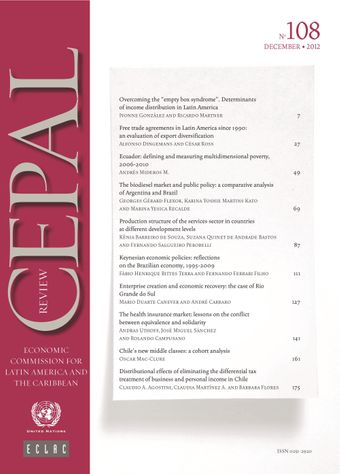
Volume 2012, Issue 108, 2012
Cepal Review is the leading journal for the study of economic and social development issues in Latin America and the Caribbean. Edited by the Economic Commission for Latin America, each issue focuses on economic trends, industrialization, income distribution, technological development and monetary systems, as well as the implementation of reforms and transfer of technology. Written in English and Spanish (Revista De La Cepal), each tri-annual issue brings you approximately 12 studies and essays undertaken by authoritative experts or gathered from conference proceedings.
-
-
Overcoming the “empty box syndrome”. Determinants of income distribution in Latin America
More LessAuthors: Ivonne González and Ricardo MartnerLatin America’s persistent inequality seem to reflect the lack of specific policies to reduce income disparities. The present study uses econometric techniques to estimate the determinants of the income distribution in the region, in a context in which economic growth seems to coexist with the reduction of inequalities — thereby overcoming the “empty box syndrome” that characterized the region in the 1980s and 1990s. Using cross-section studies of a sample of member countries of the Organization for Economic Cooperation and Development (OECD) and Latin America, along with panel estimations for 18 Latin American countries in the period 1990-2010, the article reveals the key role played by educational, institutional and macroeconomic variables in the recent improvements. It also identifies the importance of fiscal action, through variables such as social spending, expenditure on education, capital expenditure and an indicator of the progressiveness of the tax system.
-
-
-
Free trade agreements in Latin America since 1990: An evaluation of export diversification
More LessAuthors: Alfonso Dingemans and César RossThis article explores the previously uncontested claim that the free trade agreements (FTAs) signed by Latin American countries —the cornerstone of their international economic integration strategies since 1990— have led to export diversification in terms of variety of goods and number of trading partners. Using data from the United Nations Commodity Trade Statistics Database (COMTRADE), we show that the bulk of export growth in the region has been in the intensive rather than the extensive margin. Concentration indices support the finding that the expansion of exports into new products and new trading partners has been limited. Latin America’s bid to diversify its exports using FTAs (based on a static concept of comparative advantages) instead of more comprehensive strategies has had a negligible impact. Governments should therefore adopt a more dynamic approach to comparative advantages and introduce more active policies. Finally, we pose some open questions for future research.
-
-
-
Ecuador: Defining and measuring multidimensional poverty, 2006-2010
More Lessمؤلف: Andrés Mideros M.This paper provides new insights into the scope, measurement and analysis of multidimensional poverty in Ecuador and generates empirical evidence for the period 2006-2010. Multidimensional poverty is defined using a rights-based approach, on the basis of the provisions of the 2008 Constitution, but the analysis is limited to information gleaned from the Survey of Employment, Unemployment and Underemployment (ENEMDU) The findings show that multidimensional poverty decreased between 2006 and 2010; however, the level of inequality remained unchanged, with higher levels of poverty for rural inhabitants and women and among indigenous and Afro-Ecuadorian populations. Enhanced social protection and the promotion of better working conditions and public services are the priorities for abolishing poverty in Ecuador, but this requires political will and social commitment.
-
-
-
The biodiesel market and public policy: A comparative analysis of Argentina and Brazil
More LessThis article presents a comparative case study of the institutional aspects of policymaking and the impacts that this has had on the development of the biodiesel market in Argentina and Brazil. The study draws upon an analysis of the policymaking process and, based on the available statistical evidence, discusses how this has influenced the market’s development. Its findings underscore the differences between the two countries’ policy objectives. In Argentina, issues relating to the supply of petrodiesel have been a crucial factor, whereas, in Brazil, the promotion of family farming has been a major objective. In Brazil, Petrobras has played a significant role, but some of the country’s policy objectives in this area have not been fully met. In Argentina, the external market continues to be the driving force behind this industry.
-
-
-
Production structure of the services sector in countries at different development levels
More LessAlthough the services sector accounts for nearly 70% of employment and income in developed and developing countries alike, it is well known that the economic performance of the tertiary sector does not depend exclusively on its capacity to add value. This article will evaluate the productive structure of the sector, by considering intra- and inter-sectoral relations in three countries with different development levels: Brazil, the United Kingdom and the United States. The article uses data from the 1995, 2000 and 2005 OECD input-output tables, to calculate the field of influence of sectoral links in the purchase and sale of inputs. The results show that the services sector in Brazil is poorly integrated with the rest of the economy; but in the other two countries, the most important links are spread across the economy as a whole.
-
-
-
Keynesian economic policies: Reflections on the Brazilian economy, 1995-2009
More LessAuthors: Fábio Henrique Bittes Terra and Fernando Ferrari FilhoAs is well known, Keynes proposed deliberate government action, particularly the implementation of economic policies, to coordinate and stabilize the dynamic of monetary economies. In that context, this article aims to retrieve and describe the Keynes’ economic-policy prescriptions, specifically monetary, fiscal and exchangerate policies, and to analyse the Brazilian economy’s performance in terms of the operating rationale of Keynesian economic policy in the period 1995-2009. The study’s findings show that the economic policies implemented following the Real Plan did not keep the Brazilian economy on a sustained and stable growth path in the face of the endogenous and exogenous economic crises that occurred throughout the period. Moreover, its conclusions question the Keynesian credentials of the countercyclical policies implemented by the Brazilian economic authorities since the 2007-2008 international crisis.
-
-
-
Enterprise creation and economic recovery: The case of Rio Grande do Sul
More LessAuthors: Mario Duarte Canever and André CarraroThis article analyses the dynamic of new enterprise creation in Rio Grande do Sul, measured by the business start-up rate in relation to the number of pre-existing firms and also relative to the labour force. The analysis shows that business start-up rates are not homogeneous regionally or across sectors. It also identifies a relation between regional economic growth and the business start-up rate, which depends on the rate of renewal of the enterprise base and fundamentally on the entrepreneurial drive of local workers, which affects the degree to which enterprise creation rates converge between regions. The results also show that an increase in the business start-up rate improves regional economic performance after a period of time.
-
-
-
The health insurance market: Lessons on the conflict between equivalence and solidarity
More LessAuthors: Andras Uthoff, José Miguel Sánchez and Rolando CampusanoHealth-care systems are highly diverse, sometimes even sharing few basic aspects of design. In developing countries, demographic profiles, poverty, the labour market and public finances are such that a comprehensive approach to solidarity —combining contributory and non-contributory mechanisms— is essential. In 1981, Chile redesigned the contributory component of its system by means of private health-insurance companies. The rationale of private, individual insurance runs counter to the ethical imperatives of contracts based on social rights. In Europe, this dilemma has been tackled using risk-levelling mechanisms that resolve the conflict between accessibility, efficiency and selection. In Chile, competitive health insurance companies (Isapres) coexist with a solidarity-based State alternative, the National Health Fund (FONASA). The Isapres engage in aggressive risk selection. The challenge for health policy is to integrate the two systems to balance the principles of equivalence and solidarity.
-
-
-
Chile’s new middle classes: A cohort analysis
More Lessمؤلف: Oscar Mac-ClureA cohort analysis methodology is used in this article to study Chile’s “new” middle classes. It describes the members of these cohorts and compares them with older cohorts that are still economically active. The relative size as of the 1990s and 2000s of these occupationally determined middle classes or strata are analysed, and a distinction is drawn between “new” and “old” cohorts. The question as to whether or not the emergence of new occupational cohorts correlates with differences in income is also explored. This analysis leads to the conclusion that a new middle class has taken shape that is composed of people who became full-fledged members of the labour force during the economic growth surge of the 1990s and 2000s. The upper stratum of these new middle classes occupies a preeminent position, and social class influences income levels.
-
-
-
Distributional effects of eliminating the differential tax treatment of business and personal income in Chile
More LessAuthors: Claudio A. Agostini, Claudia Martínez A. and Barbara FloresThis paper estimates the distributional effects that would result from eliminating the differential tax treatment of business and personal income in the Chilean tax system, as well as from the elimination of the main personal income tax exemption, the one for voluntary retirement savings. The results of the analysis show that, while the majority of taxpayers benefitting from this exemption are in the upper income brackets, its elimination would not make the income tax more progressive. As to removing the favourable tax treatment for corporate income, the distributional effect is of relevant magnitude and the income tax becomes significantly more progressive. Generally speaking, the results suggest that income taxation in Chile is less progressive than it appears and that it is feasible to give it a more important redistributional role in reducing income inequality.
-
Volumes & issues
-
Volume 2025
-
Volume 2024
-
Volume 2023
-
Volume 2022
-
Volume 2021
-
Volume 2020
-
Volume 2019
-
Volume 2018
-
Volume 2017
-
Volume 2016
-
Volume 2015
-
Volume 2014
-
Volume 2013
-
Volume 2012
-
Volume 2011
-
Volume 2010
-
Volume 2009
-
Volume 2008
-
Volume 2007
-
Volume 2006
-
Volume 2005
-
Volume 2004
-
Volume 2003
-
Volume 2002
-
Volume 2001
-
Volume 2000
-
Volume 1999
-
Volume 1998
-
Volume 1997
-
Volume 1996
-
Volume 1995
-
Volume 1994
-
Volume 1993
-
Volume 1992
-
Volume 1991
-
Volume 1990
-
Volume 1989
-
Volume 1988
-
Volume 1987
-
Volume 1986
-
Volume 1985
-
Volume 1984
-
Volume 1983
-
Volume 1982
-
Volume 1981
-
Volume 1980
-
Volume 1979
-
Volume 1978
-
Volume 1977
-
Volume 1976
Most Read This Month
