


CEPAL Review - Volume 2013, Issue 109, 2013
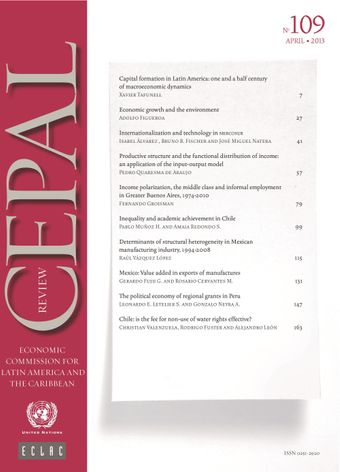
Volume 2013, Issue 109, 2013
Cepal Review is the leading journal for the study of economic and social development issues in Latin America and the Caribbean. Edited by the Economic Commission for Latin America, each issue focuses on economic trends, industrialization, income distribution, technological development and monetary systems, as well as the implementation of reforms and transfer of technology. Written in English and Spanish (Revista De La Cepal), each tri-annual issue brings you approximately 12 studies and essays undertaken by authoritative experts or gathered from conference proceedings.
-
-
Capital formation in Latin America: One and a half century of macroeconomic dynamics
More Lessمؤلف: Xavier TafunellMacroeconomic studies indicate that physical capital formation has played a pivotal role in long-term economic growth. These studies have been hampered, however, by a data constraint: in order to pinpoint exactly what the role of capital formation has been, a larger empirical database –larger in terms of both the time span and the geographical area covered– is needed. This study addresses that problem by providing new and very extensive series on capital formation in Latin America. It also describes the different series used to identify long, medium and short-term movements. One of the outstanding features of these investment trends were their marked instability up to 1950. Another salient aspect has been the more robust growth in investment seen in the second half of the nineteenth century, which actually outdistanced the growth spurt that occurred during the “golden age” of 1950-1980.
-
-
-
Economic growth and the environment
More Lessمؤلف: Adolfo FigueroaThe relationship between economic growth and the environment is one of the most significant problems in modern economics. Empirical data are increasingly available, but the theories behind those data remain a matter of debate. This paper presents an elementary theoretical model of the interactions between the economic process and the environment, drawing on a theory developed by Georgescu-Roegen, in which the laws of thermodynamics are applied to the economic process. The model assumes that the growth and distribution process is currently operating amid conditions of environmental distress. The model is able to predict and explain the observed relationship between economic growth and the environment, identifying new public policy implications. The paper thus aims to contribute to the debate on the choices that society must make about the future of humanity.
-
-
-
Internationalization and technology in MERCOSUR
More LessAuthors: Isabel Álvarez, Bruno B. Fischer and José Miguel NateraThe Southern Common Market (mercosur), widely recognized as one of the most advanced regional integration schemes worldwide, is increasingly attractive to multinational enterprises and also very active in outward investments, despite persistent innovation and competitiveness gaps. In this paper we analyse internationalization and technology trends in mercosur in relation to trade, the activities of multinational enterprises (mnes) and the features of national systems of innovation. Our empirical findings, based on traditional gravity models, show the impact of foreign direct investment (fdi) (inward and outward) on exports, classified according to their technological content. Income distribution, which shapes the institutional characteristics of mercosur countries, is specifically addressed as a proxy for the structural aspects of mercosur countries. The findings confirm that technological and internationalization capacities —both as host and home countries of fdi— influence trade within the bloc.
-
-
-
Productive structure and the functional distribution of income: An application of the input-output model
More Lessمؤلف: Pedro Quaresma de AraujoThe eclac tradition views structural heterogeneity as one of the main causes of Latin America’s unequal income distribution. Accordingly, industrial policy should aim to change the productive structure, while incorporating technical progress and raising productivity levels. Simulations performed using Brazilian input-output tables make it possible to discover and evaluate the effects of changes in the productive structure on the functional distribution of income and employment levels over the most recent business cycle. These simulations are an important tool for formulating industrial policies that simultaneously promote higher growth rates and a reduction in inequalities. The estimations made revealed that increasing the proportion of engineering-intensive sectors could help to improve distributive results, expand the share of wages in output, and create more jobs.
-
-
-
Income polarization, the middle class and informal employment in Greater Buenos Aires, 1974-2010
More Lessمؤلف: Fernando GroismanThis article examines the social structure of Argentina’s main conurbation, Greater Buenos Aires, over the past four decades. The research focused on identifying changes in society by stratifying it into three social classes: high, middle and low. Contributions are made in three areas. First, the article engages with the renewed debates about methodology on the issue of which criteria are best suited to achieving an adequate demarcation of social classes, especially the middle class. Second, it uses a variety of approaches to document changes in the social structure with a view to identifying common trends. Lastly, it highlights certain dominant features of the workings of the labour market that appear to have left their mark on the social morphology of Argentina.
-
-
-
Inequality and academic achievement in Chile
More LessAuthors: Pablo Muñoz H. and Amaia Redondo S.This work uses a set of panel data to contribute new evidence on the impacts of socioeconomic determinants on academic achievement in Chile. Socioeconomic determinants are found to have a statistically significant effect, which rises over time, on academic achievement. The evidence shows that two individuals of different socioeconomic levels (sel) who achieve the same score in Chile’s Educational Quality Measurement System (simce) in eighth grade, are separated by a gap of over 70 points on average four years later, when they sit the University Selection Test (psu). It is concluded that in a context of great income inequality and high returns on tertiary education, academic achievement indexes throw up barriers to access to tertiary education, principally for the population of low socioeconomic level, thereby perpetuating poor income distribution.
-
-
-
Determinants of structural heterogeneity in Mexican manufacturing industry, 1994-2008
More Lessمؤلف: Raúl Vázquez LópezThis article analyses the stagnation of productivity and the increasing structural heterogeneity of Mexican manufacturing industry in the period 1994-2008. Traditional indicators of dispersion are estimated for 200 activity classes, 50 branches and nine divisions of the manufacturing sector; and these corroborate the widening disparity in productive efficiency between globalized activities and traditional industries that has been reported in other papers. The study also provides a more detailed account of the intensification of this trend in the first decade of the present century and the specific characteristics of within-sector heterogeneity. Other results obtained using a shift-share technique show that structural change contributes very little to productivity growth, and that technological progress is concentrated in just a few activities that engage with the domestic economy in a variety of ways. Nonetheless, these activities have weak local linkages and add little value to the content of the goods they make.
-
-
-
Mexico: Value added in exports of manufactures
More LessAuthors: Gerardo Fujii G. and Rosario Cervantes M.In the last few decades, Mexico’s export sector has seen extraordinarily robust growth and has undergone sweeping changes, with exports of manufactures, especially intermediate- and high-technology products, leading the way. At the same time, however, the gap between exports and gdp has been widening, which indicates that the export sector is underperforming as a driver of economic growth. This study is based on the idea that the ability of exports to galvanize the economy will be heightened if export activity leads to an expansion of the domestic market. Whether or not it will do so depends on the amount of national income that is incorporated into exports. The authors estimate how much national value added is contained in exports of manufactures, by sector and by category (direct income, i.e., income generated directly by export activity, and indirect income, i.e., income incorporated into the inputs used to produce export goods). This information is provided for total exports of manufactures, exports of the maquila industry and non-maquila exports.
-
-
-
The political economy of regional grants in Peru
More LessAuthors: Leonardo E. Letelier S. and Gonzalo Neyra A.This paper explores the regional allocation pattern of general resources (recursos ordinarios) in Peru, which are distributed to regional governments through a discretionary grant by the national government. We estimate an empirical model based on a panel of annual data between 2004 and 2010. Although national transfers are significantly biased towards regions where the national government received the lowest electoral support, the data suggest that this effect is strongest at the beginning of the administration’s period in office. In the long run, however, opposition regions appear to host more volatile constituencies, which is compatible with the swing-voter hypothesis. Interestingly, regions that strongly supported the president receive the fewest benefits. Finally, the role of regional conflicts, the effect of lobbying by organized regionally based civil groups and the size of the regional constituency, among others variables, are statistically significant in the estimations.
-
-
-
Chile: is the fee for non-use of water rights effective?
More LessAuthors: Christian Valenzuela, Rodrigo Fuster and Alejandro LeónThis paper examines whether the fees for non-use of water rights implemented in Chile in 2005 have provided an incentive for the exploitation of unused water. Two comparisons are made and descriptively analysed: between fees charged and paid, and between fees and the market price of water rights. In the successive fee charging rounds, payment levels increased from 67% of the total charged in 2007 to 81.4% in 2009. It was also found that several years of fee payment would be required to match the market price of water rights. The conclusion is that the fee has not been effective in discouraging non-use, since owners tend to pay it rather than forfeit rights whose market price exceeds the fee. Some improvements to the legal design of the instrument are also suggested.
-
Volumes & issues
-
Volume 2025
-
Volume 2024
-
Volume 2023
-
Volume 2022
-
Volume 2021
-
Volume 2020
-
Volume 2019
-
Volume 2018
-
Volume 2017
-
Volume 2016
-
Volume 2015
-
Volume 2014
-
Volume 2013
-
Volume 2012
-
Volume 2011
-
Volume 2010
-
Volume 2009
-
Volume 2008
-
Volume 2007
-
Volume 2006
-
Volume 2005
-
Volume 2004
-
Volume 2003
-
Volume 2002
-
Volume 2001
-
Volume 2000
-
Volume 1999
-
Volume 1998
-
Volume 1997
-
Volume 1996
-
Volume 1995
-
Volume 1994
-
Volume 1993
-
Volume 1992
-
Volume 1991
-
Volume 1990
-
Volume 1989
-
Volume 1988
-
Volume 1987
-
Volume 1986
-
Volume 1985
-
Volume 1984
-
Volume 1983
-
Volume 1982
-
Volume 1981
-
Volume 1980
-
Volume 1979
-
Volume 1978
-
Volume 1977
-
Volume 1976
Most Read This Month
