


CEPAL Review - Volume 2022, Issue 138, 2022
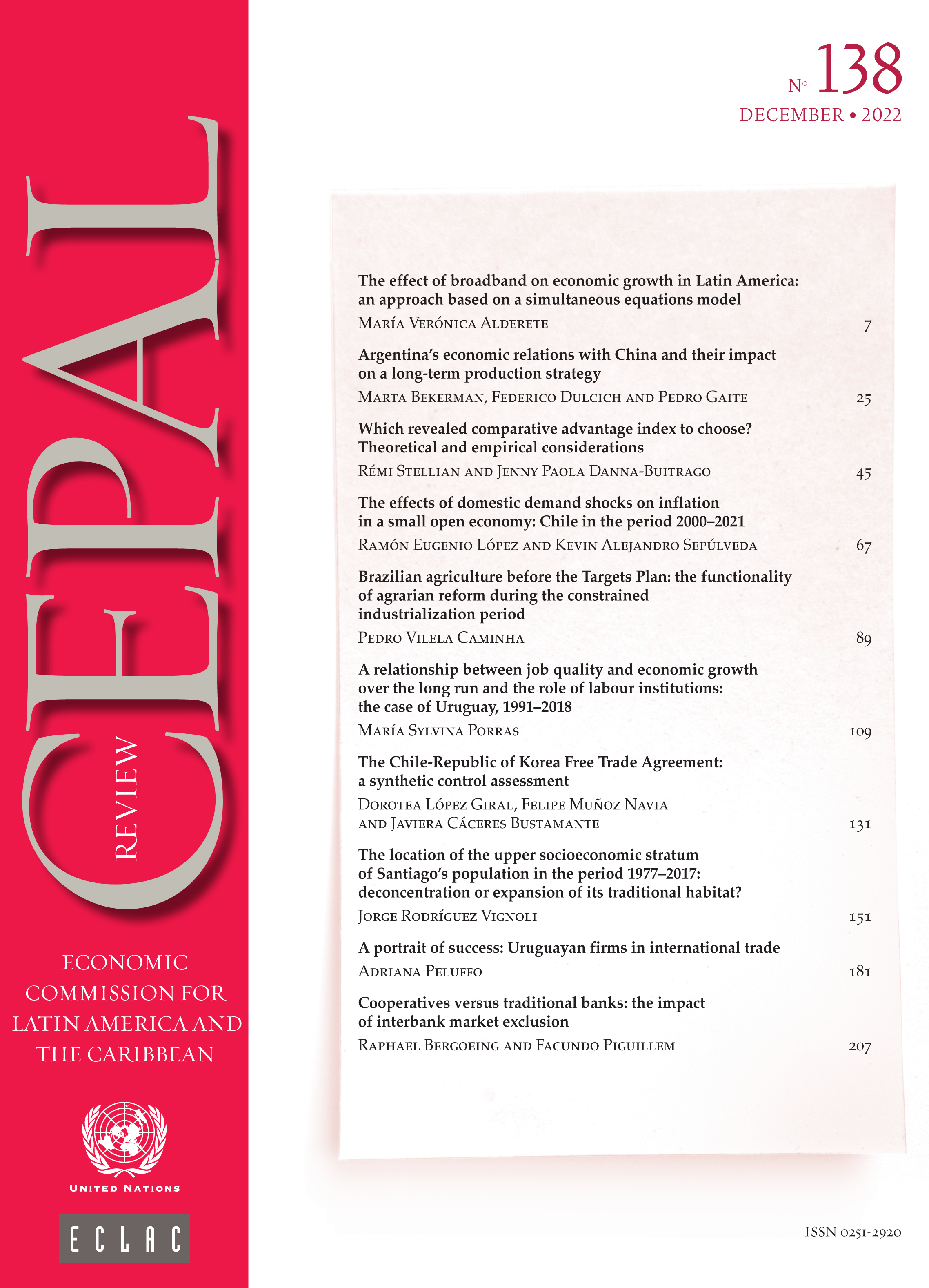
Volume 2022, Issue 138, 2022
-
-
The effect of broadband on economic growth in Latin America: an approach based on a simultaneous equations model
Más MenosAutor: María Verónica AldereteThis work analyses the effects of broadband on economic growth in Latin America, distinguishing between mobile and fixed broadband. Although there are studies on the countries of the Organisation for Economic Co-operation and Development (OECD), in the Latin American region such research is scarce. This work uses data from 20 countries for the period 2010–2018 and estimates a simultaneous equations model based on Koutroumpis (2009) and Katz and Callorda (2013). The results show that mobile and fixed broadband make a significant positive contribution to the region’s economic growth. A 1% increase in mobile broadband penetration generates a 0.23% increase in GDP, while a 1% increase in fixed broadband increases GDP by 0.31%. This effect is greater than that found in other analyses which do not examine the complementarity between the two types of broadband.
-
-
-
Argentina’s economic relations with China and their impact on a long-term production strategy
Más MenosAuthors: Marta Bekerman, Federico Dulcich and Pedro GaiteThis article analyses how trade and investment relations between Argentina and China have evolved in the post-convertibility period. In the case of trade, Argentina’s sales to China are more concentrated in the primary sector than its exports to other countries. Chinese competition has adverse effects on Argentina’s domestic production only in specific sectors, but it has caused significant displacement of Argentine exports to Brazil. In the case of foreign direct investment, Chinese FDI is driven by a quest for natural resources and generates little productive or technological spillover. Thus, the trends of both bilateral trade and Chinese investments in Argentina (which are closely linked) in neither case are conducive to a long-term export diversification strategy.
-
-
-
Which revealed comparative advantage index to choose? Theoretical and empirical considerations
Más MenosAuthors: Rémi Stellian and Jenny Paola Danna-BuitragoThis article proposes guidelines for choosing an index of revealed comparative advantages (RCA) to analyse a given configuration of countries, products and periods. Following a systematic review of the main theoretical strengths and weaknesses inherent in RCA indices, a standardized method is designed to gauge the quality of their empirical measurement. This method is illustrated for Colombia and the Northern Triangle. The guidelines formalize a number of theoretical and empirical trade-offs that need to be weighed to provide a better basis for choosing an RCA index.
-
-
-
The effects of domestic demand shocks on inflation in a small open economy: Chile in the period 2000–2021
Más MenosAuthors: Ramón Eugenio López and Kevin Alejandro SepúlvedaThis study decomposes the factors that determined inflation in Chile during the period 2000–2021. It finds that the main determinants of domestic inflation were variables of external origin and the exchange rate. Domestic demand played a rather limited role as an inflationary factor. In normal periods, increases in domestic demand generally explained no more than 25% of observed inflation. The average monthly inflation observed during the period 2000–2021 was 0.3%, which means that domestic demand growth in normal periods explained monthly inflation of 0.08%. Surprisingly, the extraordinary periods of rapid demand growth resulting from highly expansionary fiscal policies, large withdrawals from pension retirement savings or both had a rather modest effect on inflation. This study corroborates what might be expected in a small, open economy like Chile’s: most domestic price changes are determined by foreign price changes.
-
-
-
Brazilian agriculture before the Targets Plan: the functionality of agrarian reform during the constrained industrialization period
Más MenosAutor: Pedro Vilela CaminhaThis article reviews the economic structure of Brazilian agriculture during the years of constrained industrialization, by providing a descriptive analysis of the sector’s main economic data. It reconsiders the debate of the 1950s and 1960s on the roles played by agriculture in national economic development; and it shows that the growth of agricultural production in Brazil was hindered by the deterioration of the terms of trade between agriculture and agribusiness, which was also associated with miserly rural wages. These factors rendered agricultural modernization relatively disadvantageous in Brazil, which raises questions as to the functionality of agrarian reform in those years.
-
-
-
A relationship between job quality and economic growth over the long run and the role of labour institutions: the case of Uruguay, 1991–2018
Más MenosAutor: María Sylvina PorrasThe trend reflected in the job quality index constructed for this study indicates that economic growth alone is not enough to improve the quality of employment. Econometric techniques are used to estimate the long-run relationship between this index and GDP. The results of those calculations clearly point to a negative relationship between these two variables from 2005 on, when job quality began to improve against a backdrop of strong economic growth in combination with changes in the institutional framework (labour laws and collective bargaining mechanisms) that were conducive to an improvement in job quality.
-
-
-
The Chile-Republic of Korea Free Trade Agreement: a synthetic control assessment
Más MenosAuthors: Dorotea López Giral, Felipe Muñoz Navia and Javiera Cáceres BustamanteIn 2003, Chile and the Republic of Korea signed the first trans-Pacific free trade agreement (FTA). The two countries’ objectives differed. Chile sought to increase, diversify, and add value to its exports, while the Republic of Korea had the political economy-driven goal of initiating preferential liberalization negotiations, and Chile was seen as an ideal candidate for exploring this path. This paper focuses on the Chilean objectives behind the signing of the Chile-Republic of Korea FTA and therefore considers its effects on Chilean exports. Synthetic control methods are used to assess the impact of the Agreement on exports, in terms of value and number of products. As an extension, the impact of the Agreement on the intensive and extensive margins of Chilean exports to the Republic of Korea is analysed. While the Agreement is found to have had a positive impact on Chilean exports, this effect is non-significant for newly exported products.
-
-
-
The location of the upper socioeconomic stratum of Santiago’s population in the period 1977–2017: deconcentration or expansion of its traditional habitat?
Más MenosAutor: Jorge Rodríguez VignoliThe appearance of suburbs inhabited by the upper socioeconomic stratum in Santiago suggests a dispersion of this group and a loss of importance for the barrio alto, the area in the east of the capital that is its traditional habitat. However, the barrio alto has continued to grow upward and outward in both demographic and real-estate terms. Migration is decisive in this process. Therefore, this paper conducts a detailed and rigorous investigation of its role in the location and redistribution of the socioeconomic strata in Santiago, using microdata from Chile’s last four official censuses. The conclusion drawn is that the territorial dispersion of the upper socioeconomic stratum has not been reducing the attractiveness of the barrio alto and that, rather than deconcentration, this spread could actually be giving rise to an expansion of the geographical scale of the barrio alto, considering its contiguity with the new suburbs inhabited by this group.
-
-
-
A portrait of success: Uruguayan firms in international trade
Más MenosAutor: Adriana PeluffoThis article provides a portrait of firm heterogeneity in connection with international activities. We analyse the impact of the extensive margins of exports and imports and of trade with different types of partners on firms’ performance, using detailed national customs and manufacturing firm survey data from Uruguay for the period 1997–2005. This is the first study to use customs data and analyse the extensive margins of trade and types of partner for Uruguayan firms. In line with previous studies, we find that trade is highly concentrated and that firms which both export and import show a superior performance. Furthermore, the product extensive margin of imports and the country extensive margin of exports have positive effects on two key variables: total factor productivity and employment. Where trade is concerned, lastly, firms trading with both high-income countries and Southern Common Market (MERCOSUR) partners are the best performers.
-
-
-
Cooperatives versus traditional banks: the impact of interbank market exclusion
Más MenosAuthors: Raphael Bergoeing and Facundo PiguillemWe analyse the desirability of allowing cooperative banks to participate in the interbank market in Chile. We find that it is advisable to allow this if the quality of their governance is not too deficient relative to that of traditional commercial banks. When cooperative banks do participate in the interbank market, both the probability of financial crises and the volatility of gross domestic product (GDP) rise. However, because the inclusion of cooperatives generates large efficiency gains in the financial sector, both GDP and aggregate welfare substantially increase. We conclude that there is no policy reason to unilaterally exclude cooperatives from the Chilean interbank market.
-
Volumes & issues
-
Volume 2025
-
Volume 2024
-
Volume 2023
-
Volume 2022
-
Volume 2021
-
Volume 2020
-
Volume 2019
-
Volume 2018
-
Volume 2017
-
Volume 2016
-
Volume 2015
-
Volume 2014
-
Volume 2013
-
Volume 2012
-
Volume 2011
-
Volume 2010
-
Volume 2009
-
Volume 2008
-
Volume 2007
-
Volume 2006
-
Volume 2005
-
Volume 2004
-
Volume 2003
-
Volume 2002
-
Volume 2001
-
Volume 2000
-
Volume 1999
-
Volume 1998
-
Volume 1997
-
Volume 1996
-
Volume 1995
-
Volume 1994
-
Volume 1993
-
Volume 1992
-
Volume 1991
-
Volume 1990
-
Volume 1989
-
Volume 1988
-
Volume 1987
-
Volume 1986
-
Volume 1985
-
Volume 1984
-
Volume 1983
-
Volume 1982
-
Volume 1981
-
Volume 1980
-
Volume 1979
-
Volume 1978
-
Volume 1977
-
Volume 1976
Most Read This Month
