


Asia-Pacific Development Journal - Volume 20, Issue 2, 2014
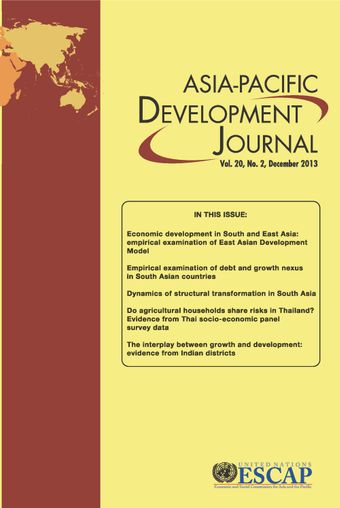
Volume 20, Issue 2, 2014
This journal, published twice a year, provides a platform for the exchange of knowledge, experience, ideas, information and data on all aspects of economic and social development issues and concerns facing the region and to stimulate policy debate and assist in the formulation of policy. It provides a scholarly means for bringing together research work by eminent social scientists and development practitioners from the region and beyond for use by a variety of stakeholders. Over the years, the Journal has emerged as a key United Nations publication in telling the Asian development story in a concise, coherent and impartial manner to stimulate policy debate and assist in the formulation of policy in the region.
Language:
Inglés
-
-
Economic Development in South and East Asia: empirical examination of East Asian development model
Más MenosAutor: Prakash Kumar ShresthaIn this paper, a comparison is made of the level of economic development between South Asia and East Asia, and the East Asian Development Model (EADM) is analysed as well as empirically examined. Several development indicators reveal that South Asia in general is far behind East Asian countries where some distinctive features of the development process followed in the past were the developmental role of the state, high investment, emphasis on the manufacturing sector, export-led growth and a focus on infrastructure and human capital. Based on an empirical examination, which supports these facts, policymakers in South Asia should take heed of some of these features despite changing circumstances.
-
-
-
Empirical Examination of debt and growth nexus in South Asian countries
Más MenosAutor: Naeem AkramOver the years, South Asian countries have been facing the problem of a twin deficit and the need to rely on public external and domestic debt to finance their developmental activities. The positive impact of public debt relates to the fact that in resource-starved economies debt financing, if done properly, leads to higher growth and adds to the borrower’s capacity to service and repay external and internal debt. The negative effect works through two main channels, namely “debt overhang” and “crowding out”. In the present study, the consequences of public debt for economic growth and investment are examined for the four countries in South Asia, namely Bangladesh, India, Pakistan and Sri Lanka, for the period 1975-2011. To conduct the study, a hybrid model that explicitly incorporates the role of public debt in growth equations was developed. The standard panel data estimation techniques have been used. The results show that both public external debt and debt servicing negatively affect economic growth and investment, which points to the existence of the “debt overhang effect” and the “crowding out effect”. Similarly, domestic debt also exhibits a negative and significant relationship with economic growth and investment. The results suggest that reliance on debt for development purposes is not a safe option and countries need to extend the efforts to increase the revenue to finance the development expenditure.
-
-
-
Dynamics of structural transformation in South Asia
Más MenosAutor: P.V. SrinivasanThis paper contains an analysis of the pattern of growth and the structure of employment in various sectors of six South Asian economies (Bangladesh, Bhutan, India, Nepal, Pakistan and Sri Lanka); the trends in the technological capabilities of these countries are also examined, by characterizing the structure of their exports. It shows that although the level of sophistication is lower compared with East Asian economies, the distribution of exports in South Asian countries has shifted towards products that have a higher productivity index and are located “centrally” in product space, enabling production of several nearby goods. In terms of the summary measure of the proximity of the export basket to all currently unexploited products, highvalue ones in particular, the potential for future export sophistication is seen to be the highest for India among the South Asian countries and lowest for Bhutan followed by Bangladesh. Going by the East Asian experience, the South Asian governments have an important role to play in transforming their industrial structures.
-
-
-
Do agricultural households share risks in Thailand? Evidence from Thai socio-economic panel survey data
Más MenosAutor: Aeggarchat SirisankananFor this paper, three waves of the Thai Socio-Economic Panel Survey data which cover the years 2005-2007, are used for the first time to examine risk sharing through many specifications. The findings show that the null hypothesis of full insurance against income shock is rejected for the whole country case together with a group consisting of a sample from the Central, Eastern and Western regions. This rejection, nevertheless, is supported by the existence of evidence of partial insurance for the whole country case. Unlike income shock, a specific adverse shock, which uses the illness of the household head as a proxy, is fully insured by households for all region groups except a group consisting of a sample from the Central, Eastern and Western regions.
-
-
-
The interplay between growth and development: evidence from indian districts
Más MenosAuthors: Jyoti Prasad Mukhopadhyay and Nilanjan BanikIn this paper we examine the nexus between growth and development using a recursive structural equation system which, to the best of our knowledge, has not been tried so far to examine such relationships in the Indian context. Another novel feature of our study is that we use district-level data to capture greater heterogeneity at a substate level. We use the growth rate of per capita income (PCI) as an indicator of economic growth, and the infant mortality rate (IMR) and literacy rate as the development outcomes. We find that IMR and literacy rate have a positive and statistically significant effect on the growth rate of PCI. Our results also show that the growth rate of PCI has a positive and statistically significant effect on IMR and the literacy rate. Further sensitivity analysis is performed to test the robustness of these findings.
-
Most Read This Month
Article
content/journals/24119873
Journal
10
5
false
es
