


Africa Renewal - Volume 19, Issue 2, 2005
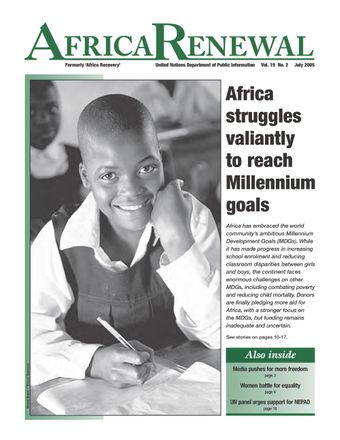
Volume 19, Issue 2, 2005
The Africa Renewal magazine examines the many issues that confront the people of Africa, its leaders and its international partners: sustainable development goals, economic reform, debt, education, health, women's empowerment, conflict and civil strife, democratization, investment, trade, regional integration and many other topics. It tracks policy debates. It provides expert analysis and on-the-spot reporting to show how those policies affect people on the ground. And, it highlights the views of policy-makers, non-governmental leaders and others actively involved in efforts to transform Africa and improve its prospects in the world today. The magazine also reports on and examines the many different aspects of the United Nations’ involvement in Africa, especially within the framework of the New Partnership for Africa’s Development (NEPAD).
-
-
Africa’s media pushes for more freedom
Más MenosAutor: Michael FleshmanIn the perennial war between governments and the media over what the public should know, few battles have been fought as stubbornly as the one between the late Nigerian military ruler, Gen. Sani Abacha, and the “guerrilla journalists” of Tell magazine. The popular newsweekly earned the general’s ire by criticizing his 1993 coup and reporting too closely on his administration’s inner workings. In response, the government shuttered the magazine’s offices and jailed a senior editor.
-
-
-
Community radio: A voice for the poor
Más MenosAutor: Itai MadamombeTheir transmitters may reach only a few miles, but community radio stations are enabling isolated communities across Africa to voice their own concerns. On air, ordinary citizens discuss issues that are central to them, such as gender relations and combatting HIV/AIDS. They share farming tips and income generation ideas and explore ways to improve education.
-
-
-
African women battle for equality
Más MenosAutor: Gumisai MutumeAdecade ago, African women had reason to expect change following a much-heralded global conference that set ambitious targets to transform the lives of women across the world. This year marks the 10th anniversary of that milestone event, the Fourth World Conference on Women, held in Beijing, China, in 1995. Like their counterparts elsewhere, African women are taking stock of progress and asking to what extent promised reforms have been implemented. They are also examining why progress has been limited in many countries and are seeking ways to overcome the obstacles.
-
-
-
Giant step for Kenya’s schools
Más MenosAutor: Michael FleshmanThe first day of classes at the Doonholm Primary School, near Nairobi, in January 2003 was more than the usual uproar of returning students, anxious parents and impatient teachers. Just weeks earlier, Headmaster Margaret Ayiemba told Africa Renewal, the newly elected Kenyan government had announced the abolition of school fees, and “the teachers were not really prepared. We didn’t know what would happen.” Could the school accommodate the expected surge of new arrivals? More than 200 eager new students did arrive, adding to nearly 1,300 already squeezed into the existing facilities.
-
-
-
Africa and the challenge of the Millennium Development Goals
Más MenosAutor: United NationsMDGs World leaders gathered at the Millennium Summit in New York in September 2000 adopted an ambitious set of goals aimed at achieving measurable progress towards reducing poverty and improving human well-being across the globe. They recognized the particular needs of Africa, the world’s poorest region, which lags behind on virtually every major indicator of development. They will return to New York in September 2005 to review what must be done to achieve the goals.
-
-
-
Focusing aid on Africa’s own priorities
Más MenosAutor: Ernest HarschWhen the government of the African island nation of Madagascar decided last year to apply for assistance under the US’s new supplementary aid programme, the Millennium Challenge Account, it chose to break with standard practice. Instead of simply asking government ministries to suggest potential projects, the Malagasy authorities consulted civil society groups, local businesses and farmers’ associations. They encountered two recurrent complaints from farmers and small-scale businesspeople: that it is very difficult to get either bank loans or official titles to land.
-
-
-
Moving ‘from rhetoric to action’
Más MenosAutor: United NationsAfrica deserves and requires more external assistance to ensure the success of its New Partnership for Africa’s Development (NEPAD), argues a special advisory panel on international support for Africa. “NEPAD cannot succeed without a significant increase in support from the international community,” said Chief Emeka Anyaoku, the chair of the panel, who submitted its recommendations to UN Secretary-General Kofi Annan on 3 June.
-
-
-
Accelerating Africa’s agriculture plan
Más MenosAutor: United NationsAfrican governments generally agree that “agriculture must lead economic development,” Ghanaian President John Kufuor told African and international officials and farm experts meeting in Accra. “But the sad truth is that Africa does not seem to have the know-how to let this happen, and the agricultural sectors are inadequately supported.”
-
Most Read This Month
Article
content/journals/25179829
Journal
10
5
false
es
