


Asia-Pacific Sustainable Development Journal - Volume 26, Issue 2, 2020
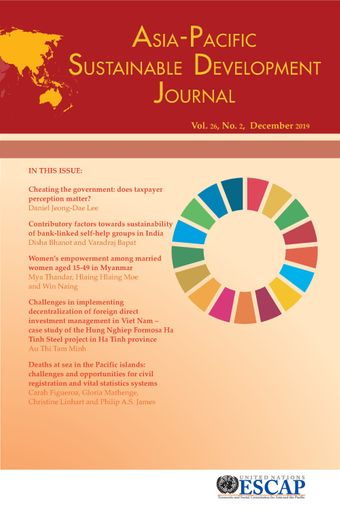
Volume 26, Issue 2, 2020
-
-
Cheating the government: Does taxpayer perception matter?
More LessAuthor: Daniel Jeongdae LeeDo people cheat because they can get away with it or because they feel that the rules are unfair? This paper addresses this question in the context of tax evasion. Specifically, taxpayer perception is incorporated into a widely used consumption-based method for estimating income tax evasion. Compared to the standard method, which distinguishes taxpayers only by their occupational or income type as a way of measuring their “ability” to misreport income, the refined method introduces taxpayers who may be “able but unwilling” to cheat because they feel fairly treated with respect to public services and as compared to other taxpayers. Applied to a longitudinal data for the Republic of Korea (2007–2015), the standard method yields a uniform tax evasion rate of 13 per cent, but the refined method provides a range of 7 to 25 per cent based on taxpayer perception. This implies that strategies for improving tax compliance must be tailored to different motivations for tax evasion.
-
-
-
Contributory factors towards sustainability of bank-linked self-help groups in India
More LessAuthors: Disha Bhanot and Varadraj BapatThe present study focuses on the Indian flagship financial inclusion scheme – the Self Help Group-Bank Linkage Programme, which successfully leverages the social collateral concept and the vast network of bank branches in India to deliver financial services to small, cohesive and participatory women’s self-help groups. To develop a deeper understanding of the topic of sustainability of self-help groups, we propose a framework that conceptualizes sustainability by integrating the financial and organizational aspects of functioning of self-help groups. Sustainability is assessed in the light of the group’s performance (on set of indicators) with respect to the primary objective of the Self Help Group-Bank Linkage Programme, which is financial intermediation. Subsequently, we ascertain the effect of plausible contributory factors related to group management practices on the sustainability of self-help groups. The results of regression analysis on primary data captured from a survey of 170 self-help groups show that such factors as equitable access to credit, group savings, growth in savings, loan utilization in income generation activities, members depositing a savings contribution or loan installment on each other’s behalf, and distance from bank contribute significantly to group sustainability. Accordingly, designing suitable measures to monitor and improve group governance and management practices would be a critical policy intervention.
-
-
-
Women’s empowerment among married women aged 15 to 49 in Myanmar
More LessAuthors: Mya Thandar, Hlaing Hlaing Moe and Win NaingThe present study entails an investigation of the empowerment of married women aged 15 to 49 in Myanmar from socioeconomic and demographic perspectives based on data from the Myanmar Demographic and Health Survey 2015-16. The dimensions of women’s empowerment are categorized into two parts: women’s control over their earnings, and women’s participation in household decision-making (decisions on major household purchases, visits to family or relatives, their health care; and the well-being of their children). These two dimensions are combined to create an index of women’s empowerment. A binary logistic regression is used, by means of odds ratios to assess the relationship between women’s level of empowerment and their socioeconomic and demographic characteristics. Overall, the findings of the study show that a higher empowerment level is associated with women’s employment, increased age, urban residence, a higher educational attainment, a higher wealth quintile, and a lower level of husband’s education. In addition, women that have one child or up to four children are more likely to have a higher level of empowerment than women with no children. About three fourths of the women in the sample live in rural areas. Among those women, the ones with a higher level of empowerment are more educated, employed and have higher household income. Generating employment opportunities for women and educating women are important factors that can lead to an increase in women’s income, and accordingly, help raise the levels of women’s empowerment.
-
-
-
Challenges in implementing decentralization of foreign direct investment management in Viet Nam — case study of the Hung Nghiep Formosa Ha Tinh Steel project in Ha Tinh province
More LessAuthor: Au Thi Tam MinhOver the past decades, an increasing number of developing countries in Asia have experimented with decentralization in varying degrees to achieve good governance and promote democracy. In Viet Nam, even though decentralization has been limited to de-concentration (or administrative decentralization), foreign direct investment (FDI) management is vigorously decentralized at the provincial level and has proven to be problematic. In one instance, it led to an environmental disaster in 2016. The objective of the present paper is to explore the factors resulting in ineffective decentralization of FDI management in Viet Nam, focusing on the challenges that the local government has been dealing with under the decentralization set-up, in particular with respect to environmental protection. Drawing on the case study of the Hung Nghiep Formosa Ha Tinh Steel project in Ha Tinh province, it is argued that Viet Nam continues to lack the essential prerequisites for effective decentralization. It is the time for Viet Nam to reconsider the policy of decentralization in the area of FDI management. Bearing in mind that economic development is vital, it should go hand in hand with environment protection in order to ensure the country’s sustainable development.
-
-
-
Deaths at sea in the Pacific Islands: Challenges and opportunities for civil registration and vital statistics systems
More LessAuthors: Carah Figueroa, Gloria Mathenge, Christine Linhart and Philip A.S. JamesAccurate and reliable death statistics produced by civil registration and vital statistics systems are essential for health planning and programme evaluation. The quality of death registration data in Pacific island countries and territories remains suboptimal. Data on deaths occurring at sea are especially limited. While coastal and oceanic activities are the norm and essential to the livelihoods of Pacific island populations, such activities pose risks for accidents at sea, especially those involving small-scale vessels. In this paper, the scale of deaths at sea associated with small vessels in three Pacific island countries or territories over the period 2008-2017 is investigated using data from the health, civil registry, and police and fisheries departments, and reports produced by national statistics offices, ministries of health, the Pacific Community, the World Health Organization and media sources. Data on deaths at sea were found to be fragmented among multiple sources and missing key information on age, sex, and cause. Standardized procedures for reporting deaths and accidents at sea and harmonized data sharing between local communities and government agencies are urgently needed to improve civil registration and vital statistics systems and sea safety in the Pacific island subregion.
-
Most Read This Month
