


Professional Training Series in Human Rights
Pocketbook on Human Rights for Law Enforcement Officials
This revised edition of the Expanded Pocketbook forms part of OHCHR’s updated “Human Rights and Law Enforcement Guidance and Training Package”. The training package also includes a Manual on Human Rights Training for Law Enforcement Officials and a Training Guide on Human Rights for Law Enforcement Officials, in addition to presentation slides corresponding to each chapter of the Manual. The Expanded Pocketbook is designed to be a readily accessible and portable reference tool for law enforcement officials. It can be further tailored to a particular law enforcement agency’s local context. The international standards can, for example, be complemented with references to national law, internal policies or standard operating procedures. The Expanded Pocketbook contains hundreds of point-form standards and recommendations, organized according to law enforcement duties, functions and topics.
Training Guide on Human Rights for Law Enforcement Officials
This revised edition of the Training Guide forms part of OHCHR’s updated “Human Rights and Law Enforcement Guidance and Training Package”. The training package also includes a Manual on Human Rights Training for Law Enforcement Officials and an Expanded Pocketbook on Human Rights for Law Enforcement Officials, in addition to presentation slides corresponding to each chapter of the Manual. The Training Guide provides advice on methodology and guidance for trainers developing training activities aimed at law enforcement officials. It also includes session outlines based on each chapter in the Manual, which provide guidance for trainers and sample session plans, as well as indicative answers to discussion questions and exercises related to the respective chapters.
Manual on Human Rights for Law Enforcement Officials
This revised edition of the Manual forms part of OHCHR’s updated “Human Rights and Law Enforcement Guidance and Training Package”. The training package also includes a Training Guide on Human Rights for Law Enforcement Officials and an Expanded Pocketbook on Human Rights for Law Enforcement Officials, in addition to presentation slides corresponding to each chapter of the Manual. The Manual provides in-depth information on key instruments, principles and standards for human rights in law enforcement. It explains the application of human rights standards and their implications in law enforcement practice and provides practical recommendations for law enforcement institutions and agencies. The Manual consists of 21 chapters, which are divided into four parts. Each chapter provides the reader with the normative framework of the subject matter and a thorough explanation of the application of the respective principles and standards in law enforcement work.
Reporting Under the Convention Against Torture and Other Cruel, Inhuman or Degrading Treatment or Punishment
Training Guide (Part I – Manual)
The manual is aimed at assisting States parties in fulfilling their reporting obligations under the Convention against Torture and Other Cruel, Inhuman or Degrading Treatment or Punishment. Its objective is to facilitate understanding of the rights enshrined in the Convention and the corresponding obligations of the States parties in respecting, protecting and fulfilling those rights. The manual is based on the provisions of the Convention, the general comments of the Committee against Torture, its jurisprudence on individual communications and its concluding observations on State party’s initial and periodic reports, as well as its reporting guidelines, rules of procedure, working methods and other documents. The manual should be seen as a practical tool, while bearing in mind the constantly developing practice of the Committee in interpreting the Convention. The present manual also constitutes a reference document for trainers who intend to design and deliver training courses on reporting to the Committee on the implementation of the provisions of the Convention. The manual can be used jointly with the training guide on reporting to the United Nations treaty bodies, which covers all the procedural aspects of the reporting process.
Implementing the Rights of Persons with Disabilities – the Role of Independent Monitoring Frameworks
Practical Guide
This practical guide on independent monitoring frameworks is aimed at assisting parties to the Convention on the Rights of Persons with Disabilities and other stakeholders, including national human rights institutions and civil society, in understanding the key criteria for the establishment and functioning of independent monitoring frameworks according to the requirements of the Convention and the jurisprudence of the Committee on the Rights of Persons with Disabilities. States invariably indicate in their periodic reports to the Committee that they have established some form of independent monitoring framework, yet the structure and operation of such frameworks vary from State to State in their legal basis, composition, mandate and resources. The preparation of this guide was led by the Office of the United Nations High Commissioner for Human Rights (OHCHR), together with the Committee on the Rights of Persons with Disabilities and the United Nations Development Programme through a global initiative supported by the United Nations Partnership on the Rights of Persons with Disabilities. It was developed in consultation with the Global Alliance of National Human Rights Institutions and the International Disability Alliance.
Becoming a Party to the International Convention for the Protection of All Persons from Enforced Disappearance
Practical Guide
This practical guide aims to promote the universal ratification of the International Convention for the Protection of All Persons from Enforced Disappearance and to assist States as they move towards becoming parties to the Convention. Its objective is to provide answers to questions commonly raised by States when considering this commitment. Its purpose is also to offer practical guidance to States regarding the process of becoming a party to the Convention and what that entails.
Towards a Human Rights-Based Approach to Migration
Training Guide
This training guide is designed to enable participants to understand the human rights perspective on migration, and how human rights laws and standards can be operationalized to make migration safer and an empowering experience for all. It provides an introduction to related principles and issues and is designed for persons with limited knowledge of human rights or migration. The training guide contains session plans for the trainer and is supported by sample slide presentations and associated materials, including activities and handouts for participants, which are available electronically as individual components on the OHCHR website.
Reporting Under the International Convention for the Protection of All Persons From Enforced Disappearance
Training Guide (Part I – Manual)
This Training Guide seeks to assist States parties in meeting their obligations to respect, protect and fulfil the rights enshrined in the Convention for the Protection of all Persons against Enforced Disappearances. The Manual, which is the first part of the Training Guide, outlines the provisions of the Convention and provides useful guidance on the content and scope of the rules of procedure and the working methods of the Committee on Enforced Disappearances, as well as reporting obligations under the Convention. The publication draws on the wealth of experience acquired by the Committee over the years. It highlights practical examples on the submission of information and data under the Convention and the successful implementation of Committee’s recommendations. These examples would be of use to States parties and, in particular, to those involved in the delivery of training courses on reporting to the Committee and on the implementation of the Convention. By promoting a greater understanding of the provisions of the Convention, the Training Guide aims to provide guidance and support to reporting States as to the content of reports and the implementation of recommendations. The Manual will be complemented by training materials (Part II), tailored to each of the Convention’s rights, to be published on the OHCHR website.
Istanbul Protocol
Manual on the Effective Investigation and Documentation of Torture and Other Cruel, Inhuman or Degrading Treatment or Punishment
This revised edition strengthens the widely recognized and highly valued Istanbul Protocol standards on the effective investigation into and documentation of torture and ill-treatment. Relying on multi-sectoral engagement, specialized global expertise, and practical experiences of law, health, and human rights professionals in the field, including members of United Nations anti-torture bodies, the updated edition seeks to fortify the implementation of international norms and preventive tools to assist survivors of torture worldwide. The Istanbul Protocol and the accompanying “Istanbul Principles” also serve as a global standard against which the delivery of expert legal and medical evidence can be benchmarked in the investigation and prevention of torture.
Human Rights and Elections
A Handbook on International Human Rights Standards on Elections
With hundreds of references to the jurisprudence of United Nations human rights mechanisms, this handbook provides human rights and electoral practitioners with a clear picture of the close interplay between elections and international human rights law. The handbook discusses international human rights standards regarding electoral processes and political participation, and how these standards apply to specific aspects of elections. Current issues such as gender-based violence in politics, disinformation and data manipulation, and the impact of Internet shutdowns are considered in the light of international human rights law and the recommendations of United Nations experts.
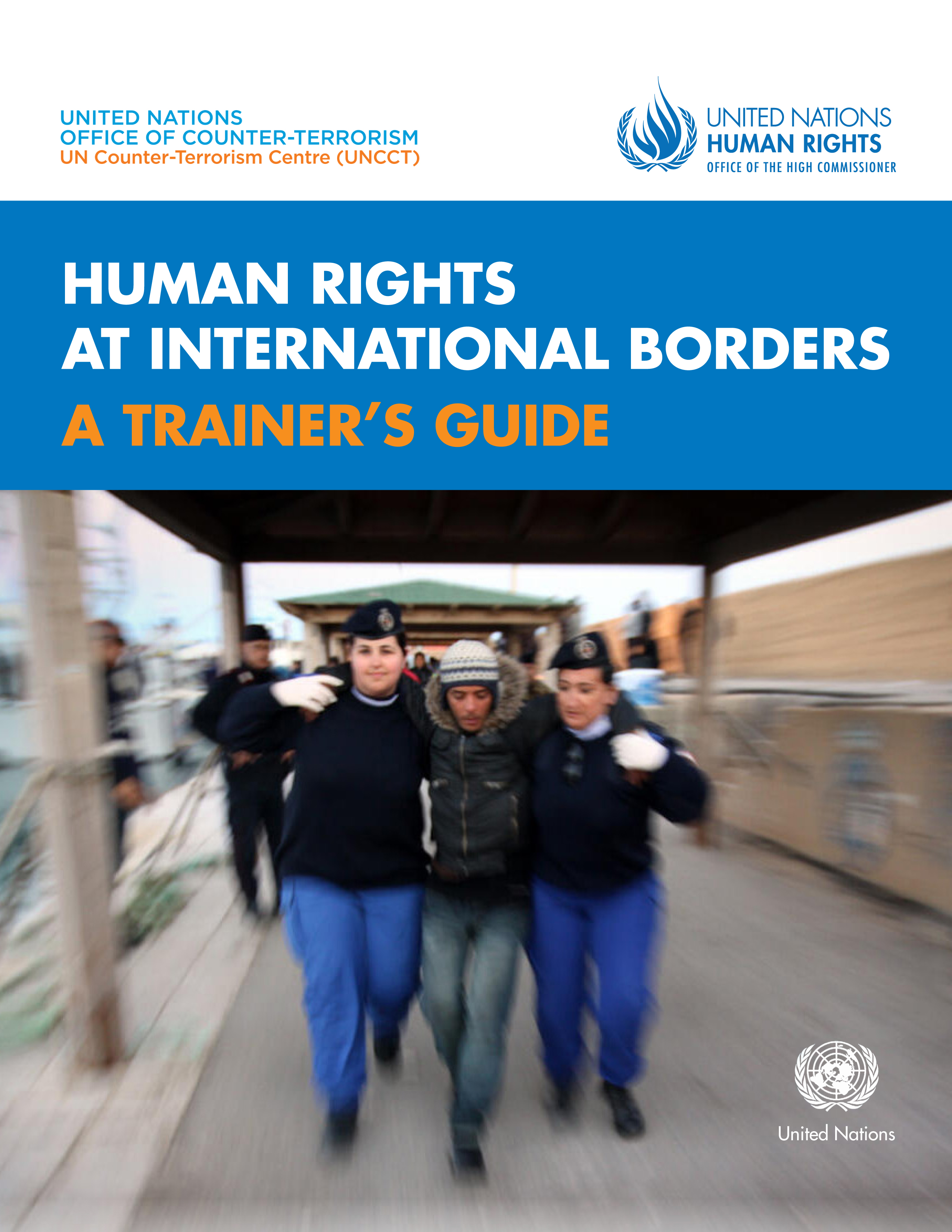
Human Rights at International Borders: A Trainer's Guide
This is a joint publication of the Office of the UN High Commissioner for Human Rights and the UN Office on Counter-Terrorism. This Trainer’s Guide seeks to help trainers prepare, organize and deliver a training course on Human Rights at International Borders. The course itself is a capacity-building tool for individuals working in border governance to adopt a human rights-based and gender-responsive approach to migration governance, including with a focus on migrants in vulnerable situations at international borders. The Trainer’s Guide is designed for UN and government officials, national human rights institutions, non-governmental organizations, trade unions, other relevant civil society actors and humanitarian actors.
Reporting Under the International Covenant on Civil and Political Rights – Training Guide
Part I – Manual
Part of the Professional Training Series (No. 23), this Guide aims to assist States parties by facilitating an understanding of the rights enshrined in the International Covenant on Civil and Political Rights and the corresponding obligations of the States. It is based on the provisions of the Covenant and the Committee’s general comments, jurisprudence on individual communications and concluding observations on State party reports, as well as reporting guidelines, rules of procedure, working methods and other documents. The Guide provides practical tools to enhance reporting skills with respect to the Covenant and the capacity to implement the Committee’s recommendations. It further serves as an analytical information and training tool for trainers to design and deliver courses on reporting to the Committee.
From Planning to Impact: A Manual on Human Rights Training Methodology
Preventing Torture - The Role of National Preventive Mechanisms: A Practical Guide
Guidelines on Indigenous Peoples' Issues
The Convention on the Rights of Persons with Disabilities: Training Guide
Monitoring the Convention of the Rights of Persons with Disabilities
Guidance for Human Rights Monitors

Human Rights Standards and Practice for the Police
Expanded Pocket Book on Human Rights for the Police
This Pocketbook examines human rights in relation to police work involving investigations, arrest, detention and the use of force. It is a valuable and portable reference tool for police officers worldwide.