United Nations Historical Series
This series of publications offers a fresh and enlightening look into the history of the League of Nations involvement in social issues. The objective is to contribute to the literature on the history of international organizations and transnational history while also contributing to current dialogues on contemporary United Nations politics and policies in a way that draws upon lessons learnt from its historical predecessor.
Filter :
Sustainable Development Goals
موضوع
تاريخ النشر
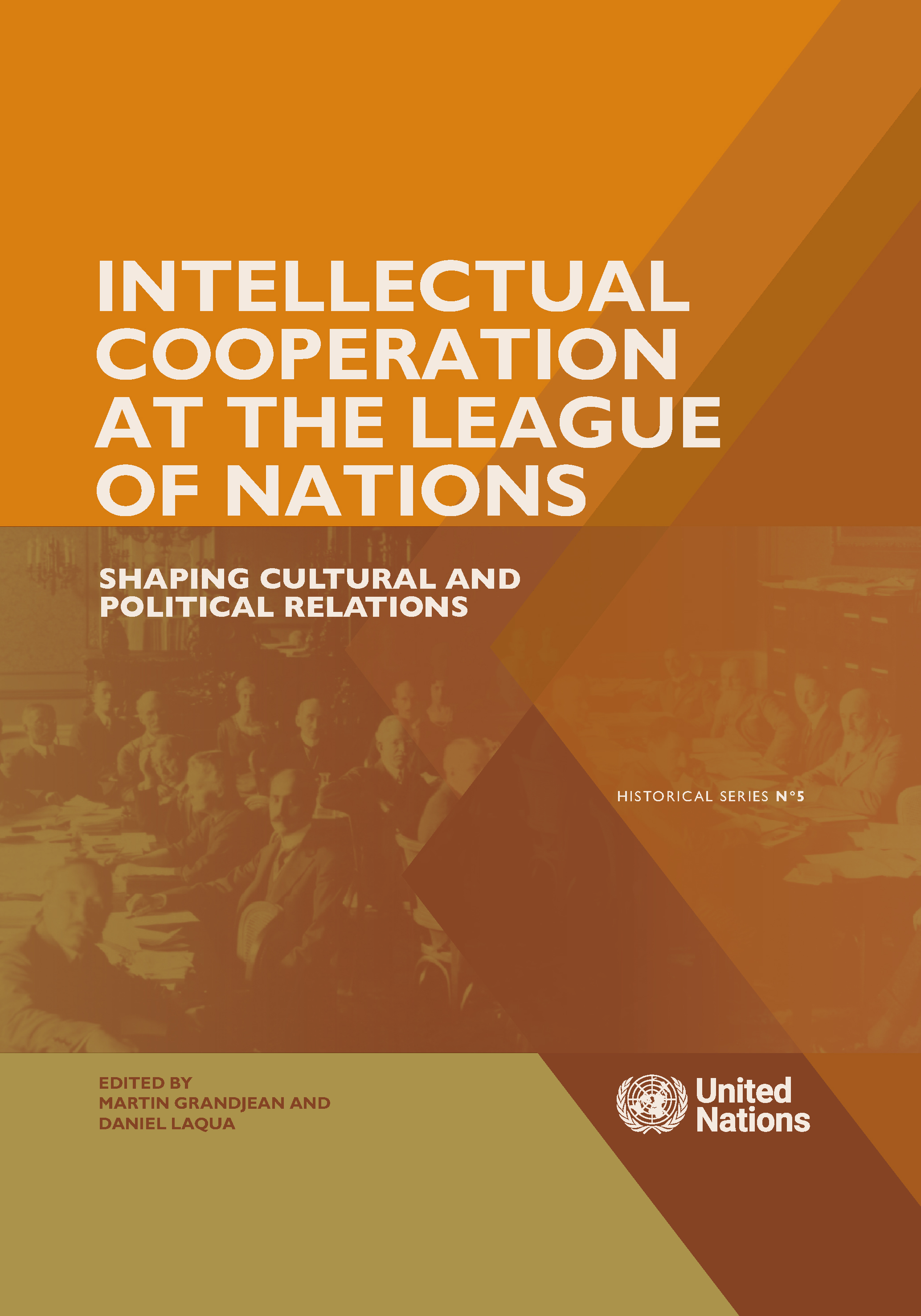
Intellectual Cooperation at the League of Nations
Shaping Cultural and Political Relations
Edited by Martin Grandjean and Daniel Laqua, this book brings together the work of 17 scholars and highlights the breadth of the League of Nations’ work in the field of intellectual cooperation, detailing a range of transnational connections across a variety of cultural fields. Building a new global order after the First World War required not only political and economic reconstruction, but also the coordination of scientific and cultural relations on an international scale. To this end, the League of Nations established first a committee and then a Paris-based institute dedicated to “intellectual cooperation”. Operative from1922 and 1926 respectively, these bodies aimed to develop a collaborative dynamic around issues as diverse as professor and student exchanges, scientific cooperation, the discussion of educational means for peace, as well as artistic and literary relations. Attracting some of the era’s most eminent intellectuals, this initiative did not lead to the creation of a “League of Minds”, as some of the architects of the League of Nations had so eagerly hoped, but it played a key role in the development of cultural diplomacy in the interwar period. When citing the publication, please use the following language: Martin Grandjean and Daniel Laqua, eds. Intellectual Cooperation at the League of Nations: Shaping Cultural and Political Relations. Vol. 5. UN Historical Series. Geneva: United Nations, 2025.

Communicating the League of Nations
Contributions to a Transnational Communication History of the League of Nations in the Inter-War Period (1920–1938)
The volume aims to contribute to a deeper understanding of the League of Nations (1920-1946) as an international organization with complex transnational communication relations from a perspective of communication researchers. The authors focused on the reconstruction of internal communication processes within the Information Section as well as its strategies of external public communication The complex relationships between organized information practices of the Information Section and the profession and practices of League of Nations’ journalism can be understood as a co-evolution of journalism, public relations and press work. By the normative guidelines of the “principle of publicity” and the concept of “open diplomacy” media-mediated public communication, preferably via the press, was defined as an important factor for the legitimization of the organization and politics of the League of Nations.
Trafficking in Women (1924-1926)
The Paul Kinsie Reports for the League of Nations - Vol. 2
This book provides a transcription of the reports written by undercover agent Paul Kinsie for the League of Nations Special Body of Experts on Traffic in Women and Children in the mid-1920s. Between 1924 and 1926, a team travelled to more than a hundred cities in Europe, the Americas and the Mediterranean area to interview individuals involved in the regulation, repression, medical control, organization and practice of the sex trade. American undercover agents were included on the team to infiltrate the so-called ‘underworld’ and obtain ‘facts’ about the traffic. Among these, Kinsie was the most prolific. He visited more than forty cities and produced hundreds of reports in which his contacts with prostitutes, brothel owners, madams, pimps and procurers are described in detail. For a proper contextualization of the reports, scholars from around the world were asked to provide short introductions to the situation with regard to prostitution in each city that was visited. The book offers a unique source of information which is of great ethnographic value for people interested in the history of human trafficking and prostitution.
Trafficking in Women (1924-1926)
The Paul Kinsie Reports for the League of Nations - Vol. 1
This book provides a transcription of the reports written by undercover agent Paul Kinsie for the League of Nations Special Body of Experts on Traffic in Women and Children in the mid-1920s. Between 1924 and 1926, a team travelled to more than a hundred cities in Europe, the Americas and the Mediterranean area to interview individuals involved in the regulation, repression, medical control, organization and practice of the sex trade. American undercover agents were included on the team to infiltrate the so-called ‘underworld’ and obtain ‘facts’ about the traffic. Among these, Kinsie was the most prolific. He visited more than forty cities and produced hundreds of reports in which his contacts with prostitutes, brothel owners, madams, pimps and procurers are described in detail. For a proper contextualization of the reports, scholars from around the world were asked to provide short introductions to the situation with regard to prostitution in each city that was visited. The book offers a unique source of information which is of great ethnographic value for people interested in the history of human trafficking and prostitution.