


CEPAL Review - Volume 2009, Issue 98, 2009
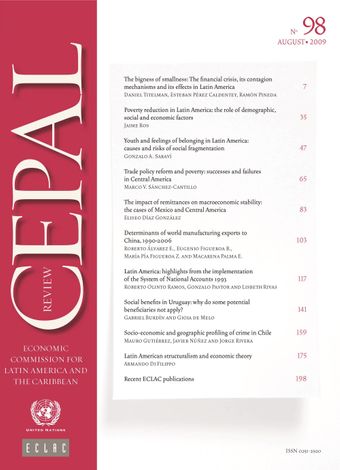
Volume 2009, Issue 98, 2009
Cepal Review is the leading journal for the study of economic and social development issues in Latin America and the Caribbean. Edited by the Economic Commission for Latin America, each issue focuses on economic trends, industrialization, income distribution, technological development and monetary systems, as well as the implementation of reforms and transfer of technology. Written in English and Spanish (Revista De La Cepal), each tri-annual issue brings you approximately 12 studies and essays undertaken by authoritative experts or gathered from conference proceedings.
-
-
The bigness of smallness: The financial crisis, its contagion mechanisms and its effects in Latin America
More LessAuthors: Daniel Titelman, Esteban Pérez Caldentey and Ramón Pineda-SalazarThis paper has two purposes. First, it seeks to explain the reason why a relatively small shock (in the subprime market in the United States) had a systemic effect on the world economy. It is argued that this responds to the combination of off balance sheet funding and pro-cyclical leverage management. Second, it analyses the transmission mechanisms and the possible effects of the crisis on Latin American economies. Past crises had generalized, deep and enduring effects across the region, and restricted access to external finance and the disruption of international trade turned out to be their main channels transmission. In spite of specificities, the current episode and its manifestations are not an exception to the pattern of previous crises. The final outcome will depend on the type of recovery that takes place in the developed world and on the effectiveness of the counter-cyclical policies applied in Latin America.
-
-
-
Poverty reduction in Latin America: The role of demographic, social and economic factors
More LessAuthor: Jaime RosThe recent socio-economic development of Latin America presents a puzzle. This is that while economic growth in the region in the past 25 years has been very slow, falling behind past performance and behind most of the rest of the world, poverty rates have continued to fall significantly and soginicial indicators have continued to improve. This paper assesses the role of various factors —income distribution, social spending and demographic changes— in explaining the paradox. The main finding, rather disturbingly, is that with few exceptions (Chile in particular) the major factor contributing to the reduction of poverty has been the demographic dividend brought about by the demographic transition that the region recorded over the period.
-
-
-
Youth and feelings of belonging in Latin America: Causes and risks of social fragmentation
More LessAuthor: Gonzalo A. SaravíOver the last few decades, Latin American societies have undergone structural and secular reforms that have caused far-reaching social fragmentation extending over many spheres of social life. It is therefore pertinent to ask whether this has affected the socially shared notions that define a common sense of belonging. What has happened to such sentiments and how have they changed in the heat of the changes that have taken place in the region? This article analyses the weakening of two institutions capable of engaging individuals and generating shared perceptions, wishes and values, which had become key mechanisms of integration and social cohesion in the past: namely school and work. In this context, the article reviews the experiences and meaning of school and work for young people from the most disadvantaged sectors of the population, and the emergence of new competing institutions that display increasing capacity to engage and give meaning.
-
-
-
Trade policy reform and poverty: Successes and failures in Central America
More LessAuthor: Marco V. Sánchez CantilloDuring the past two decades, trade regimes in Latin America have been reformed to facilitate export-led growth, in the expectation that the benefits of this growth would eventually trickle down and thereby help the poor. These goals have been achieved to differing degrees. Their accomplishment has depended not only upon the effectiveness of the trade policy reforms but also upon exchange-rate policy, external shocks and remittance inflows. Technological change has also been crucial when it comes to capitalizing on the benefits of the reforms. These assertions are substantiated using simulation results from a computable general equilibrium model solved with data for Costa Rica, El Salvador and Honduras. The model is combined with a microsimulation methodology to capture the full distributive implications of simulated policy and external shocks.
-
-
-
The impact of remittances on macroeconomic stability: The cases of Mexico and Central America
More LessAuthor: Eliseo Díaz GonzálezThe present study uses the monetary approach to the balance of payments and a macroeconomic model of the Mundell-Fleming type to analyse the effects of family remittances on economic growth in Mexico and the countries making up the Central America region. The methodology employed is based on the application of a panel data model to quarterly balance-of-payments series for the 1990-2005 period. The study findings suggest that the repercussions of inward remittances are different in each country and depend on monetary policy. The econometric estimates also indicate that, when an upsurge in remittances occurs, its contribution to economic growth is smaller in countries where remittances tend to produce an overvalued exchange rate, reinforcing macroeconomic stability in the context of an open economy.
-
-
-
Latin America: Highlights from the implementation of the System of National Accounts 1993
More LessAuthors: Roberto Olinto Ramos, Gonzalo Pastor and Lisbeth RivasThis paper reviews the Latin American experience with the implementation of the 1993 System of National Accounts and the updating of the national accounts’ base year. It also makes a preliminary assessment of the possible measurement biases in nominal gdp estimates stemming from the use of outdated national accounts base years, downward biases in household final consumption estimates, and an overestimation of gross fixed capital formation in construction activities.
-
-
-
Social benefits in Uruguay: Why do some potential beneficiaries not apply?
More LessAuthors: Gabriel Burdín and Gioia de MeloCash transfer programmes have become very important in Latin America. Concerns about proper targeting have centred on excluding people who do not meet eligibility requirements. Less attention has been paid to the failure of programmes to reach the whole of their target population, partly because there are people who do not even apply. The present article analyses the determinants of non-take-up of social benefits. The case studied is the National Social Emergency Plan, an income transfer programme implemented in Uruguay between 2005 and 2007. It is calculated that over a fifth of eligible households have never enrolled in the programme. A probit model is used to estimate the determinants of the decision to apply. The evidence obtained is highly consistent with theoretical and empirical research into the subject.
-
-
-
Socio-economic and geographic profiling of crime in Chile
More LessAuthors: Mauro Gutiérrez, Javier Núñez and Jorge RiveraMany empirical studies of crime assume that victims and perpetrators live in a single geographical unit, the implication being that the socio-economic characteristics of victims’ places of residence can be treated as determinants of crime. This study offers an alternative approach which consists in measuring crime by the proportion of alleged offenders in the whole population and treating the characteristics of their home communes as socio-economic causes of criminal behaviour. The conclusion is that those charged with crimes present a high degree of geographic mobility. In the case of economically motivated crimes, the evidence partly supports Becker’s propositions. Lastly, we show that the number of people charged with crimes tends to be greater in communes that have low incomes, a larger police presence, a predominance of urban areas with higher levels of education and a geographical location in the north of the country, which to some degree bears out the findings of other studies on Chile.
-
-
-
Latin American structuralism and economic theory
More LessAuthor: Armando Di FilippoThis essay suggests that there is a body of Latin American structuralist economic theory which possesses distinctive characteristics while having a family resemblance to other institutionalist schools of thought, and which is based on an original approach to economic value. The founders of structuralism conceived a systemic, multidimensional and dynamic approach. They applied it to the study of improvements in, and the social distribution of, labour productivity generated in the central economies and the effects of these on the societies of the periphery. This outlook challenges the notion of markets as self-regulating systems that return to stable equilibrium positions, presenting them rather as a quantitative expression of the national or international power status of contracting parties. Different development styles and processes progressively alter the power structure of social systems and these changes are reflected in the dynamic of relative market prices.
-
Volumes & issues
-
Volume 2025
-
Volume 2024
-
Volume 2023
-
Volume 2022
-
Volume 2021
-
Volume 2020
-
Volume 2019
-
Volume 2018
-
Volume 2017
-
Volume 2016
-
Volume 2015
-
Volume 2014
-
Volume 2013
-
Volume 2012
-
Volume 2011
-
Volume 2010
-
Volume 2009
-
Volume 2008
-
Volume 2007
-
Volume 2006
-
Volume 2005
-
Volume 2004
-
Volume 2003
-
Volume 2002
-
Volume 2001
-
Volume 2000
-
Volume 1999
-
Volume 1998
-
Volume 1997
-
Volume 1996
-
Volume 1995
-
Volume 1994
-
Volume 1993
-
Volume 1992
-
Volume 1991
-
Volume 1990
-
Volume 1989
-
Volume 1988
-
Volume 1987
-
Volume 1986
-
Volume 1985
-
Volume 1984
-
Volume 1983
-
Volume 1982
-
Volume 1981
-
Volume 1980
-
Volume 1979
-
Volume 1978
-
Volume 1977
-
Volume 1976
Most Read This Month
