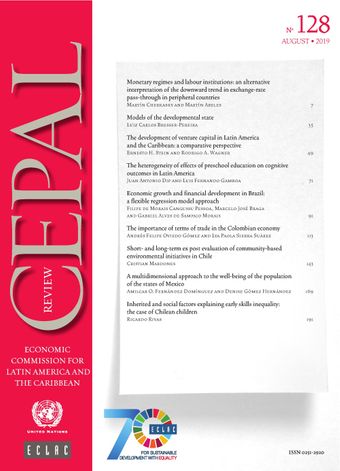
- E-ISSN: 16840348
-
Monetary regimes and labour institutions: An alternative interpretation of the downward trend in exchange-rate pass-through in peripheral countries
- Source: CEPAL Review, Volume 2019, Issue 128, Aug 2019, p. 7 - 34
- Spanish
-
- 17 Apr 2020
Abstract
In recent years, several empirical studies have documented the decline in exchange-rate pass-through in peripheral countries. Conventional wisdom has interpreted this trend—verified in the last two decades—as the result of greater central bank credibility stemming from the implementation of formal inflation-targeting regimes. This paper offers an alternative interpretation, in line with the structuralist tradition, as it examines other instrumental transformations, concurrent with the establishment of inflationtargeting regimes, including ubiquitous labour market flexibilization. Empirical estimates for a set of peripheral countries for the period 1994–2016 show a marked correlation between the intensity of the exchange-rate pass-through and the weakening of labour market institutions.