


CEPAL Review - Volume 2025, Issue 145, 2025
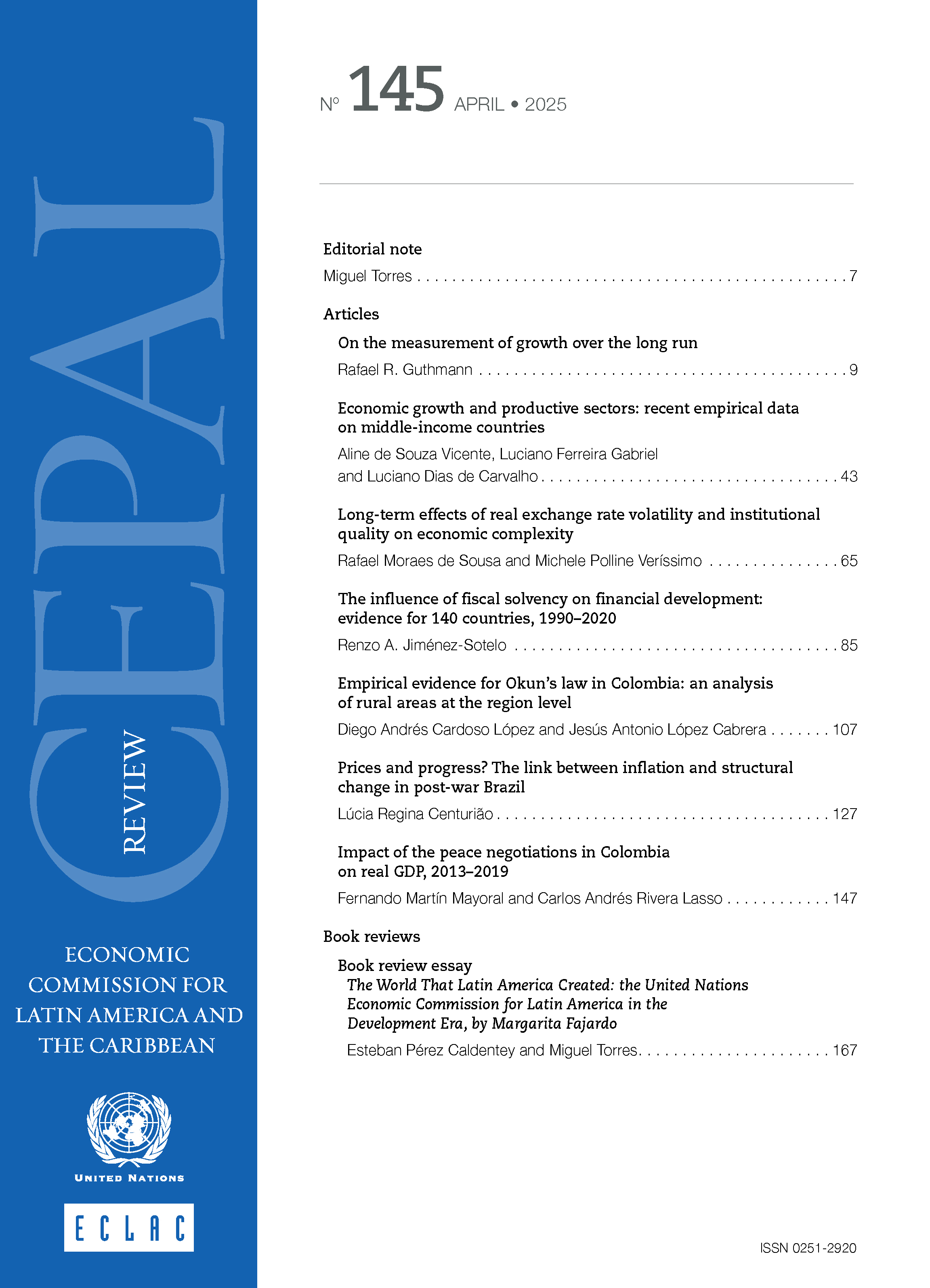
Volume 2025, Issue 145, 2025
-
-
Editorial note
More LessAt the close of the first four months of 2025, we are pleased to share with our readership a new issue of CEPAL Review, the 145th edition of our ever-expanding catalogue that seeks to promote knowledge and understanding —from an academic, structural and contemporary perspective— of the various economic, social and environmental aspects of development in Latin America and the Caribbean.
-
-
-
Articles: On the measurement of growth over the long run
More LessMethodologies for the construction of nominal and real gross domestic product (GDP) time series often differ over time and between countries. This paper discusses the main issues raised by this methodological heterogeneity for long-run measures of economic growth and, informed by these issues, provides a set of internationally comparable GDP estimates from 1820 to 2020. The estimates are based on real product benchmarks relative to the United Kingdom as the reference economy. The GDP time series of the reference economy is a normalized composite of several indices. These estimates suggest that the Maddison Project data sets overestimate economic growth after 1950 relative to the period from 1820 to 1950.
-
-
-
Economic growth and productive sectors: recent empirical data on middle-income countries
More LessThis article examines how structural change affected economic growth in middle-income developing countries between 1960 and 2019, especially in Brazil (between 1948 and 2020), using the vector autoregression (VAR) model and panel data. The VAR model suggests that structural change in Brazil resulted in the services sector having a greater impact on economic growth owing to the transfer of resources from high-productivity sectors to low-productivity sectors, which reduced the rate of economic growth. Panel data suggest that economic growth in the sample of countries continues to be heavily influenced by the industrial sector and that the weaker momentum of the industrial sector in Brazil is one of the reasons why the country is falling behind.
-
-
-
Long-term effects of real exchange rate volatility and institutional quality on economic complexity
More LessThis article analyses whether real exchange rate volatility and institutional quality, combined as conditioning variables of the productive specialization of economies, can have a negative impact on a country’s ability to achieve greater economic sophistication, especially in countries with a commodity-dominated and natural resource-based export basket. The methodology used consists of panel cointegration estimation (pooled mean group) using data from 1995 to 2018 for a sample of 54 countries. The results indicate that real exchange rate volatility is indeed an obstacle to the implementation of structural measures aimed at diversification and sophistication of a country’s productive fabric, while the quality of its institutions has a positive effect on its economic complexity and increases the possibilities for developing local capabilities.
-
-
-
The influence of fiscal solvency on financial development: evidence for 140 countries, 1990–2020
More LessIf financial development facilitates economic development at the international level, as is the consensus view, then it follows that each government’s task is to implement policies that effectively boost national financial development. This study tests the new hypothesis that a more fiscally solvent policy approach positively influences financial development. The results, based on a yearly comparison, show that fiscal solvency, approximated by the credit rating on sovereign debt denominated in local currency, affects three dimensions of financial development: (i) the depth of credit leveraging of economic activity; (ii) the efficiency of the bank lending-deposit spread; and (iii) retail access through bank branches and automatic teller machines (ATMs). The test confirms that there is one tool upon whose importance not all macroeconomic policymakers have agreed in their strategic planning for enhanced general public welfare: fiscal solvency.
-
-
-
Empirical evidence for okun’s law in Colombia: an analysis of rural areas at the region level
More LessThis article analyses the relationship between income and unemployment, controlling for the variable of human capital, in rural areas of four Colombian regions. The objective is to test for the existence of the empirical regularity known as Okun’s law and thereby measure income’s impact on unemployment by region. The analysis is based on a monthly series for the period 2010–2022, and the methodologies used to determine the behaviour of this relationship include ordinary least square differences, dynamic ordinary least squares, and error correction and vector autoregressive models, establishing the existence of equilibria in the short and long terms. The results are found to be consistent with Okun’s law, showing a negative relationship between real income and unemployment and a positive one between unemployment and human capital.
-
-
-
Prices and progress? The link between inflation and structural change in post-war Brazil
More LessThis paper employs a multivariate time series model to examine the relationship between price increases and structural change in post-war Brazil (1945–1964). To assess this relationship, the model investigates the link between prices, the industrial share of total output in the economy, net investment and industrial sector wages. With a view to addressing criticisms commonly made of the vector autoregression (VAR) family of models, and particularly the ad hoc nature of Cholesky’s decomposition method, hypotheses drawn from the economic literature on development theory were applied to the matrix of restrictions. The findings indicate that inflation played a significant role in structural change in Brazil, while the influence of structural change on inflation was less pronounced.
-
-
-
Impact of the peace negotiations in Colombia on real GDP, 2013–2019
More LessThe peace negotiations between the Revolutionary Armed Forces of Colombia –People’s Army and the Government of Colombia, which began in late 2012 and concluded with the signing of the Final Agreement for Ending the Conflict and Building a Stable and Lasting Peace in 2016, sought to bring an end to decades of violence, loss of life, destruction of infrastructure and social fragmentation. This study uses the synthetic control method proposed by Abadie and Gardeazabal (2003) and Abadie, Diamond and Hainmueller (2010) to assess the impact of the Agreement on Colombia’s real per capita GDP growth, taking into account economic, demographic and institutional factors. The main findings indicate that Colombia has registered higher growth rates than its synthetic counterpart since 2013, reflecting a shift in the expectations of economic agents from the outset of the peace process.
-
-
-
Book reviews: Book review essay: The world that Latin America created the United Nations economic commission for Latin America in the development era, by Margarita Fajardo
More LessThis book review essay analyses and builds on the work of Margarita Fajardo on the history of the establishment of the Economic Commission for Latin America (ECLAC)2 and the growth and decline of its influence in the region and around the world in the two decades following its founding.
-
-
-
Guidelines for contributors to the CEPAL review
More LessIn order to facilitate the submission, consideration and publication of articles, the editorial board of the CEPAL Review has prepared the following information and suggestions to serve as a guide for future contributors.
-
Volumes & issues
-
Volume 2025
-
Volume 2024
-
Volume 2023
-
Volume 2022
-
Volume 2021
-
Volume 2020
-
Volume 2019
-
Volume 2018
-
Volume 2017
-
Volume 2016
-
Volume 2015
-
Volume 2014
-
Volume 2013
-
Volume 2012
-
Volume 2011
-
Volume 2010
-
Volume 2009
-
Volume 2008
-
Volume 2007
-
Volume 2006
-
Volume 2005
-
Volume 2004
-
Volume 2003
-
Volume 2002
-
Volume 2001
-
Volume 2000
-
Volume 1999
-
Volume 1998
-
Volume 1997
-
Volume 1996
-
Volume 1995
-
Volume 1994
-
Volume 1993
-
Volume 1992
-
Volume 1991
-
Volume 1990
-
Volume 1989
-
Volume 1988
-
Volume 1987
-
Volume 1986
-
Volume 1985
-
Volume 1984
-
Volume 1983
-
Volume 1982
-
Volume 1981
-
Volume 1980
-
Volume 1979
-
Volume 1978
-
Volume 1977
-
Volume 1976
Most Read This Month
