- E-ISSN: 16840348
-
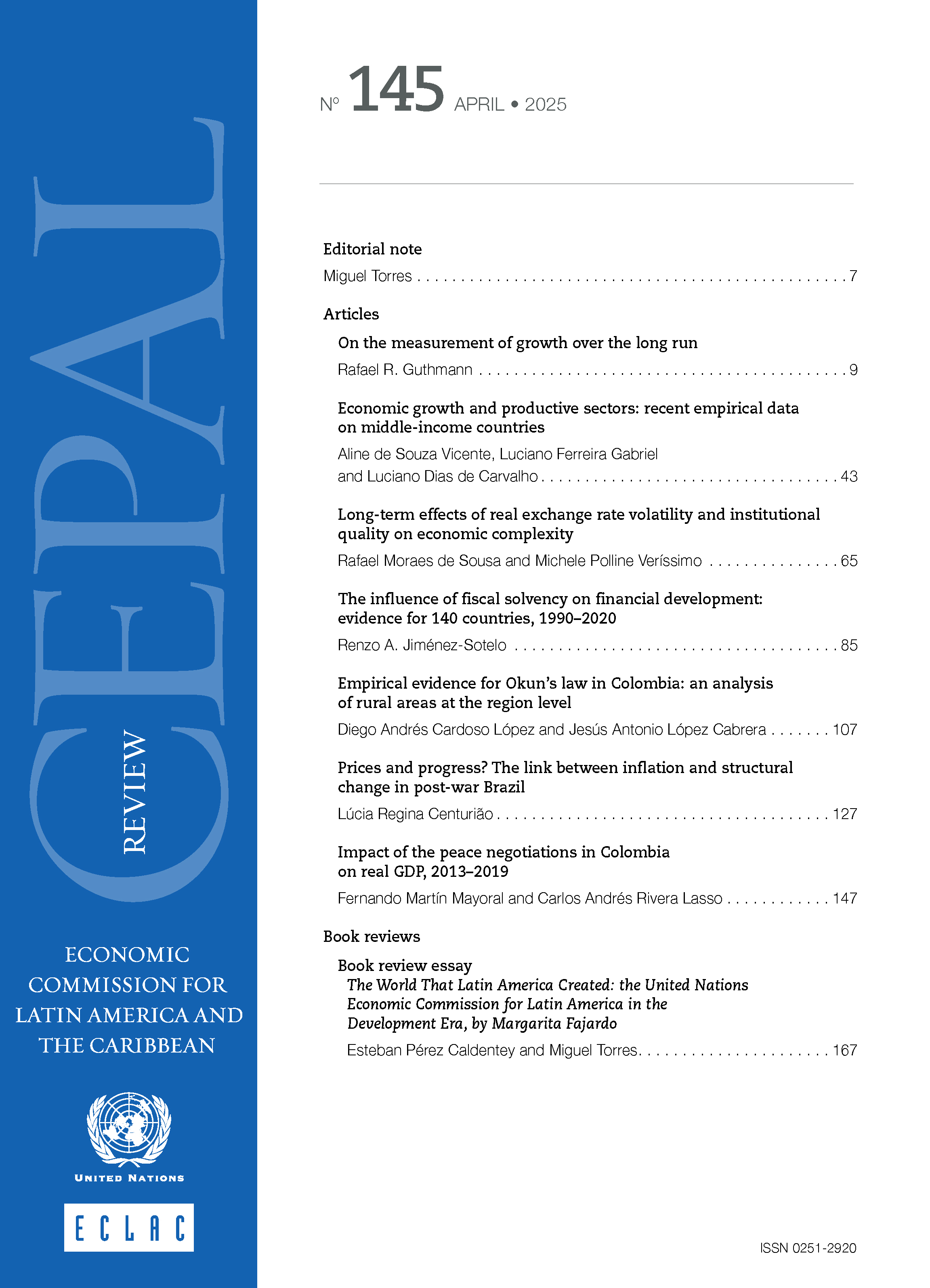
Economic growth and productive sectors: recent empirical data on middle-income countries
- Source: CEPAL Review, Volume 2025, Issue 145, Apr 2025, p. 43 - 63
- Spanish
-
- 30 Apr 2025
Abstract
This article examines how structural change affected economic growth in middle-income developing countries between 1960 and 2019, especially in Brazil (between 1948 and 2020), using the vector autoregression (VAR) model and panel data. The VAR model suggests that structural change in Brazil resulted in the services sector having a greater impact on economic growth owing to the transfer of resources from high-productivity sectors to low-productivity sectors, which reduced the rate of economic growth. Panel data suggest that economic growth in the sample of countries continues to be heavily influenced by the industrial sector and that the weaker momentum of the industrial sector in Brazil is one of the reasons why the country is falling behind.