


Asia-Pacific Development Journal - Volume 22, Issue 1, 2016
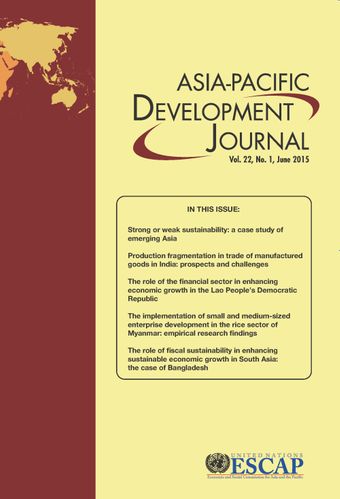
Volume 22, Issue 1, 2016
This publication provides a platform for the exchange of knowledge, experience, ideas, information and data on all aspects of economic and social development issues and concerns facing the region and aims to stimulate policy debate and assist policy formulation. The Asian development experience is an example of what can be achieved when policymakers, experts, scholars and people at large harness their creativity, knowledge and foresight. The APDJ provides a scholarly means for bringing together research work by scientists and practitioners for use by a variety of stakeholders.
Language:
English
-
-
Strong or weak sustainability: A case study of emerging Asia
More LessAuthors: Anamika Barua and Bandana KhataniarSustainability can be weak or strong, depending on the nature of capital accumulation. Weak sustainability is characterized by a non-declining combined stock of capital and assumes that man-made capital can be replaced with natural capital. Strong sustainability, on the other hand, implies that natural capital cannot be replaced by any other capital. Based on this understanding, the present study analysed the growth patterns of 10 emerging Asian economies using time-series data over a 20-year period. For this purpose, the study used genuine savings as an indicator of weak sustainability and ecological footprint as an indicator of strong sustainability. The study found that the selected Asain economies, particularly the middle-income countries, are following a path of weak sustainability. While the high-income countries are gradually making an attempt, through various policy interventions, to move from a path of weak to strong sustainability, despite genuine savings having stabilized their ecological footprint per capita continues to show an increasing trend.
-
-
-
Production fragmentation in trade of manufactured goods in India: Prospects and challenges
More LessAuthors: Sadhana Srivastava and Rahul SenThe present paper analyses the phenomenon of production fragmentation in trade of manufactured goods in India, using trade data at the Standard International Trade Classification (SITC) 5-digit product level. It estimates production fragmentation through a decomposition of intra-industry trade in parts and components into horizontal and vertical intra-industry trade over the period 1994-2012. The paper at the product level finds that aircraft parts and automobile parts and the components industry are emerging areas of production fragmentation in manufactured goods trade over this sample period. It further observes that aircraft parts (SITC 79295) is the only parts and component product to undergo product fragmentation at the higher end of the global value chain and that the auto parts and components industry is found to be experiencing this primarily at the lower end of the value chain.
-
-
-
The role of the financial sector in enhancing economic growth in the Lao People’s Democratic Republic
More LessAuthor: Kristina SpantigThe financial sector of the Lao Peoples Democratic Republic has been developing rapidly in recent years in terms of financial depth, intermediation and distribution. A developed financial sector is the basis for dynamic economic growth. Yet, unsustainable financial liberalization and growth poses risks to financial sector stability. The present report scrutinizes the role of the financial sector in enhancing economic growth in the Lao Peoples Democratic Republic and aims to answer the question of adequate financial sector supervision with respect to the economys development. It is argued that only a prudentially supervised financial sector can enhance the economic growth performance of the country in the medium and long term.
-
-
-
The implementation of small and medium-sized enterprise development in the rice sector of Myanmar: Empirical research findings
More LessAuthor: Naylin OoThis study has three objectives in assessing the implementation of small and medium-sized enterprise (SME) development in the rice sector of Myanmar. This study attempted to (a) assess the current status of SME development in the rice sector; (b) identify the level of perceptions of the factors affecting the implementation of SME development in Myanmar; and (c) study the impact of policy implementation on different types of businesses in the rice sector of Myanmar. The factors include policy implementation, market access, financing accessibility, technology acceptance, entrepreneurial capability and internationalization. The conceptual framework was prepared and a questionnaire was designed based on these factors. Thirteen hypotheses were proposed in order to ascertain the factors. The study used active agents of SMEs in three top rice-growing regions of Myanmar as the target population for the primary data. In addition, the representatives of government agencies and business associations as well as relevant experts were alternative sources of data. All of the hypotheses were successfully tested and only 3 out of 13 were accepted. The findings revealed that the capability of implementers and local market access had a highly significant relationship with the income generation aspect of SME development, while financing accessibility and entrepreneurial capability exhibited strong significant influences on the employment generation aspect of SME development. The findings are applicable for policymakers, practitioners, implementers of SME development, and entrepreneurs in Myanmar and other developing countries.
-
-
-
The role of fiscal sustainability in enhancing sustainable economic growth in South Asia: The case of Bangladesh
More LessAuthor: Tapan Kumar SarkerThe present paper examines the role of fiscal sustainability in achieving sustainable economic growth in the context of South Asia. Excessive government debts have long-term implications and can cause serious intergenerational consequences. In this paper, the role of fiscal sustainability is discussed and the concept of a just tax system is analysed. Such a tax system can play an important role in achieving economic growth that is sustainable, rather than being focused on short-term gain. Using the case of Bangladesh, the paper highlights some of the key imminent challenges to transforming a tax system to be more equitable and fair. It finds that current taxation systems are based on short-term frameworks and can leave future generations with the ultimate burden of dealing with the limitations of those systems. Based on the case study, which supports those facts, policymakers in South Asian countries could integrate longterm measures to ensure fiscal sustainability in achieving sustainable economic development.
-
Most Read This Month
Article
content/journals/24119873
Journal
10
5
false
en
