


UN Chronicle - Volume 49, Issue 2, 2012
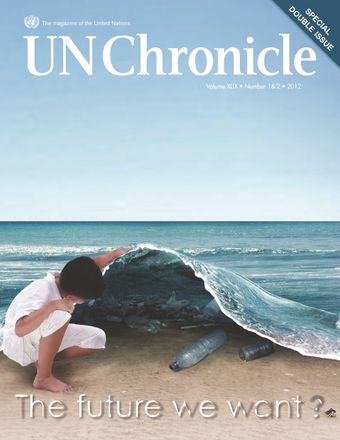
Volume 49, Issue 2, 2012
A must-read for every concerned world citizen, the United Nations Chronicle is a quarterly, easy-to-read report on the work of the United Nations and its agencies. Produced by the United Nations Department of Public Information, every issue covers a wide range United Nations related activities: from fighting the drug war to fighting racial discrimination, from relief and development to nuclear disarmament, terrorism, and the world-wide environmental crisis. This is a double issue, numbers 1 and 2.
-
-
Objectives and vision for Rio+20
Más MenosAutor: Sha ZukangThe United Nations Conference on Environment and Development, held in Rio de Janeiro in June 1992, also known as the Earth Summit, was a landmark event. It adopted the Rio Declaration on Environment and Development, otherwise known as the Rio Principles, and Agenda 21, a programme of action for sustainable development worldwide, and it led to legally binding instruments on climate change and biodiversity. A number of other important agreements and plans of action emerged from the Rio follow-up process, including those relating to combating drought and desertification, and advancing the sustainable development of small island developing States. The Summit left participants filled with great hopes for the future.
-
-
-
Civil society and Rio+20
Más MenosAutor: Bonian GolmohammadiThe 20 years following the original Rio conference in 1992 have not raised high hopes for the Rio process. Priorities have shifted back to business as usual, environmental goals, and the implementation of Agenda 21 are advancing too slowly, economic instabilities dominate the public discourse, and global climate negotiations are continually on the verge of collapse. However, we have not abandoned ship.
-
-
-
Working towards a sustainable UN
Más MenosAutor: Achim SteinerReputation is a key asset for any organization, and the United Nations is no different. That is why it is critical that the organizations that make up the United Nations system clearly demonstrate that they adhere to the same principles that they promote. It is fundamental for maintaining both their reputation and integrity.
-
-
-
Managing the Risks of Extreme Events and Disasters
Más MenosAutor: R. K. PachauriThe Fourth Assessment Report (AR4) of the Intergovernmental Panel on Climate Change (IPCC), which was completed in 2007 stated that: “Warming of the climate system is unequivocal, as is now evident from observations of increases in global average air and ocean temperatures, widespread melting of snow and ice, and rising global average sea level.” It also stated that observational evidence from all continents and most oceans shows that many natural systems are being affected by regional climate changes, particularly in increases in temperature. Significantly, the AR4 found that since the mid-twentieth century most of the observed increase in global average temperatures is very likely due to the observed increase in anthropogenic greenhouse gas concentrations. When the term “very likely” is used in this context, it denotes a probability level of 90 per cent or higher.
-
-
-
Feeding the world sustainably
Más MenosAutor: José Graziano da SilvaThe 1992 Earth Summit in Rio de Janeiro was memorable for its landmark agreements to guide sustainable development worldwide. The first principle of the 1992 Rio Declaration on Environment and Development states: “Human beings are at the centre of concern for sustainable development. They are entitled to a healthy and productive life in harmony with nature.” Twenty years later we have yet to deliver on this fundamental principle—too many people in this world are still not living healthy and productive lives in harmony with nature. Approximately 925 million people are suffering from hunger. We cannot call development sustainable if one out of every seven persons is left behind. At the same time there is hunger, which is senseless in a world that already produces enough food to feed everyone. Hundreds of millions more suffer from obesity and related medical problems.
-
-
-
Sustainable energy for all: Towards Rio+20
Más MenosAutor: Kandeh YumkellaEnergy powers human progress. From generating employment to creating economic competitiveness, from strengthening security to empowering women, energy is the great uniter. It cuts across all sectors and lies at the heart of all countries’ core interests. Now, more than ever, the world needs to ensure that the benefits of modern energy are available to all and that energy is provided as cleanly and efficiently as possible. This is a matter of equity, first and foremost, besides being an issue of urgent practical importance, and it was the impetus for the launch, on 7 November 2011, of the new Sustainable Energy for All Initiative by UN Secretary-General Ban Ki-moon.
-
-
-
Vision needs a seat at the negotiating table
Más MenosAutor: William S. BeckerWhen American theorist Buckminster Fuller said, “[we] are called to be architects of the future, not its victims,” he may not have known how difficult a challenge that would become in the years following his death.
-
-
-
The link between disarmament and sustainable development
Más MenosAutor: Enrique Román-MoreyTwenty years after the 1992 landmark Earth Summit, the world is getting prepared for another conference of the same magnitude, hopefully with increased positive results. Building on commitments adopted by the international community over the last two decades, the United Nations Conference on Environment and Development— Rio+20— should pave the way for the launch of a reinvigorated sustainable development agenda—one that takes into account the complex nature of the root causes of poverty which lie at the core of the devastating effects of environmental degradation, as well as the cross-cutting nature of this issue that it is embedded in almost every economic and social activity of mankind. The conference, to be held in Rio de Janeiro from 20 to 22 June this year, must also consider the so-called “new and emerging challenges” that are affecting the world today, and frame its outcome under four basic key objectives: implementation, coherence, integration, and accountability.
-
-
-
Managing the water-land-energy nexus for sustainable development
Más MenosAuthors: Holger Hoff, Charles Iceland, Johan Kuylenstierna and Dirk Willem te VeldeWe live in the Anthropocene in which humans have become a major force shaping the environment. Rising incomes and reduced poverty have coincided with the growing demand for goods and services, such as food and energy, which in turn has increased the pressure on natural resources and ecosystems leading to their overexploitation and degradation. Climate change adds to this predicament, as several climate adaptation and mitigation measures such as irrigation, desalination, or biofuels, are also resource intensive.
-
-
-
Why water management starts at the local level
Más MenosAutor: Margaret Catley-CarlsonWater is ubiquitous: it is essential for all forms of life and virtually all economic activities. The United Nations has declared that a human right exists for reliable access to safe and clean drinking water and sanitation which, along with other domestic purposes, accounts for about 7 to 10 per cent of all water use. We require water for so much: transportation, municipal and industrial uses (from about 10 to 30 per cent), agricultural (more than 70 per cent), recreational, religious, and more.
-
-
-
Floods and climate change: Sustainable development and other imaginations
Más MenosAutor: Rohan D’SouzaSoaked as we are in anxieties about climate change, the great flood in the Book of Genesis offers a defining metaphor. Nature, in this mythological account, plays out as vengeful disaster. The Ark, on the other hand, is a technology that can mitigate and ultimately save lives while Noah, the patriarch, embodies prescient policy. The story of the great deluge, however, for all its compelling elements, gets one aspect of the plot wrong—the idea of the flood itself as always being an overwhelmingly calamitous event.
-
-
-
Bringing star power to earth
Más MenosAutor: Young-Gil KimThe international community is threatened by a global energy crisis, climate, and ecosystem changes due to global warming, as well as water and food contamination. The whole world faces tremendous challenges in closing the gap between projected energy demand and the supply of sustainable, carbon-free, affordable energy. Today, about 80 per cent of the world’s total primary energy demand is met by fossil fuel which emits significant quantities of carbon dioxide (a greenhouse gas) into the atmosphere. An inherently secure supply from safe, environmentally sustainable, and commercially viable sources is needed in order to meet the capacity of the global demand for baseload energy requirements—the minimum constant demands.
-
-
-
Health and food security benefits from climate change mitigation
Más MenosAutor: Drew ShindellSocieties must find a way to stop the rapid growth in carbon dioxide (CO2) emissions to avoid a disastrous future for our planet. As the greatest contributor to global warming, CO2 is the natural focus of current climate negotiations. Unfortunately, one of the very properties that makes CO2 so problematic—the long time it stays in the atmosphere—creates high barriers to efforts aimed at reducing its emissions. First, the benefits of limiting CO2 emissions present themselves only after many decades, which is well beyond the focus of most politicians or corporations. Second, nations disagree over how much responsibility for reductions should be based on historical emissions or on current levels.
-
-
-
Our cities ourselves: Visions of the future
Más MenosAutor: United NationsThe twenty-first century is without doubt the era of the metropolis. Cities must confront major environmental challenges, and they have the means to do so. Cities know how to create valuable synergies between citizens, enterprises and institutions. By building direct links with inhabitants and those utilizing cities for work and leisure, key communities can be unified for reflection and action. The Chronicle addresses these important points.
-
-
-
Vulnerable countries should take centre stage at Rio+20
Más MenosAutor: Cheick Sidi DiarraAs the world’s attention turns to the United Nations Conference on Sustainable Development or Rio+20 in June 2012, we are all reminded of the multiple crises which continue to bedevil the globe. These crises are all the more evident in resource-strapped nations that continue to battle a myriad of challenges related to poverty and underdevelopment.
-
-
-
Addressing the sustainable urbanization challenge
Más MenosAutor: Aisa Kirabo KacyiraOver the last two decades, demographic and economic changes have propelled cities and urban centres to become the principal habitat of humankind. Cities are not only where rapid improvements in socio-economic and environmental conditions are possible, but it is, indeed, where such change is most needed. The cities of the world’s emerging economies are increasingly drivers of global prosperity while the planet’s resources are fast depleting. It is, therefore, more critical than ever that Member States and United Nations agencies commit themselves to realize the goal of sustainable urbanization as a key lever for development.
-
-
-
Gender equality and sustainable development
Más MenosAuthors: Monique Essed Fernandes and Eleanor BlomstromChampioned by a wide range of stakeholders from civil society and the Women’s Major Group, to Governments and United Nations agencies, the Rio+20 Conference in June will no doubt include gender equality in several places of its outcome document. What will this mean for the achievement of true gender equality and sustainable development? The two are inextricably linked, but the discourse on gender equality and sustainable development within the context of Rio+20 cannot be fully understood without looking back at some remarkable events which shaped the first Rio Conference 20 years ago.
-
-
-
Involving the forgotten: Widows and global sustainable development
Más MenosAutor: Raj LoombaFour years ago, the UN Chronicle offered me a forum to propose, and give reasons for, the proclamation of an annual International Widows’ Day. That idea has become reality with the United Nations General Assembly declaring 23 June as International Widows’ Day. In a message last year, United Nations Secretary-General Ban Ki-moon observed that “this first International Widows’ Day is an occasion to call attention to the many “firsts” that women must face when their husbands die. In addition to coping with grief, they may find themselves for the first time since marriage without any social safety net. Far too often, widows lack access to inheritance, land tenure, employment and even the means to survive. In places where a widow’s status is linked to her husband, she may find herself suddenly shunned and isolated. Marriage—whether she desires it or not—may be the only way for a widow to regain her footing in society. Of the approximately 245 million widows in our world, more than 115 live in extreme poverty. In countries embroiled in conflicts, women are often widowed young and must bear the heavy burden of caring for their children amid fighting and displacement with no help or support. Some of these widows are teenagers—or even younger. The deaths of their husbands can leave a terrible legacy these widows must endure throughout their remaining years.”
-
-
-
Ombudspersons for future generations: Bringing intergenerational justice into the heart of policymaking
Más MenosAutor: Alice VincentNational and international policymaking is inherently constricted to short-term thinking by electoral cycles, and waylaid from a sustainable path by the obsession with profit margins. Heads of Government spend so much of their time defending their incumbent seat that their policymaking is primarily focused on gaining and retaining votes. The electorate, i.e., people over the age of 18, misses out a substantial chunk of the demographic—namely, those under 18, the generations that are yet unborn, and the generations deceased. As the philosopher Edmund Burke wrote: “[Society is] a partnership not only between those who are living, but between those who are living, those who are dead, and those who are to be born.” Society is not, as it has become, a game of political horse-trading between the ruling party and the opposition which tries to court capricious swing voters.
-
-
-
Hunger: A National Security Threat
Más MenosAutor: Abid Qaiyum SuleriAlthough the term food security was coined only 16 years ago, humanity has been striving against famine and hunger since ancient times. Agreement at the 1996 World Food Summit, based on the concept that food security exists “when all people at all times have access to sufficient, safe, nutritious food to maintain a healthy and active life”, gave a new vision to efforts against hunger and malnutrition. According to this definition, food insecurity is multidimensional, and affects people at the global, regional, national, sub-national and household levels. It presents itself in various forms, such as chronic, acute, and transient. In addition, in order to be food secure, there are different requirements for men, women, children and the elderly.
-
Most Read This Month
