


The UNESCO Courier - Current Issue
Volume 2025, Issue 3, 2025
-
-
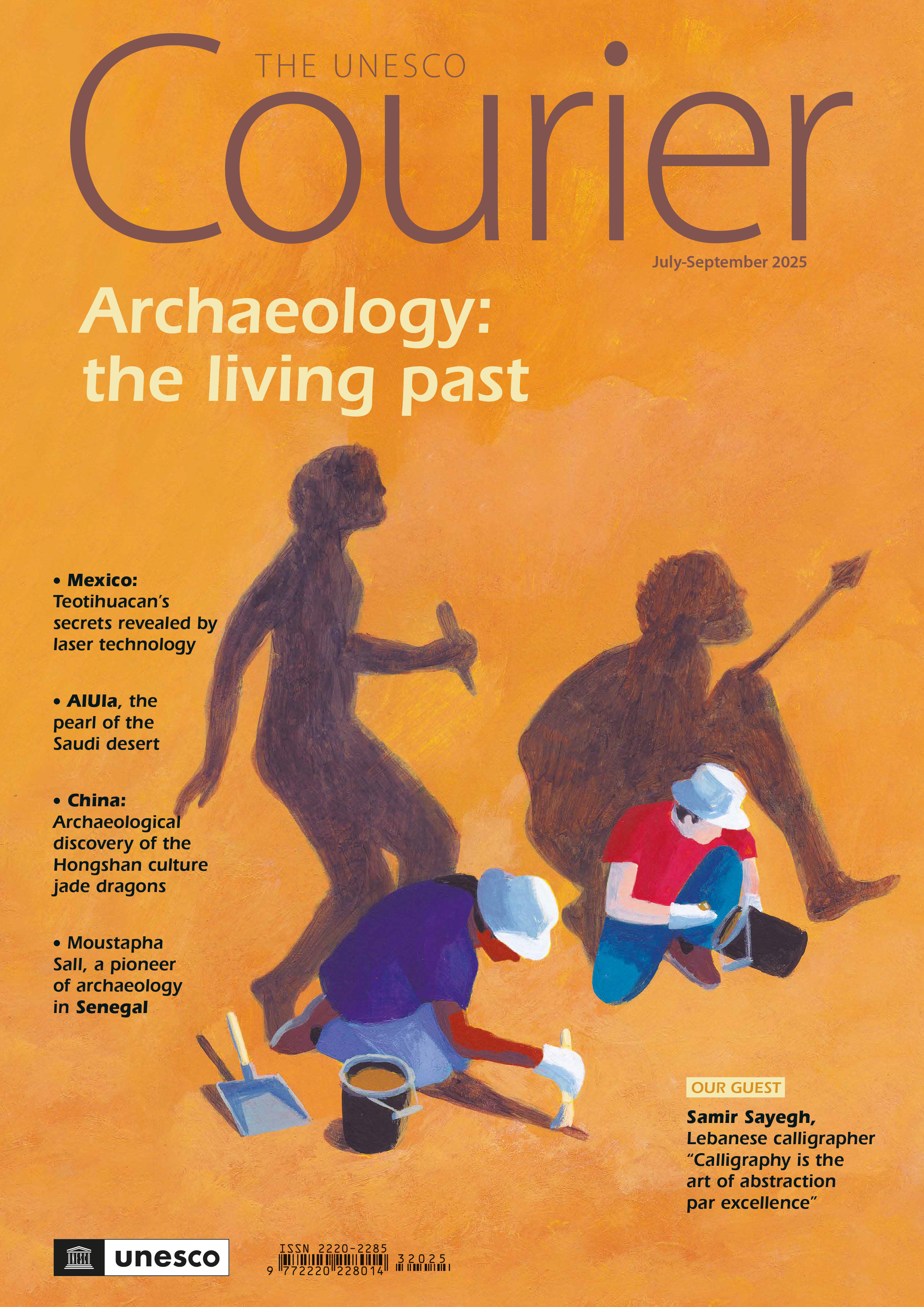
Archaeology: The living past
More LessScientific progress relies on discoveries and new perspectives that continuously challenge established certainties. Archaeology is no exception. Long-held notions – such as the perceived lack of intelligence among hunter-gatherers or the causal link between agriculture and centralized power – are now being re-examined.
-
-
-
David Wengrow: “We need to dismantle the myths surrounding the origins of our social order”
More LessAccording to the long-prevailing view, human societies were initially organized as groups of egalitarian hunter-gatherers living in harmony with nature. The domestication of livestock and the development of agriculture – and the consequent accumulation of wealth – then led to the emergence of complex, hierarchical societies. David Wengrow, a professor of comparative archaeology at University College London, challenges this idea of the natural evolution of societies. His book The Dawn of Everything, co-written with anthropologist David Graeber, has become a best-seller.
-
-
-
AlUla, the pearl of the Saudi desert
More LessThe AlUla oasis in Saudi Arabia’s desert heart has long been a wellguarded archaeological secret. Today, layer by layer, the millenniaold history of this ancient crossroads of cultures – a strategic stop on the Incense Route that linked the Arabian Peninsula to the great civilizations of East and West – is being unveiled.
-
-
-
Archaeological discovery of the Hongshan culture jade dragons
More LessIn 2024, archaeologists unearthed some of the most important vestiges of ancient settlements in Chifeng, in the Inner Mongolia Autonomous Region of China. To date, over 700 sites of Hongshan culture have been found. The archaeological discoveries unveil the narrative of a vibrant Neolithic culture rooted in the worship of ancestors, heaven, and earth.
-
-
-
The impact of climate change on archaeological sites
More LessThawing permafrost, coastal erosion, flooding, and droughts are some of the phenomena that threaten potentially millions of ancient sites around the world. Integrating archaeology into global climate policy is crucial for the preservation of the world’s archaeological heritage.
-
-
-
Moustapha Sall, a life spent exploring the past
More LessSenegal has only a few archaeologists to explore the country’s numerous sites. One of them is Moustapha Sall. For decades, he has roamed the region in search of traces left by the people who once lived there.
-
-
-
Mexico: Laser technology is revealing Teotihuacans secrets
More LessThe largest metropolis in pre-Columbian America is now yielding valuable information thanks to lidar, a revolutionary laser mapping technology that is opening up new perspectives for archaeologists throughout the region.
-
-
-
André Delpuech : “Looting a site means irreparably destroying unique sources of information”
More LessHighly prized by collectors, pre-Columbian relics are the object of intense trafficking, fuelled in particular by “huaqueros”, the grave robbers who operate in several Latin American countries. These clandestine excavations deprive archaeologists of information essential to understanding civilizations that have now disappeared, laments André Delpuech, a French general curator of heritage. He is also a researcher at the Alexandre Koyré Centre of the École des Hautes Études en Sciences Sociales in Paris.
-
-
-
The undiminished glory of the pharaohs
More LessAncient Egypt has fascinated people for centuries. Synonymous with blockbuster museum visitors, the history of the kings of the Nile Valley occupies a special place in the collective imagination. The aura of mystery that surrounds this period, this civilizations spectacular monuments and its links with the afterlife partly explain this.
-
-
-
What will remain of us for tomorrows archaeologists?
More LessMan-made minerals, synthetic plastic, concrete blocks, and inked sheets of paper are among the remnants of our civilization that future archaeologists will uncover, according to Jan Zalasiewicz and Sarah Gabbott, professors of paleobiology and authors of a book on the subject.
-
-
-
Zoom: The inner seasons of Han Feng
More LessAttention is the rarest and purest form of generosity.” Few ideas resonate more deeply with The Gift, the still life photography series by the artist Han Feng, than this reflection by French philosopher Simone Weil. Created in the quiet of her New York home during the pandemic, the photographs are intimate compositions of fruits, vegetables, stones, ceramics and treasured objects collected from around the world, assembled on an antique Chinese wooden table. There, the everyday becomes extraordinary. A precariously balanced pumpkin, a chipped porcelain bowl, a motionless yet swimming ribbonfish, a withering flower – each is not merely a subject, but a gesture, a moment suspended between memory and play. In Han Feng’s lens, the language of cuisine, vessels, and lights wave into a visual diary that is both personal and universal.
-
-
-
When reality bites: What draws us to true crime?
More LessBorrowing narrative elements from both investigative journalism and the crime novel, true crime – often called “crime documentary” – has long fascinated the public. Today, streaming series and podcasts are putting a huge boost on this deeply rooted popular culture genre. Its success stems partly from a human need to comprehend the inexplicable, confront our fears, and draw a clear line between good and evil. However, these criminal narratives also bring significant ethical questions to the forefront.
-
-
-
Our guest: Samir Sayegh: “Calligraphy is the art of abstraction par excellence”
More LessLebanese thinker, poet, and art critic Samir Sayegh is also one of the undisputed masters of contemporary Arabic calligraphy. In an attempt to liberate calligraphy beyond the meaning of each letter, he uses geometric forms to develop a universal language. His work, influenced by the minimalism of modern art, is exhibited by major international institutions such as the British Museum (United Kingdom) and the Barjeel Art Foundation (United Arab Emirates).
-
-
-
In depth: Ocean science: Youth dive in!
More LessLaunched in 2021, the Environmental DNA (eDNA) Expeditions[1] have allowed to mobilize hundreds of students and schoolchildren across marine World Heritage sites to collect water samples with kits for recording species’ presence. The goal is to study the impacts of climate change among global marine biodiversity hotspots. A second phase of the eDNA project was launched in June 2025.
-
Volumes & issues
Most Read This Month Most Read RSS feed
