- E-ISSN: 16840348
-
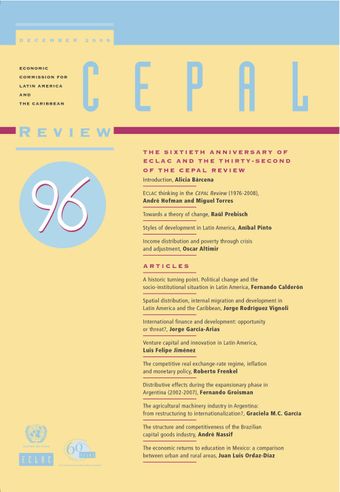
The competitive real exchange-rate regime, inflation and monetary policy
- Source: CEPAL Review, Volume 2008, Issue 96, Dec 2008, p. 191 - 201
- Spanish
-
- 07 Dec 2008
Abstract
This article argues that in a stable and competitive real exchange-rate (SCRER) macroeconomic regime, the exchange-rate component can drive up Inflation through the very mechanisms that stimulate high rates of gross domestic product and employment growth: to offset this pressure, fiscal and monetary policies will have to be used to control aggregate demand. It finds that in an exchange-rate regime of this type, monetary policy has a degree of autonomy that can be exploited to apply active monetary policies. It analyses the degree to which monetary policy can be used to control aggregate demand and concludes that it cannot bear the main responsibility for this, which means that fiscal policy ought to be the main instrument for controlling aggregate demand.