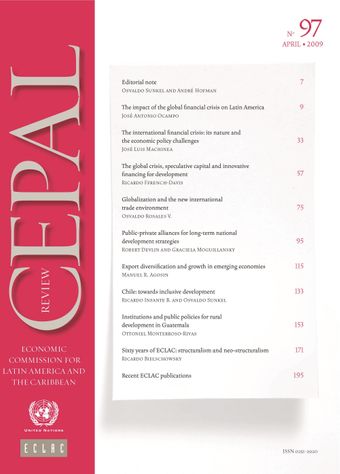
- E-ISSN: 16840348
-
Public-private alliances for long-term national development strategies
- Source: CEPAL Review, Volume 2009, Issue 97, Jul 2009, p. 95 - 113
- Spanish
-
- 27 Jul 2009
Abstract
Few developing countries have succeeded in consistently closing the income gap with the world’s richest nations without proactive government action in pursuit of economic transformation and a dynamic role in the global economy. Two factors are crucial here: the development and implementation of a medium- and long-term strategy to achieve rapid economic transformation, and the support provided to this strategy by a public-private alliance forged by means of a social process suited to local conditions. This article analyses the way alliances of this kind operate in 10 countries outside the region deemed to be successful because they have achieved a process of convergence with the developed countries or performed better than those of Latin America and the Caribbean, despite having similar resource endowments. One element that is lacking in the region, or at best is only incipient, is public-private collaboration. Thus, the aim of the analysis is to prompt reflection about the kind of alliances we ourselves could form to underpin strategies aimed at creating “Latin American tigers”.