- E-ISSN: 16840348
-
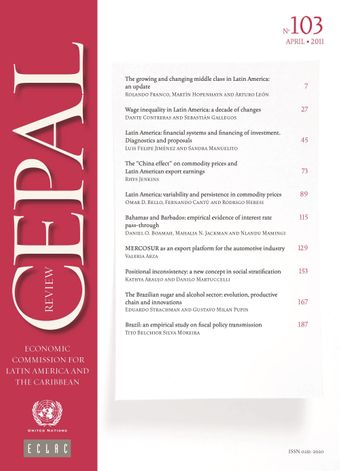
Wage inequality in Latin America: A decade of changes
- Source: CEPAL Review, Volume 2011, Issue 103, Aug 2011, p. 27 - 44
- Spanish
-
- 02 Aug 2011
Abstract
This work helps to explain the determinants of wage distribution in Latin America in the 1990s. The study employs the basic model of wage variance decomposition developed by Fields (2002), on the basis of an estimated Mincer wage equation adjusted for selection bias, which enables quantification of the impacts of the different explanatory variables of wage inequality. One of the main findings is that education is by far the most important factor in wage inequality in the region. What is more, it has become more significant over time, even though the explanatory power of the model has remained stable.
© United Nations