


The UNESCO Courier - Volume 2021, Issue 4, 2021
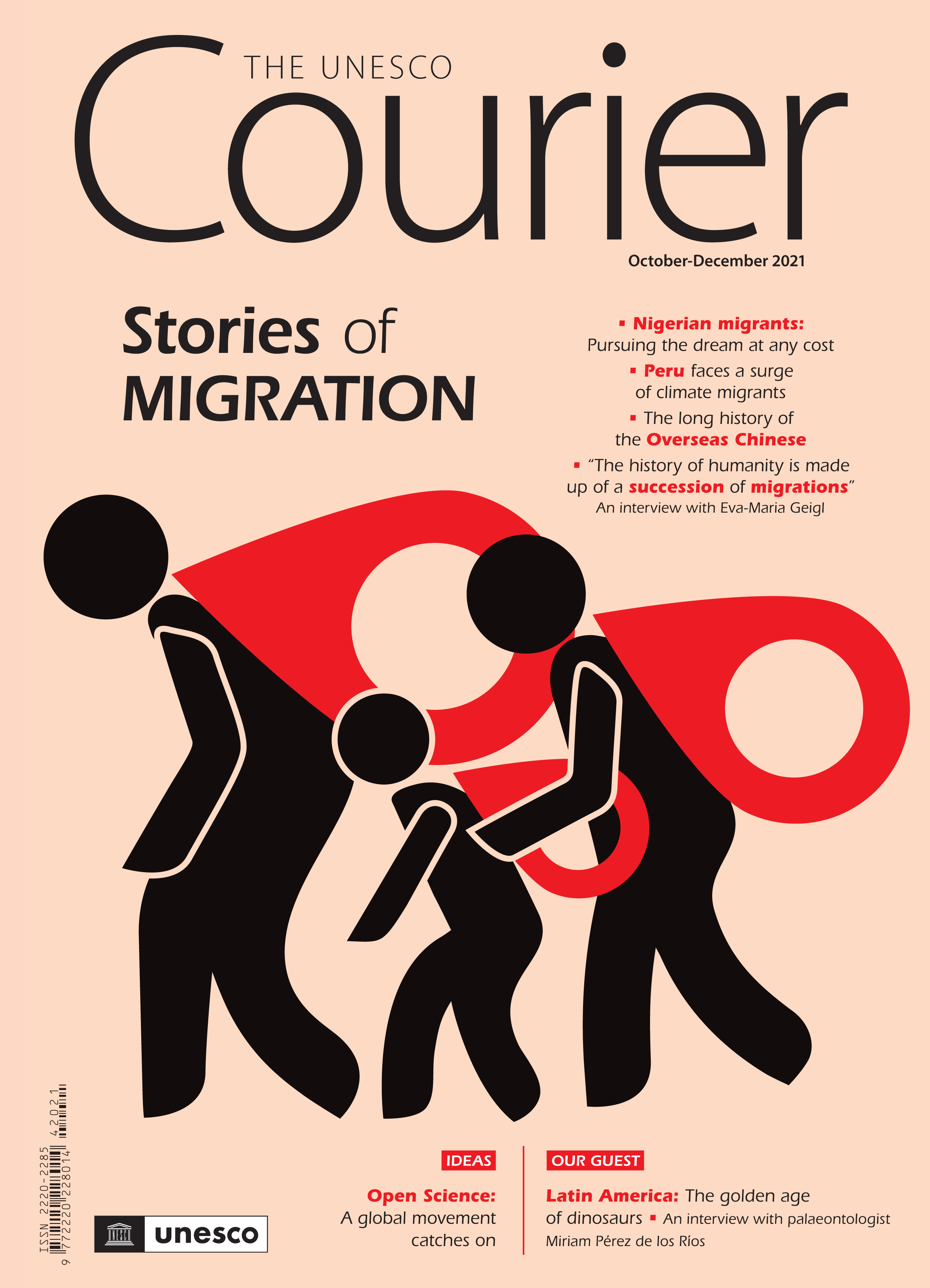
Volume 2021, Issue 4, 2021
-
-
Wide angle: Stories of migration
More LessAuthor: Agnès BardonFor the first time in many years, the increase in the number of international migrants slowed down in 2020. This slight downturn can be explained primarily by the restrictions on movement linked to the Covid-19 pandemic – the flow of migrants has otherwise been steadily growing for decades. In 2020, 281 million people were living in a country in which they had not been born. This figure has increased from 173 million in 2000, and 84 million in 1970.
-
-
-
Nigerian migrants: Pursuing the dream at any cost
More LessAuthor: Lanre IkuteyijoNigerian youth constitute one of the largest populations among migrants travelling from countries of the Global South to Europe. Why are these young people deciding to leave their country? Are they aware of the dangers they may encounter en route? These questions formed the basis for my study, Irregular Migration as Survival Strategy: Narratives from Youth in Urban Nigeria, published in 2019.
-
-
-
Refugees: Overcoming prejudices
More LessAuthor: Alexander BettsToday there are more people displaced by persecution, conflict, and other crises than at any time since the Second World War – 82.4 million, with 26 million having crossed a border as refugees. However, amid the politicization of asylum and immigration, in both rich and poor countries, refugees increasingly face challenges of accessing international protection.
-
-
-
Peru faces a surge of climate migrants
More LessAuthor: Laura BerdejoBetween 2008 and 2019, around 656,000 of Peru’s 33 million inhabitants were forced to move because of natural disasters, according to the Internal Displacement Monitoring Centre (IDMC). It is estimated that by 2100, these movements could reach unprecedented levels, as the frequency and intensity of environmental hazards are expected to skyrocket.
-
-
-
In Canada, a centre to treat the wounds of exile
More LessAuthor: Guy SabourinAssane Traoré, now a refugee in Quebec, recently left West Africa, where he witnessed massacres and violence perpetrated by jihadist groups. In the evenings, he locks himself in with his family, pulling the shades to cover the windows. He constantly feels he is being followed.
-
-
-
Mobile phones: An indispensable tool for migrants
More LessAuthor: Moha Ennaji“Sometimes I have to choose between food and internet connectivity, to keep in touch with my family back home. When I need money, I make a call to them via WhatsApp, and they send it very quickly.” This is how Mamadou, a 22-year-old from Niger, sums up the key role that smartphones now play in the lives of migrants. The fact that refugees can spend up to a third of their budget on internet access – according to the Rabat office of the UNHCR, the United Nations Refugee Agency – is proof of how important these portable devices are.
-
-
-
Venera Toktorova: A Kyrgyz migrant makes her way
More LessAuthor: Nazigul JusupovaIn a lively café filled with Asian music in Moscow’s east, a woman watches the comings and goings of the servers with an authoritative eye, while checking her mobile phone from time to time. Wearing a light-coloured dress and her hair neatly tied back, Venera Toktorova, 40, is the owner of the Sulaiman-Too – named after the sacred mountain of her homeland.
-
-
-
The overseas Chinese: A long history
More LessAuthor: Zhuang GuotuThere are more than 10.7 million Chinese overseas today – about 60 million, if their descendants are included – according to the International Organization for Migration (IOM).
-
-
-
Teeth: Mapping our past mobility
More LessAuthor: Jenny DareAncient teeth can be analysed by archaeologists to uncover patterns of migration. “With some sleuthing, the chemical composition of a person’s tooth provides a mini-life history,” says Carolyn Freiwald, archaeologist and associate professor of Anthropology at the University of Mississippi, United States, who studies the biology and chemistry of teeth.
-
-
-
Zoom: Dominique Roger: “UNESCO offered me the world”
More LessAuthor: Katerina MarkelovaOn 4 November 1966, an acqua alta, an exceptionally high tide that periodically floods Venice, burst the coastal dykes, drowning the city under more than a metre of water. Following the call for international solidarity launched by UNESCO, countries around the world came to the rescue of this architectural wonder.
-
-
-
Ideas: Open science: A global movement catches on
More LessAuthor: Chérifa Boukacem-ZeghmouriThe Covid-19 pandemic has allowed us to observe a great surge of collaboration and sharing of scientific knowledge among researchers – in the effort to cope with the virus, provide the most effective treatments, and especially, to find a vaccine. We have seen barriers fall when the major scientific publishing groups – such as Elsevier, Springer Nature, and Wiley – opened access to thousands of research articles. This allowed scientists from all over the world to read them, keep up with research advances, and thus, accelerate their work.
-
-
-
Making scientific evaluations more transparent
More LessAuthor: Alex HolcombeA year and a half into the Covid-19 pandemic, science has saved many lives. Without basic biomedical research, the vaccines could not have been engineered and evaluated for safety and efficacy. But the scientific community has not been as clear on other critical issues related to the pandemic. The evidence on the usefulness of masks, for example, and on the reliability of models of viral transmission, has been tentative. This is partly because many of the relevant studies have been flawed.
-
-
-
In depth: Journalism: A dangerous profession
More LessAuthor: Linda KlaassenOver the past decade, a journalist has been killed every four days on average. Each year since 2016, more journalists have been killed outside of conflict zones than in countries currently experiencing armed conflict. A total of eighty-six killings of journalists worldwide have been reported between 2020 and the end of June 2021.
-
Volumes & issues
Most Read This Month
