Artificial Intelligence (AI)

Did you know that this collection also highlights ethical and sustainable considerations? Discover how AI can drive sustainable development and foster innovation for a better future.
Collection Contents
1 - 20 of 24 resultados
-
-
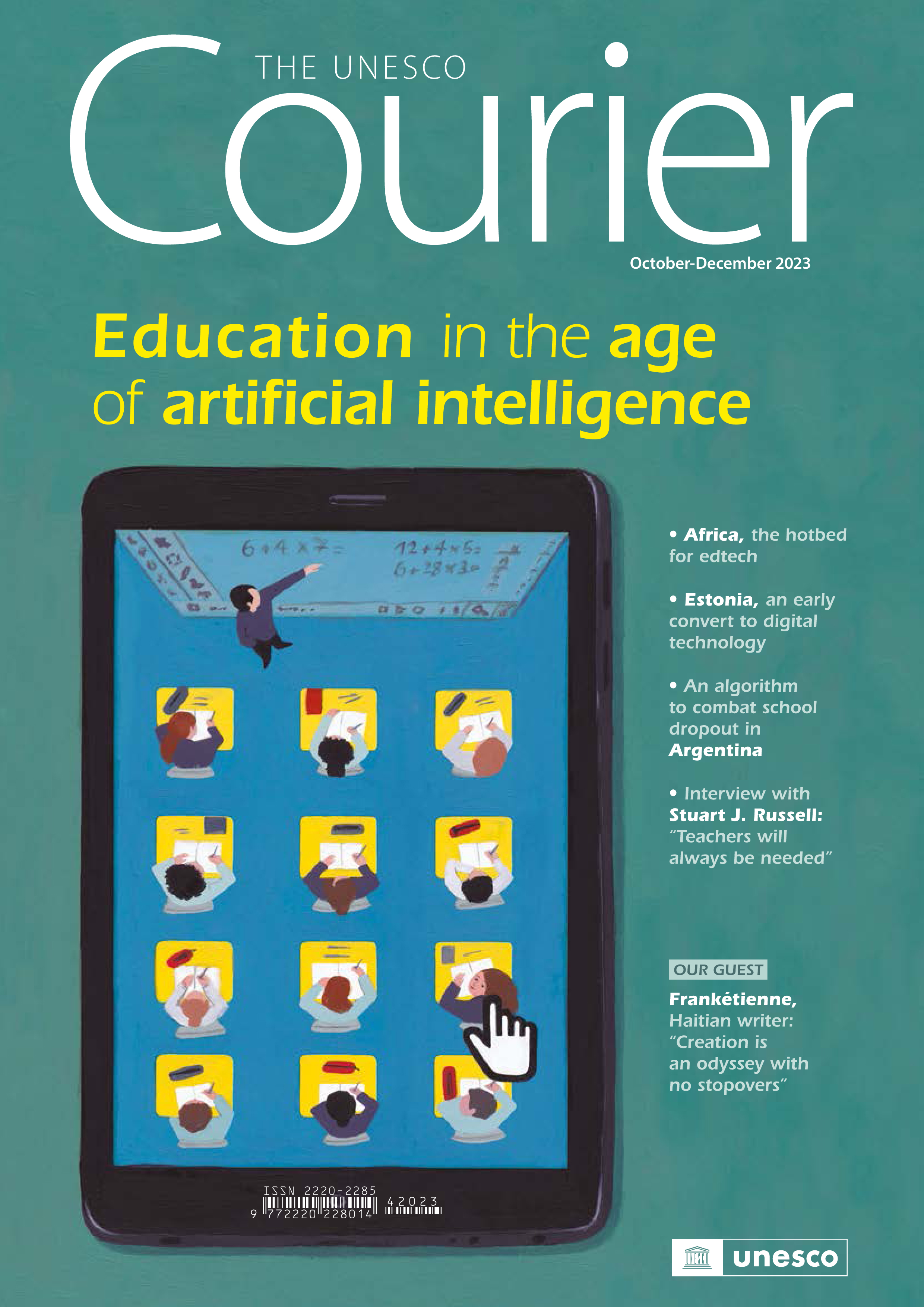
Wide Angle: Education in the age of artificial intelligence
Más MenosAt a time when the field of education is in worldwide ferment, a single instructional phenomenon has captured the attention not only of professionals but of laymen.” Does the innovation in question refer to artificial intelligence (AI), or to the use of augmented reality in the classroom? Neither one. This quote is from an article in The UNESCO Courier about “teaching machines”, a set of programmes developed in the USA to guide students in their learning. It dates back to March 1965.
-
-
-
AI must be kept in check at school
Más MenosThe use of artificial intelligence in education needs to be subject to supervision and independent evaluations. Only then, argues Ben Williamson, will schools be able to maintain their mission of developing critical thinking and shaping the citizens of tomorrow.
-
-
-
Machine Learning
Más MenosMachine learning is a “field of study that gives computer the ability to learn without explicitly being programmed”. It is closely related to, and uses methods from, other fields such as statistics, computer science and artificial intelligence.
-
-
-
Sal Khan: “I see AI as an additional tool, but a very powerful one”
Más MenosSince March 2023, Khan Academy, a non-profit organization offering free online education, has been piloting a teaching assistant powered by artificial intelligence (AI) called Khanmigo. Khan Academy’s founder Sal Khan is convinced that, when properly supervised, this tool can help students consolidate their learning and improve their self-esteem.
-
-
-
Industry 4.0: Concept and main characteristics
Más MenosIndustry 4.0, often interchangeably called the fourth industrial revolution, refers to the smart and connected production systems made possible by new technologies, particularly involving the increased use of automation and data exchanges (UNIDO, 2017). The technologies identified as part of industry 4.0 vary by source, yet it is commonly understood that artificial intelligence, the Internet of things, big data, robotics and three-dimensional printing are integral parts of this new wave (UNCTAD, 2019a; UNCTAD, 2021a).
-
-
-
Stuart J. Russell: “Teachers” work may change but we will always need them”
Más MenosCapable not only of providing content but also of interacting with students, generative artificial intelligence (AI) can be an excellent aid to teachers, as long as its development is controlled and supervised, explains Stuart J. Russell, professor of computer science at the University of Berkeley (United States) and co-author with Peter Norvig of the reference book Artificial Intelligence: A Modern Approach.
-
-
-
An algorithm to combat school dropout in Argentina
Más MenosSince 2022, schools in the province of Mendoza have been using artificial intelligence to detect the pupils most likely to drop out early.
-
-
-

AI innovations to counter social challenges
Más MenosArtificial intelligence (AI) is being harnessed to tackle two of the most challenging problems today – the flagrant proliferation of fake news and the increasing invasion of individual privacy. Factmata, which uses AI to fight disinformation and D-ID, which protects identities from facial recognition systems using AI, were two of the ten winners of the 2019 Netexplo awards, presented at UNESCO Headquarters in April.
-
-
-
UNODA Occasional Papers No. 45
Handbook on Responsible Innovation in AI for International Peace and Security
Más MenosThe objective of this handbook is to compile basic knowledge and means for artificial intelligence (AI) practitioners to understand, evaluate and mitigate, in the research and innovation process, the risks of the diversion and misuse of civilian AI technology by irresponsible actors. The handbook shows why and how decisions around the development and diffusion of research and innovation can impact risks of misuse, and in turn generate risks or even opportunities for international peace and security.
-
-
-

Harnessing the Potential of Human-in-the-loop Artificial Intelligence for Risk Anticipation and Violence Prevention
Development Futures Series No. 63
Más MenosDevelopment organizations and conflict experts struggle to manage the magnitude, complexity and persistent volatility that characterize contemporary crises. Conflicts evolve at such a rapid pace that the amount of data produced by conflict or crisis situations is simply overwhelming. Because of the sheer amount of data and the pace at which they are being produced, human beings are unable to track crisis evolutions and manage effective decision-making processes. Under these radically changing circumstances, artificial intelligence (AI) can help us understand, and even anticipate, the outbreak and evolution of a crisis. Human-in-the-loop (HITL) AI combines the power of machine learning with human intelligence to address complex issues. This brief presents examples from Afghanistan and Ukraine to showcase applications of HILT artificial intelligence in the sphere of conflict resolution, particularly emphasizing risk anticipation and violence prevention.
-
-
-
Benchmarking Econometric and Machine Learning Methodologies in Nowcasting
UNCTAD Research Paper No. 83
Más MenosNowcasting can play a key role in giving policymakers timelier insight to data published with a significant time lag, such as final GDP figures. Currently, there are a plethora of methodologies and approaches for practitioners to choose from. However, there lacks a comprehensive comparison of these disparate approaches in terms of predictive performance and characteristics. This paper addresses that deficiency by examining the performance of 12 different methodologies in nowcasting US quarterly GDP growth, including all the methods most commonly employed in nowcasting, as well as some of the most popular traditional machine learning approaches. Performance was assessed on three different tumultuous periods in US economic history: the early 1980s recession, the 2008 financial crisis, and the COVID crisis. The two best performing methodologies in the analysis were long short-term memory artificial neural networks (LSTM) and Bayesian vector autoregression (BVAR).
-
-
-
Policy Approaches to Direct Digital Frontier Technologies Towards Inclusive and Sustainable Development
Más MenosDuring the COVID-19 pandemic, digital frontier technologies such as artificial intelligence and big data analytics, amongst others, have been mobilized to fight against the pandemic. But it is also important that digital technologies serve the needs of the Sustainable Development Goals. This report reviews the status of digital frontier technologies in the Asia-Pacific region. It stresses that the policy framework for the next generation of technology and innovation should focus on creating an enabling environment for digital frontier technologies to positively impact economy, society, and environment; and to reduce inequalities.
-
-
-
Artificial Intelligence Futures for the Arab Region
Más MenosThis report presents a comprehensive analysis of Artificial Intelligence (AI) as a transformative global megatrend, specifically examining its far-reaching implications for the Arab region through 2040. It explores AI’s potential to revolutionize key sectors like healthcare, education, cultural preservation, and government services, driving innovation and reshaping economies across the region. The report identifies three strategic pathways for AI’s evolution in the Arab region: optimizing partnerships and technologies for local priorities, promoting cultural and linguistic identity through Arabic-language AI development, and leveraging AI to accelerate progress on the Sustainable Development Goals. Beyond opportunities such as job creation and skill transformation, the report meticulously addresses the inherent risks and challenges associated with AI, including ethical concerns, data governance, and the potential for deepening inequalities. Concluding with a series of key findings and actionable strategic recommendations, it provides essential insights for government agencies, private sector stakeholders, and civil society. It serves as a vital guide for regional leaders, equipping them with the foresight and tools to proactively engage with AI and shape its trajectory for inclusive, equitable, and sustainable development aligned with the Arab region’s unique visions and aspirations.
-
-
-

Compliance of Products with Embedded Artificial Intelligence
Overarching Principles and Declaration to Promote Convergence of Product Regulations
Más MenosInternational harmonization and interoperability of regulations of products with embedded artificial intelligence (AI) or other digital technologies is a challenge for regulators, but essential in order to achieve regulatory objectives, while avoiding unnecessary technical barriers to trade and multiplication of conformity testing. This task is complicated by the fact that products with embedded AI might change throughout their lifecycle after receiving distant updates, well after they have been released on the market. This publication establishes the overarching principles which should be taken into consideration for product regulations which largely reflects the principles set out in the United Nations General Assembly “Seizing the opportunities of safe, secure and trustworthy artificial intelligence systems for sustainable development” (A/78/L.49) and the UNESCO Recommendation on the Ethics of AI (SHS/BIO/PI/2021/1) and the WHO Ethics and governance of AI for health. This publication also builds upon the standards that exist today in this field. It is also compatible with the regulations on the topic which have been published to date. The UNECE WP.6 proposes in the annex of this publication a declaration that government agencies can sign in order to demonstrate their intention to work towards these overarching principles in their product regulation.
-
-
-
Machine Learning for Official Statistics
Más MenosNational Statistics Offices (NSOs) are exploring how machine learning (ML) can be used to increase the relevance and quality of official statistics in an environment of growing demands for trusted information, rapidly developing and accessible technologies, and numerous competitors. While the specific business environments may vary depending on the country, NSOs face similar types of challenges which can benefit from sharing knowledge, experiences and collaborating on developing common solutions within the broad official statistical community. This publication describes some of the ML application areas in the official statistics community, quality considerations needed and lessons learned based on two international initiatives conducted from 2019 to 2021.
-
-
-

Mind the AI Divide
Shaping a Global Perspective on the Future of Work
Más MenosThis report, co-authored by the United Nations and the International Labour Organization, addresses the critical issue of the uneven adoption of Artificial Intelligence (AI) and its implications for global equity, fairness, and social justice. Disparities in access to digital infrastructure, advanced technology, quality education, and training are deepening existing inequalities, particularly as the global economy shifts towards AI-driven production and innovation. Less developed countries risk being left behind, exacerbating economic and social divides. The report stresses the importance of targeted and concerted efforts to bridge this digital divide to ensure AI's potential to foster sustainable development and alleviate poverty. It highlights the role of the workplace in AI adoption, where productivity gains and improved working conditions can be achieved with the right conditions, including digital infrastructure, skills, and a culture of social dialogue. Promoting inclusive growth requires proactive strategies to support AI development in disadvantaged regions, enhance digital infrastructure, build AI skills, and ensure good quality jobs along the AI value chain. International collaboration in AI capacity building is crucial to create a more equitable and resilient AI ecosystem, unlocking opportunities for shared prosperity and human advancement worldwide. The report calls for continued collaborative efforts to shape global AI governance, uphold human dignity and labour standards, and expand economic opportunities for all.
-
-
-
Moving Fast With Frontier Technologies
UNCTAD Policy Brief No. 109
Más MenosIn the last two decades, the use of frontier technologies such as artificial intelligence, the Internet of things and energy from renewable sources has undergone significant growth, and this trend is expected to continue. However, there is still considerable concentration in these markets. The leading frontier technology providers are mostly firms from China, the United States of America and a few other developed countries, with little participation from developing countries. The same pattern is observed with regard to knowledge generation and trade. Governments of developing countries should take proactive action to increase preparedness to use, adopt and adapt such technologies and to take up the economic opportunities linked to them. Some of the challenges associated with the adoption of new technologies in developing countries are addressed in this policy brief, and some policy recommendations are proposed.
-
-
-

United Nations Global Principles for Information Integrity
Recommendations for Multi-stakeholder Action
Más MenosTechnological advances have revolutionized communications, connecting people on a previously unthinkable scale. They have supported communities in times of crisis, elevated marginalized voices and helped mobilize global movements for racial justice and gender equality. Yet these same advances have enabled the spread of misinformation, disinformation and hate speech at an unprecedented volume, velocity and virality, risking the integrity of the information ecosystem. New and escalating risks stemming from leaps in AI technologies have made strengthening information integrity one of the urgent tasks of our time. This clear and present global threat demands coordinated international action. The United Nations Global Principles for Information Integrity show us another future is possible.
-