


UN Chronicle - Volume 46, Issue 2, 2012
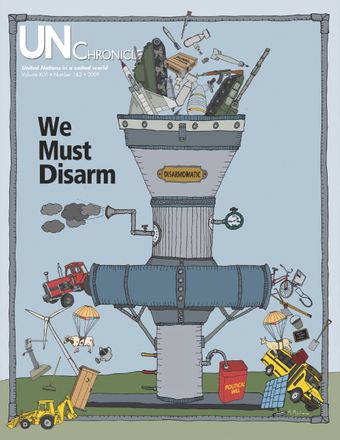
Volume 46, Issue 2, 2012
A must-read for every concerned world citizen, the United Nations Chronicle is a quarterly, easy-to-read report on the work of the United Nations and its agencies. Produced by the United Nations Department of Public Information, every issue covers a wide range United Nations related activities: from fighting the drug war to fighting racial discrimination, from relief and development to nuclear disarmament, terrorism, and the world-wide environmental crisis. Written in English and in French, this double issue of the Chronicle examines the issue of disarmament.
-
-
Forecast 2020: Financial meltdown and malnutrition
Больше МеньшеАвтор: Joachim von BraunIn the aftermath of the recent global food crisis and economic downturn, the worlds poor face unparalleled challenges to their food and nutrition security. While increased volatility in food prices will likely continue, wages for unskilled labour are failing to keep pace. Meanwhile, the financial crisis has pushed up unemployment and further reduced the purchasing power of poor people, who in a globalized economy now feel the effects of economic shocks more acutely. The crisis has also limited the funds available for social protection, which are essential for protecting the most vulnerable people from malnourishment. Under these circumstances health expenditures are often unaffordable. Because poor people in developing countries spend between 50 to 70 per cent of their income on food, they have little capacity to adapt, and their health is being sacrificed as a result.
-
-
-
Learning from slavery-The legacy of the slave trade on modern society
Больше МеньшеАвтор: Ngugi wa Thiong’OIn 2006, I gave some lectures at Harvard during which I called for a month, a weeka day evenof collective mourning for the millions whose souls still cry for proper burial and mourning rites. These lectures have now been published under the title: Something Torn and New. I did not know then that others were thinking along the same lines. I am glad that this day is being commemorated at the United Nations, but it should be actively observed in the whole world, as slave trade and plantation slavery were of prime importance in the making of the modern world. But what was a gain for the world, especially in the West, was a loss for Africa. Here I am not simply talking about the loss of human lives, power, resources, the economic loss for Africa and gain for the world: Slave trade and slavery were a historical trauma whose consequences on the African psyche have never been properly explored.
-
-
-
A short history of international human rights law
Больше МеньшеАвтор: Frans ViljoenThe phrase human rights may be used in an abstract and philosophical sense, either as denoting a special category of moral claim that all humans may invoke or, more pragmatically, as the manifestation of these claims in positive law, for example, as constitutional guarantees to hold Governments accountable under national legal processes. While the first understanding of the phrase may be referred to as human rights, the second is described herein as human rights law.
-
-
-
Four doable actions for mother and newborn care
Больше МеньшеАвтор: Daisy MafubeluWith only six years to go before the 2015 deadline to achieve the Millennium Development Goals (MDGs) to reduce child mortality and improve maternal health, some countries have made encouraging progress, while many have stagnated, or worse, slipped backwards since the Millennium Declaration was adopted in 2000.
-
-
-
Health literacy and sustainable development
Больше МеньшеАвтор: Padmini MurthyMany of us wonder what exactly literacy is and the role it plays in improving the lives of people on a daily basis. Literacy is a human right and can be considered a tool of personal empowerment: a means for social and human development. Educational opportunities depend on literacy. Thus, literacy is essential for eradicating poverty, improving the socio-economic status of communities, reducing child and maternal mortality rates, curbing population growth, achieving gender equality and promoting sustainable development at the local, regional and national levels.
-
-
-
Breastfeeding, the mother in charge
Больше МеньшеАвтор: Máire ClementsWe have reached a tipping point. In less than a century, breastfeeding has become the exception rather than the rulea devastating trend to the health and well-being of large segments of the world population. Increasing the rates and duration of breastfeeding could save the lives of 1.4 million babies. It could also help national and local governments, in both developing and developed countries, to achieve the health-related United Nations Millennium Development Goals by 2015.
-
-
-
The future of the comprehensive nuclear-test-ban treaty
Больше МеньшеАвтор: Sergio DuarteThe worlds first nuclear test, Trinity, took place on 16 July 1945, in a torrid desert in New Mexico which the Spanish Conquistadores had named Jornada del Muerto (Journey of the Dead Man). In the decades that followed, over 2,000 such tests occurred in eight countries, some in the atmosphere, some underground and others underwater.
-
-
-
A nuclear-weapons-free world: Is it achievable?
Больше МеньшеАвтор: Miguel Marín-BoschAfter the worst of times, we are perhaps entering the best of times for proponents of nuclear disarmament. At long last, advocates of the elimination of nuclear weapons have reason for some guarded optimism. The road to a nuclear-weapons-free world will be long and bumpy, but those expected to take the initiative seem to have finally decided to lead. That is encouraging.
-
-
-
Next steps to universal nuclear disarmament
Больше МеньшеАвтор: Paolo Cotta-RamusinoIt is almost 65 years since the development of the first nuclear bomb, and yet we have had only two cases of use of nuclear weapons in war, namely Hiroshima and Nagasaki. So we have been spared the horror of a large nuclear war during this period when more than 130,000 nuclear weapons were built. This is a very unusual event in the history of mankind: so many weapons built, never to be used. Why has this happened? First, the leadership of the two nuclear superpowers and of the smaller nuclear States behaved as rational decision makers, as far as the control of nuclear weapons and the decision not to initiate their use were concerned. In others words, deterrence worked, but we have to recall that the Cuban missile crisis of 1962 and other lesser crises pushed the risk of a nuclear confrontation very close to the abyss. Moreover, the system of nuclear deterrence worked and still works now on the basis of the capability of each nuclear superpower to react promptly if they receive information that they are under nuclear missile attack from their opponent. The idea is that each nuclear superpower should react against the opponent before its own nuclear missiles are destroyed while still on the ground or in their silos. With this system, known as nuclear reaction alert or launch on warning, we have had numerous incidents of false attack that risked accidental nuclear war. Among the factors that spared mankind from the horror of a nuclear war, one was good luck, in not taking wrong decisions at critical moments, and in keeping technical mistakes and failures ultimately under control.
-
-
-
Girls in war: Sex slave, mother, domestic aide, combatant
Больше МеньшеАвтор: Radhika CoomaraswamyThe attackers tied me up and raped me because I was fighting. About five of them did the same thing to me until one of the commanders who knew my father came and stopped them, but also took me to his house to make me his wife. I just accepted him because of fear and didnt want to say no because he might do the same thing to me too. This is the testimony of a young girl of 14 from Liberia as told to the Machel Review in a focus group conducted jointly by the United Nations Childrens Fund (unicef) and the Office of the Special Representative of the Secretary-General for Children and Armed Conflict (osrsg/caac).
-
-
-
Every surviving war child has two stories: One from the war and one from its aftermath
Больше МеньшеАвтор: Zlata FilipovicI remember trying to write a book report when I heard the first gunshots of my life; sounds that no child, anywhere in the world, should ever hear. I tried hard to concentrate on my homework assignment, worried what the teacher might say the next day. That was the last book report I did for almost two years of my life during the conflict in Bosnia.
-
-
-
Achieving zero new victims of landmines
Больше МеньшеАвтор: Maxwell KerleyAs we think about how to reduce and eliminate new victims of landmines, we are reminded of the remarkable advances during the evolution of mine action work which began with the Mine Action Programme for Afghanistan in 1989. Our determination to live in a world free from the threat of landmines and explosive remnants of war is fortified, as we remember those lost and those affected. It is my fervent hope that a world with zero new victims of landmines will become a reality in my lifetime.
-
-
-
Small arms: No single solution
Больше МеньшеАвтор: Rebecca PetersA thousand people die each day from gunshot wounds, and three times as many are left with severe injuries. If the death, injury and disability resulting from small arms were categorized as a disease, it would qualify as an epidemic. Yet the media and popular perception tend to suggest that gun violence is simply an unavoidable consequence of human cruelty or deprivation, rather than a public health problem which can be prevented or at least reduced.
-
-
-
Celso Furtado
Больше МеньшеАвтор: Ana Luiza CortezAsked to define underdevelopment, Celso Furtado replied in his characteristically north-eastern Brazilian accent: There is no need to define underdevelopment; just go out and look; that is underdevelopment! Yet, his greatest contribution to development thought was a thorough understanding of underdevelopment and its determinants.
-
-
-
Gunnar Myrdal
Больше МеньшеАвтор: P. Sai-Wing HoBorn in 1898 in Sweden, Nobel Laureate Gunnar would become one of the leading economists of the twentieth century. Known for his research on transformative issues in underdeveloped economies, he believed inequality to be a major impediment to economic and social progress, and the reduction of inequality a precondition for development.
-
-
-
Myrdal and the Economic Commission for Europe
Больше МеньшеАвтор: Richard JollyMyrdal served as Executive Secretary of the Economic Commission for Europe (ECE) for 10 years (from 1947 to 1957). This period was the most dynamic of the six decades of ECE and built on the three major pillars of Myrdal's leadership.
-
-
-
KBR68H, Indonesia: Radio as a force for democracy
Больше МеньшеАвтор: Isabelle BardijnFounded by six journalists in 1999, at a time of Indonesias transition to democracy, KBR68H is the first interactive media channel of its kind in Indonesia. Today, the radio news agency is a highly respected media organization which provides eight hours a day of independent information and educational programmes to a network of over 630 radio stations throughout Indonesia, parts of Asia and Australia. It is the largest private radio news agency in the Indonesian archipelago, reaching out to more than 18 million daily listeners. The radio news agency plays an important role in connecting Indonesias dispersed populations; reporters of KBR68H are active in the most remote areas of the country such as the Central Highlands of Papua, Central Sumba and South East Maluku.
-
-
-
Space debris and the battle for space
Больше МеньшеАвтор: Jamshid GaziyevOn 10 February 2009, a decommissioned Cosmos 2251 satellite and an operational Iridium 33 satellite collided at an altitude of 790 km in low Earth orbit (leo), a zone heavily populated by communications satellites. The collision created two distinct clouds of more than 800 pieces of space debrisman-made objects in orbit that no longer serve a useful purpose. It was the first collision of two intact spacecraft and the fourth known accidental hypervelocity collision caused by catalogued space debris.
-
-
-
Heavy lifting for un peacekeeping
Больше МеньшеАвтор: David BrazierWhen the decision has been taken to initiate a peacekeeping mission, the required lead-time for deployment varies, depending on the of Member States to contribute troops, equipment, and other financial and material resources in a timely fashion. Previous UN deployments have shown the paramount need for an accessible, stand- alone materiel reserve which could be rapidly dispatched anywhere, thereby facilitating the rationale to create the Strategic Deployment Stocks (sds).
-
Most Read This Month
