


CEPAL Review - Volume 2009, Issue 99, 2009
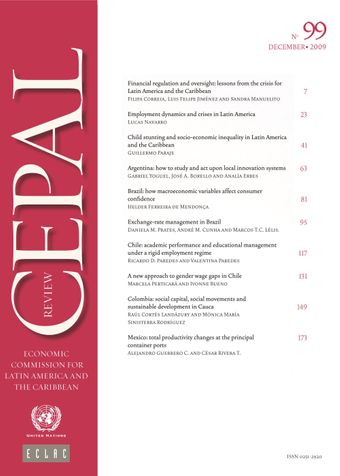
Volume 2009, Issue 99, 2009
Cepal Review is the leading journal for the study of economic and social development issues in Latin America and the Caribbean. Edited by the Economic Commission for Latin America, each issue focuses on economic trends, industrialization, income distribution, technological development and monetary systems, as well as the implementation of reforms and transfer of technology. Written in English and Spanish (Revista De La Cepal), each tri-annual issue brings you approximately 12 studies and essays undertaken by authoritative experts or gathered from conference proceedings.
-
-
Financial regulation and oversight: Lessons from the crisis for Latin America and the Caribbean
More LessAuthors: Filipa Correia, Luis Felipe Jiménez and Sandra ManuelitoThe analysis of the financial crisis that broke out in the United States in mid-2008 gave rise to a vigorous debate about the role of financial regulation and oversight. The present article briefly analyses the crisis with a particular emphasis on these subjects, with the goal of suggesting some lessons that can be drawn from it for Latin America and the Caribbean. Accordingly, it describes the economic conditions and major changes that occurred in the financial system of the United States during the 1990s and the current decade, identifying the contribution of these factors to the crisis. The initial lessons drawn from this analysis are the need to: (i) consider macroprudential risk in the regulatory framework, (ii) reduce the procyclical bias of the system, (iii) widen the scope of regulation and (iv) deal with the conflicts of interest that prevent prompt and reliable disclosure of the risk taken on by financial institutions.
-
-
-
Employment dynamics and crises in Latin America
More LessAuthor: Lucas NavarroThis study presents dynamic labour demand estimates based on information for 15 Latin American countries in the last three decades. It is found that recessions have a direct negative effect on total and wage employment creation. There is also a positive effect of recessions on employment-output elasticity and a negative one on employment-wage elasticity. These results can be interpreted as meaning that policies aimed at reducing labour costs would be of limited effectiveness in combating unemployment during recessions. On the other hand, policies to stimulate aggregate demand would have a stronger positive effect on labour market performance at times of crisis. In all cases, the effects are greater for wage employment than for total employment. This suggests that the increasing flows of workers towards the informal sector during recessions can mitigate the impact of lower economic growth on total employment.
-
-
-
Child stunting and socio-economic inequality in Latin America and the Caribbean
More LessAuthor: Guillermo ParajeThis paper investigates the factors determining the extent of the problem of child stunting and its socio-economic distribution in eight countries of Latin America and the Caribbean. It does so using a methodology that allows a socio-economic inequality index (the concentration index) to be decomposed by the factors affecting it. In the countries analysed, household “wealth” (measured by an indicator of material well-being) and maternal education are the most important determinants in the distribution of child stunting. The biomedical factors considered may be important in explaining the level of stunting, but their contribution to explaining inequality is relatively small. Geographical, cultural, ethnic and idiosyncratic factors also play a limited explanatory role, one that apparently depends on their relationship to the distribution of the socio-economic variables mentioned.
-
-
-
Argentina: how to study and act upon local innovation systems
More LessAuthors: Gabriel Yoguel, José A. Borello and Analía ErbesThis article examines a number of ideas about local innovation systems, how best they can be studied and what needs to be done to develop them further. It is based on experiences in Latin America generally and Argentina in particular. The first part briefly reviews the literature on local production and innovation systems. Following this, 10 hypotheses about the workings of innovation systems are presented, together with the same number of approaches to studying the characteristics and potential of any specific existing system. The third part sets out a number of measures that could be applied to improve local innovation systems in a given country or region. This paper argues that it is both possible and necessary to build bridges between analysis and action, theory and practice.
-
-
-
Brazil: How macroeconomic variables affect consumer confidence
More LessAuthor: Helder Ferreira de MendonçaIdentifying which macroeconomic variables underlie consumer confidence is an essential step towards implementing sound economic policies. This article contributes to the subject by way of an empirical analysis based on ordinary least squares (ols), generalized method of moments (gmm) and vector autoregression (var) techniques for the case of Brazil. The findings indicate that following a loose fiscal policy which increases public debt and taking measures to increase the volume of lending to the private sector does not represent a good strategy for improving consumer confidence. Moreover, the credibility of inflation targeting is a very important driver of consumer expectations. Working to enhance credibility is thus a key step for economies seeking to attain a high level of consumer confidence.
-
-
-
Exchange-rate management in Brazil
More LessAuthors: Daniela M. Prates, André M. Cunha and Marcos Tadeu Caputi LélisThis paper examines four hypotheses: (i) in Brazil, as in other peripheral countries in the post-crisis context, a policy choice appears to have been made for a flexible exchange rate within a currency band (“dirty float”); (ii) the underlying reasons for this policy appear to have more to do with pass-through of exchange-rate variations and precautionary demand for reserves than with the maintenance of a competitive real exchange rate; (iii) in the country’s peculiar situation, considerable capital mobility is conjoined with large and liquid financial derivatives markets and a reserves build-up policy that carries a high fiscal cost; (iv) until April 2006, reserves accumulated in much the same way under the floating exchange-rate system as they had under the currency band regime; there have been changes since then owing to the rapid growth of reserves.
-
-
-
Chile: Academic performance and educational management under a rigid employment regime
More LessAuthors: Ricardo D. Paredes and Valentina ParedesWorking with census information on standardized academic performance tests and using different estimation techniques, this article analyses sociodemographic and management factors affecting the performance of Chile’s municipal schools. The evidence suggests that the system’s lack of flexibility, particularly where teacher dismissal is concerned, is an important factor but not the main cause of poor academic performance. Conversely, the differences in academic performance between municipal schools that can be attributed to management are almost twice the standard deviation of the System for Measuring the Quality of Education (simce) performance test and 20 times the increment ascribed to the “complete school day” initiative, which costs the equivalent of half a point of gross domestic product (gdp).
-
-
-
A new approach to gender wage gaps in Chile
More LessAuthors: Marcela Perticará and Ivonne BuenoThe purpose of this study is to examine gender wage gaps in Chile using a new database, the Social Protection Survey (eps) 2002-2006, which makes it possible to control for actual work experience and its timing. Potential work experience variables do not reflect the intermittent and discontinuous participation of women in the Chilean labour market. Corrections are also introduced for occupational selection, and two key variables are instrumented: education and work experience. Although there are still wage differences between men and women, the introduction of controls for actual work experience and the instrumentation of this work experience and education bring the hourly wage gap down to some 11% to 18%, figures much lower than those reported in earlier studies for Chile. Contrary to expectations, this gap has widened in recent years.
-
-
-
Mexico: Total productivity changes at the principal container ports
More LessAuthors: Alejandro Guerrero C. and César Rivera T.Port performance is commonly measured using partial productivity indicators obtained by relating an output to an input. To ascertain the overall productivity of a port, however, it is more helpful to employ the concept of total productivity, which considers all the inputs employed to obtain the totality of outputs. This factor has been measured using the Malmquist index, which gives the change in total factor productivity (TFP). The present study uses this index to determine the change in the TFP of the principal container ports in Mexico. According to the results obtained, productivity gains were greater at medium-sized terminals such as Progreso and Ensenada than at hubs such as Veracruz and Altamira, even though the latter are more efficient.
-
Volumes & issues
-
Volume 2025
-
Volume 2024
-
Volume 2023
-
Volume 2022
-
Volume 2021
-
Volume 2020
-
Volume 2019
-
Volume 2018
-
Volume 2017
-
Volume 2016
-
Volume 2015
-
Volume 2014
-
Volume 2013
-
Volume 2012
-
Volume 2011
-
Volume 2010
-
Volume 2009
-
Volume 2008
-
Volume 2007
-
Volume 2006
-
Volume 2005
-
Volume 2004
-
Volume 2003
-
Volume 2002
-
Volume 2001
-
Volume 2000
-
Volume 1999
-
Volume 1998
-
Volume 1997
-
Volume 1996
-
Volume 1995
-
Volume 1994
-
Volume 1993
-
Volume 1992
-
Volume 1991
-
Volume 1990
-
Volume 1989
-
Volume 1988
-
Volume 1987
-
Volume 1986
-
Volume 1985
-
Volume 1984
-
Volume 1983
-
Volume 1982
-
Volume 1981
-
Volume 1980
-
Volume 1979
-
Volume 1978
-
Volume 1977
-
Volume 1976
Most Read This Month
